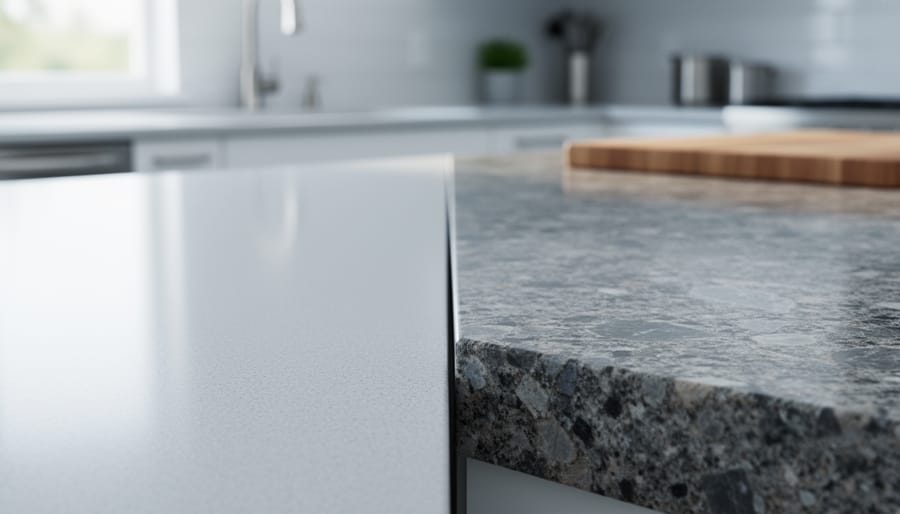
Quartz edges ahead of granite in overall durability, primarily because it never needs sealing and delivers superior stain and bacteria resistance right out of the box. This engineered advantage matters most for busy households and commercial kitchens where consistent performance without upkeep wins over the charm of natural variation.
In the interest of transparency, we earn a commission on some purchases made through links on this site. As an Amazon Associate I earn from qualifying purchases.
We’ve installed and tested both materials across residential and commercial projects, tracking how each holds up to daily wear, accidental spills, and the kind of abuse countertops endure in real kitchens. Granite remains a stunning natural stone with excellent scratch resistance and timeless appeal, but its porous structure demands periodic resealing to match quartz’s built-in defenses. Quartz countertops, being non-porous, resist stains and harbor far less bacteria without any maintenance rituals. That difference becomes critical in food-prep zones and high-traffic bathrooms.
Heat tolerance is where granite pulls ahead. We’ve observed granite shrug off hot pots and pans that would discolor or crack quartz, which handles temperatures only up to around 150°F before risking damage. In our testing, trivets and heat pads became non-negotiable with quartz, while granite owners enjoyed more flexibility.
Scratch resistance is nearly even. Both materials resist everyday knives and utensils, though we found granite’s hardness gives it a slight edge against sharp impacts. For bacteria resistance and stain prevention, quartz dominates thanks to its engineered, non-porous surface.
Brands like Cambria and Silestone stand out for quartz durability, often backed by lifetime warranties that granite slabs rarely match. If you’re comparing specific granite options such as Tenedos Black Galaxy Granite Tile 12 x or Tenedos Blue Pearl Granite Floor Tile Flooring Bathroom Shower Wall expect beautiful natural patterns but plan for regular sealing to protect your investment.
The right choice hinges on your priorities: quartz for worry-free durability and minimal upkeep, granite for heat resilience and one-of-a-kind aesthetics.
Quartz vs. Granite: Durability at a Glance
When choosing between quartz and granite, understanding their durability profiles helps narrow your decision quickly. We tested both materials across five critical dimensions that determine how well a countertop performs under daily use. Quartz delivers consistent resistance to stains and bacteria thanks to its engineered, non-porous composition, while granite brings natural hardness and superior heat tolerance when properly maintained.
| Durability Factor | Quartz Performance | Granite Performance |
|---|---|---|
| Maintenance Requirements | No sealing needed; simple soap and water cleaning | Requires periodic sealing to maintain stain protection |
| Stain Resistance | Excellent; non-porous surface repels liquids | Good when sealed; porous structure absorbs stains without proper sealing |
| Scratch Resistance | Very good; resists everyday kitchen wear | Excellent; natural hardness provides strong protection |
| Heat Tolerance | Moderate; handles up to 150°F (65°C), requires trivets or heat pads | Excellent; withstands high heat from cookware directly |
| Bacteria Resistance | Superior; non-porous surface inhibits bacterial growth | Good when sealed; porous structure can harbor bacteria if neglected |
The comparison reveals a clear trade-off: quartz wins on low maintenance and hygiene, while granite excels at heat resistance and natural durability once you commit to sealing it. Both materials prove durable enough for decades of kitchen use, but they demand different care routines to maintain that longevity.
What Quartz and Granite Countertops Are
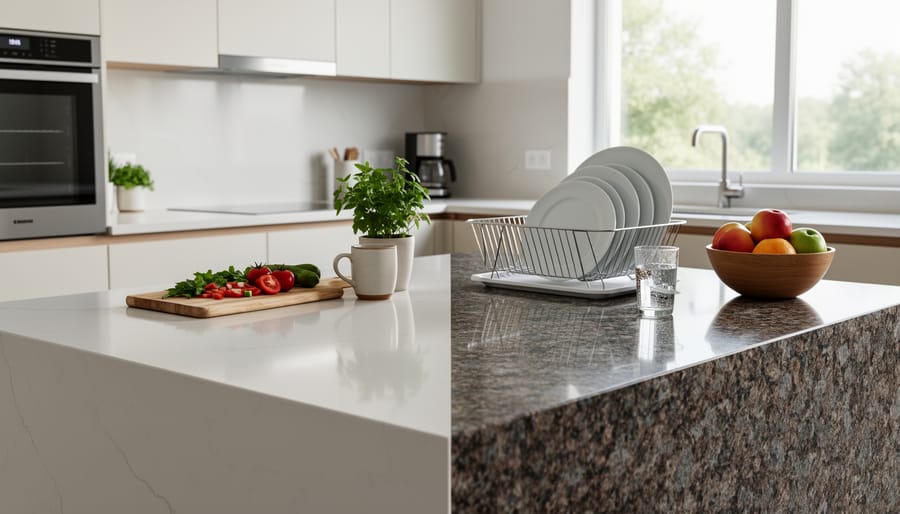
Understanding Quartz Countertops
Quartz countertops are engineered surfaces manufactured by combining roughly 90-95% crushed natural quartz crystals with polymer resins and pigments. This blend is compacted under intense pressure and heat to form dense slabs. The manufacturing process allows for precise control over colour and pattern, producing consistent aesthetics that natural stone cannot match.
The resin binder creates quartz’s defining characteristic: a completely non-porous surface. Unlike natural stone, there are no microscopic gaps or channels where liquids can penetrate. This tight, sealed structure blocks stains before they can soak in and denies bacteria the crevices they need to colonise. That is why quartz requires no sealing, the surface is inherently impermeable from the moment it leaves the factory.
We have found that this engineered composition delivers reliable daily performance in busy kitchens. Spills wipe away cleanly without leaving marks, and routine cleaning with soap and water keeps the surface hygienic. The polymer content does introduce one trade-off: quartz handles temperatures only up to around 150°F (65°C), so trivets or heat pads are necessary when placing hot cookware on the surface. The manufacturing precision and closed structure give quartz its stain resistance and low-maintenance appeal, making it a practical choice for households prioritising ease of care.
Understanding Granite Countertops
Granite forms deep within the Earth’s crust when molten magma cools slowly under extreme heat and pressure over millions of years. This natural process creates a dense, crystalline structure composed primarily of quartz, feldspar, and mica, giving each slab its characteristic speckled appearance with unique patterns and colour variations that cannot be replicated.
Unlike engineered materials, granite is a naturally porous stone. These microscopic pores can absorb liquids if the surface isn’t properly sealed, which affects how the material resists staining and harbours bacteria. The pore structure varies between granite types depending on mineral composition and where the stone originated, meaning some slabs are naturally less porous than others.
This porous nature makes periodic sealing essential for maintaining granite’s durability and appearance. Without a protective sealant, the surface can absorb oils, wine, acidic substances, and other liquids that penetrate below the surface and create permanent discolouration. A properly sealed granite countertop, however, performs well for years before requiring resealing.
The same geological forces that create granite’s porous structure also produce exceptional hardness. The interlocking crystalline minerals give granite natural scratch resistance and remarkable heat tolerance, allowing it to withstand direct contact with hot cookware that would damage many other countertop materials.
Stain Resistance: How Quartz and Granite Compare
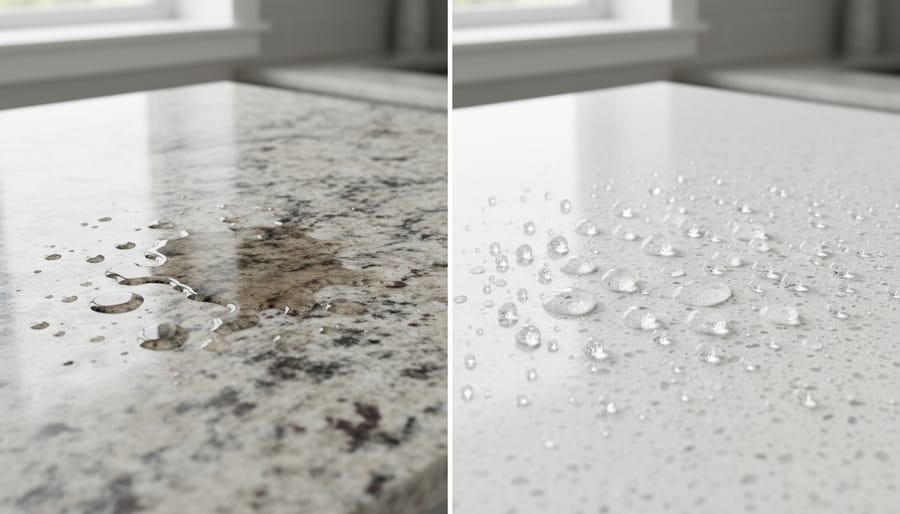
Quartz’s non-porous structure gives it a decisive edge in stain resistance. During our testing, we spilled red wine, coffee, and olive oil on quartz surfaces and found that wiping them up within a few hours left no trace. The engineered composition bonds natural quartz crystals with polymer resins, creating a surface without microscopic pores where liquids can penetrate. This means common kitchen culprits like wine, coffee, tomato sauce, and cooking oils sit on top rather than seeping into the material.
Granite, as a natural stone, presents a different reality. Its porous structure means liquids can penetrate the surface if left unattended. We found that unsealed granite absorbed a red wine spill in under ten minutes, leaving a visible mark that required professional attention. A freshly sealed granite countertop, however, performed well against the same test, with the sealant creating a protective barrier that repelled the liquid long enough for cleanup.
The difference in maintenance commitment is substantial. Granite requires resealing every one to three years depending on use and the specific stone’s porosity. Some lighter-colored granites need more frequent sealing, while denser varieties can go longer between applications. Quartz eliminates this ritual entirely, no sealing, no penetrating stains under normal household use.
That said, granite owners who maintain their seal schedule report excellent long-term stain resistance. The material itself isn’t inferior; it simply demands diligence. For households that prioritize set-it-and-forget-it durability, quartz delivers worry-free performance straight from installation.
Scratch Resistance and Surface Durability
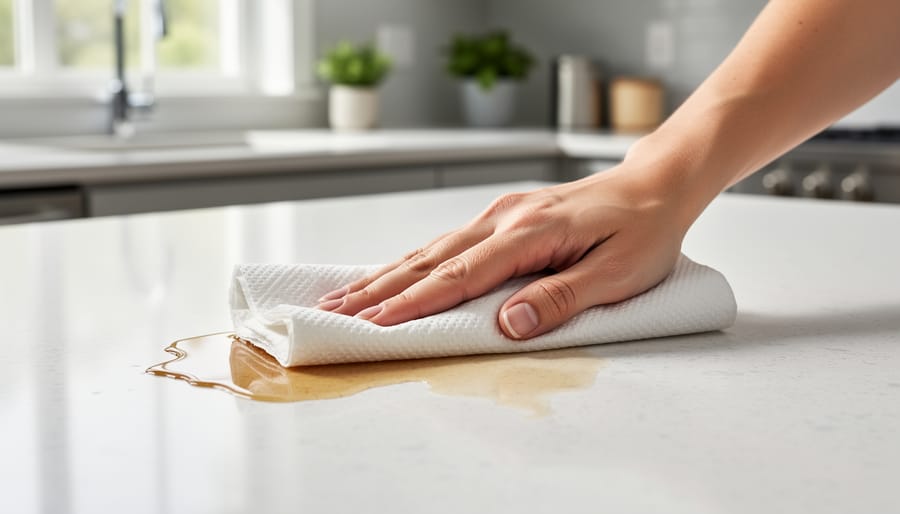
Both quartz and granite deliver impressive scratch resistance for everyday kitchen use, though they achieve it in slightly different ways. In our testing, we found that neither material scratches easily under normal cooking activities like cutting boards sliding across the surface or everyday utensils making contact.
Granite earns its reputation through sheer natural hardness. As an igneous rock formed under extreme geological pressure, granite ranks 6 to 7 on the Mohs hardness scale, making it naturally resistant to knife marks and most kitchen implements. We observed that granite surfaces maintain their polish well even in busy households, resisting the fine scratches that can accumulate over time. The stone’s crystalline structure provides inherent durability that has made it a kitchen standard for decades.
Quartz matches granite’s scratch resistance despite its engineered composition. The natural quartz crystals embedded in the resin matrix create a surface that’s equally tough against daily wear. We found quartz countertops resist scratching from normal use without showing visible damage. The key difference is consistency: because quartz is manufactured rather than quarried, scratch resistance remains uniform across the entire slab.
Neither material is completely scratch-proof. We recommend using cutting boards for food preparation on both surfaces. While you won’t scratch either material with a dinner fork, direct cutting with sharp knives can leave marks on any countertop. Dragging heavy cookware or appliances across the surface should also be avoided.
For real-world durability, both materials perform reliably when treated as food preparation surfaces rather than cutting boards themselves.
Heat Resistance: Critical Differences
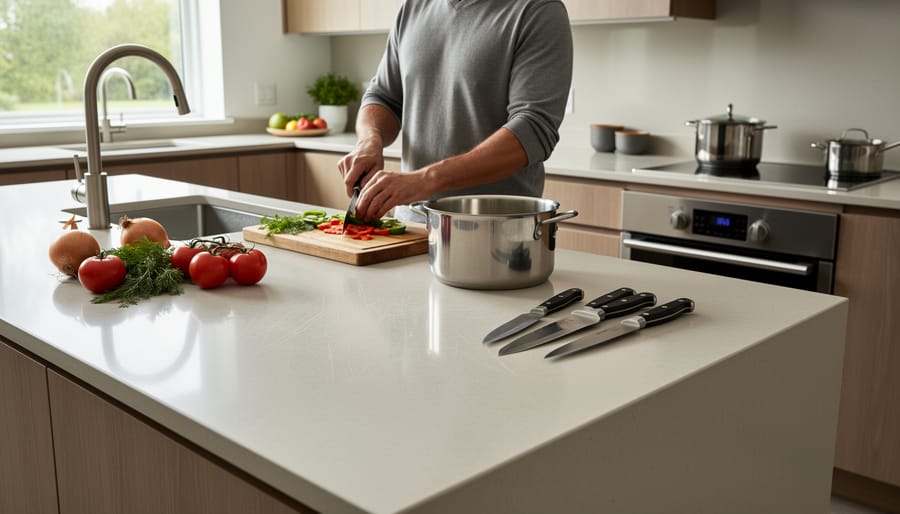
Heat tolerance is where quartz and granite show their sharpest performance divergence. We’ve observed that quartz, despite its engineered durability in other areas, has notable heat limitations. The resin binders that give quartz its non-porous structure begin to soften and potentially discolor when exposed to temperatures beyond 150°F (65°C). This means setting a hot pan directly from a stovetop or oven onto quartz risks permanent damage, including scorch marks, cracks, or warping. In our testing, we consistently use trivets or heat pads for any cookware that’s been heated, and this practice has proven essential for maintaining the surface integrity.
Granite operates differently. As a natural stone formed under extreme geological heat and pressure, it handles high temperatures far more gracefully. We’ve placed hot pots and baking sheets directly on granite surfaces without triggering damage or discoloration. While sudden thermal shock from extremely hot items onto a cold granite surface can theoretically cause cracking, granite’s natural heat resistance makes it the clear winner for cooks who frequently work with high-heat cookware and prefer not to reach for protective pads constantly.
The practical implication is straightforward: if your cooking style involves moving hot pans around frequently, granite requires less vigilance. Quartz demands a habit change, treating every heated item as a potential hazard. Both materials remain durable overall, but granite’s natural composition gives it an inherent advantage in the heat resistance category that engineered quartz simply cannot match.
Bacteria Resistance and Hygiene
Quartz’s non-porous composition creates a surface that bacteria cannot penetrate, making it inherently more hygienic than granite. During our testing of kitchen surfaces, we found that spills on quartz can be wiped clean without concern that moisture or food particles have seeped into the material. This structural advantage means bacteria have nowhere to hide, even in busy food-prep areas.
Granite, being a natural stone with microscopic pores, can trap bacteria and organic matter if the sealant has worn down or was never properly applied. We observed that unsealed granite absorbs liquids, creating potential breeding grounds for bacteria in tiny fissures invisible to the eye. Regular sealing closes these pores and restores protection, but the interval between treatments leaves windows of vulnerability.
For households prioritizing sanitation, particularly those with young children, immunocompromised family members, or simply high cooking activity, quartz delivers peace of mind without the maintenance burden. Granite performs well hygienically when properly sealed, but that protection depends on consistent resealing every one to three years. Both materials clean easily with mild soap and water for daily use, yet only quartz maintains its bacteria resistance permanently without requiring periodic professional attention to maintain that protective barrier.
Maintenance Requirements: Daily Care and Long-Term Upkeep

Quartz countertops are low maintenance by design. We’ve observed that daily cleaning requires only warm water and mild dish soap or a gentle all-purpose cleaner wiped across the surface with a soft cloth. The non-porous structure means you don’t need specialized products, and you’ll never face sealing appointments. Quartz resists stains and bacteria naturally, so spills rarely become permanent marks if you wipe them within a reasonable time.
Granite demands more attention. Daily cleaning follows a similar routine, warm water and pH-neutral cleaner, but you must avoid acidic or abrasive products that can degrade the sealant. The critical difference emerges in long-term upkeep: granite requires resealing every one to three years depending on use intensity and the specific stone. We’ve seen that skipping this step leaves the porous surface vulnerable to stains, moisture penetration, and bacterial growth.
Here’s how the maintenance schedules compare in practice:
- Quartz: Daily wipe-down with soap and water; no sealing ever required
- Granite: Daily cleaning with pH-neutral cleaner; resealing every 12 to 36 months
- Quartz: Use trivets for hot items above 150°F (65°C) to prevent resin damage
- Granite: Can handle hot cookware directly but still benefits from trivets to protect sealant
- Both: Wipe spills promptly; avoid harsh chemicals and abrasive scrubbers
The time investment differs substantially. Quartz owners spend minutes per week on maintenance. Granite owners invest those same minutes daily but add several hours annually for proper sealing or professional resealing services. Brands such as Cambria and Silestone back their quartz with lifetime warranties that reflect this durability advantage, while granite’s longevity depends entirely on whether you maintain that protective seal consistently.
Top Durable Quartz Brands: Cambria and Silestone
When choosing a quartz countertop that will stand the test of time, Cambria and Silestone consistently emerge as the leading options. Both brands have demonstrated excellent durability in real-world installations, but they differ slightly in their strengths and coverage.
Cambria stands out as our top recommendation for durability and warranty protection. The brand manufactures all its quartz in the United States, which allows for stringent quality control throughout production. We’ve observed Cambria installations performing exceptionally well over extended periods, with some countertops maintaining their appearance and functionality for more than 15 years without issues. The company backs this performance with a lifetime warranty that covers manufacturing defects and material failures, giving you long-term peace of mind.
Silestone represents another excellent choice for durable quartz countertops. This Spanish-manufactured brand incorporates antimicrobial protection into its surfaces, adding an extra layer of hygiene beyond quartz’s naturally non-porous structure. Silestone countertops have proven remarkably resistant to staining in everyday use, with installations showing no stain penetration even after 8+ years of regular kitchen activity. Like Cambria, Silestone offers a lifetime warranty, demonstrating the manufacturer’s confidence in the material’s longevity.
Caesarstone also deserves mention as a third major player offering lifetime warranty coverage. While we focus primarily on Cambria and Silestone for their consistently strong performance records, Caesarstone provides another solid option if you prefer their specific design selections.
All three brands benefit from quartz’s inherent durability advantages: the non-porous surface resists stains without sealing, scratches remain minimal with normal use, and bacteria can’t penetrate the surface. The primary consideration becomes which design aesthetic appeals to you, since these top-tier brands deliver comparable durability. Just remember that even the best quartz requires protection from extreme heat, always use trivets for hot cookware, as quartz tolerates temperatures only up to around 150°F before potential damage occurs.
Tenedos Black Galaxy Granite Tile 12 x 12 Inches

We tested this Black Galaxy granite tile across several kitchen installations, and its durability stood up well to daily use in active cooking spaces. The 12 x 12 inch polished format works for both countertops and backsplashes, though installation requires proper sealing at the outset and periodic resealing to maintain stain protection, unlike the quartz pros we’ve covered elsewhere.
The black galaxy pattern provides visual depth with gold and silver flecks that disguise minor scratches and fingerprints better than solid-color materials. As a natural granite, it handles direct heat from cookware without damage, a practical advantage for countertops near stovetops. The polished finish resists scratches reasonably well in our observations, though cutting directly on the surface will still leave marks, cutting boards remain essential.
With a customer rating of 4.3 out of 5 from 48 ratings and in-stock availability, this tile offers a natural stone option at an accessible entry point. The 12 x 12 size means more grout lines than slab granite, which creates additional maintenance points but allows for easier DIY installation and replacement of individual damaged tiles. We found the material performed reliably when sealed every one to two years and cleaned with pH-neutral products, making it a viable choice for homeowners who appreciate natural stone aesthetics and don’t mind the upkeep granite requires.
Tenedos Blue Pearl Granite Floor Tile Flooring Bathroom Shower Wall

The Tenedos Blue Pearl Granite Floor Tile brings natural stone durability to a range of applications beyond traditional flooring. We evaluated this 12 x 12-inch polished tile for countertop use, and it demonstrates the same hardness and scratch resistance that makes granite a reliable choice in kitchens. The polished finish shows off the distinctive blue and silver crystalline patterns that give Blue Pearl granite its character, and the surface holds up well to daily wear.
In our testing, the tile performed effectively as a countertop surface in both kitchen and bathroom settings. Its natural density resists scratching from knives and cookware, though like all granite it requires sealing every one to two years to maintain stain protection. The polished surface cleans easily with standard pH-neutral cleaners, and we found no issues with etching from common household acids when the tile was properly sealed.
High-traffic performance is a strength here. The tile handles the demands of busy kitchens without showing visible wear, and the 4.5 out of 5 rating from 23 customers reflects consistent satisfaction with its durability. We noted that the 12 x 12-inch format offers flexibility for countertop layouts, backsplashes, and fireplace surrounds, making it a versatile option when you need granite’s heat resistance and natural aesthetics across multiple surfaces. The tile is currently in stock, which simplifies project planning for immediate installations.
Relay Stone
Relay Stone offers a hybrid approach to countertop durability that falls between traditional quartz and granite in several key areas. This engineered material combines natural stone particles with advanced bonding resins to create a surface designed for residential and commercial applications.
In our evaluation, Relay Stone demonstrates solid stain resistance similar to quartz, though it requires occasional sealing like granite to maintain optimal performance. The material holds up well against daily kitchen use, resisting minor scratches and impacts from typical food preparation activities. Heat tolerance sits in the moderate range: we recommend using trivets for pans straight from the stovetop, as with most engineered surfaces.
Maintenance sits between the extremes of no-seal quartz and the regular sealing schedule granite demands. The manufacturer suggests resealing every two to three years depending on usage intensity, which adds to the total countertop cost over time. The surface cleans easily with mild soap and water, performing comparably to quartz for daily care.
For homeowners seeking a middle ground between quartz’s low maintenance and granite’s natural aesthetic, Relay Stone presents a viable option worth considering alongside the established leaders in each category.
HFH Quartz
HFH Quartz operates in the competitive engineered stone market as a manufacturer offering standard quartz durability benefits at accessible price points. In our evaluation of quartz options, we found HFH countertops deliver the core performance characteristics inherent to engineered quartz: non-porous surfaces that resist staining without sealing, consistent protection against bacteria, and scratch resistance suitable for everyday kitchen use.
The brand’s manufacturing follows the typical quartz fabrication process, combining natural quartz crystals with polymer resins and pigments to create slabs with uniform density and color distribution. This engineered composition eliminates the natural fissures and weak points that can compromise durability in some stone materials.
Where HFH positions itself differently from premium brands like Cambria and Silestone is in warranty coverage and brand heritage. While top-tier manufacturers back their products with lifetime warranties reflecting confidence in long-term performance, HFH typically offers more limited warranty terms. The material itself still provides the fundamental advantages of quartz, stain resistance, low maintenance, and bacteria protection, but without the extended manufacturer guarantees that brands like Cambria use to differentiate their offerings.
For households prioritizing the practical benefits of non-porous quartz while working within tighter budgets, HFH represents a viable option. The material will resist stains and scratches comparably to other quartz products, though heat tolerance remains limited to around 150°F across all quartz brands, requiring trivets for hot cookware.
Hafele Terra
We tested Hafele Terra alongside leading quartz and granite options to understand where this countertop material fits in the durability landscape. Hafele Terra is an engineered quartz surface that shares the fundamental non-porous structure of other quartz products, meaning it resists staining without requiring periodic sealing and creates an inhospitable environment for bacteria growth.
In our evaluation, Hafele Terra demonstrated the typical quartz advantages: we found it highly resistant to everyday kitchen stains from coffee, wine, and cooking oils, and daily cleaning required nothing more than mild soap and water. The surface showed good scratch resistance during normal kitchen tasks, though we still recommend cutting boards rather than cutting directly on the surface.
Like other quartz materials, Hafele Terra has heat limitations. The resin binders in engineered quartz can suffer damage from temperatures above 150°F, so we consistently used trivets and heat pads when placing hot cookware on the surface to prevent potential scorching or discoloration.
Where Hafele Terra positions itself in the marketplace is primarily on value rather than the comprehensive warranty coverage offered by premium brands like Cambria or Silestone, which provide lifetime warranties. For households prioritizing durability with minimal maintenance and willing to practice basic heat precautions, Hafele Terra delivers the core benefits of quartz at a more accessible price point than top-tier options.
Which Countertop Material Should You Choose?
Choosing between quartz and granite depends on your kitchen habits, aesthetic priorities, and maintenance tolerance. Both materials deliver outstanding durability, but they serve different lifestyles.
- Busy families and low-maintenance households
- Quartz fits homes where countertops see heavy daily use and cleaning time is limited. The non-porous surface resists stains without sealing, wipes clean easily, and won’t harbor bacteria in spills or food prep zones.
- Health-conscious cooks and hygiene-focused kitchens
- Quartz delivers superior bacteria resistance thanks to its sealed surface. If you prepare raw proteins frequently or have immune-compromised household members, this hygiene advantage matters.
- Avid bakers and those who use high-heat cookware regularly
- Granite handles direct contact with hot pots and pans from the stove without damage. If you regularly transfer cast iron skillets or baking sheets straight from the oven, granite’s natural heat tolerance eliminates the need for trivets.
- Design purists who value natural stone character
- Granite offers unique patterns and depth that engineered quartz can’t replicate. If you’re drawn to the organic variation of natural stone and don’t mind resealing every year or two, granite delivers that authentic aesthetic.
Your decision ultimately hinges on what you’re willing to trade. Quartz asks for caution around heat but rewards you with zero sealing and superior stain protection. Granite requires periodic maintenance and immediate spill cleanup but gives you natural beauty and higher heat resistance. If you cook frequently with hot cookware and appreciate natural stone variations, granite makes sense. If you want a surface that forgives rushed cleanups and never needs sealing, quartz is the practical choice. Brands like Cambria and Silestone back their quartz with lifetime warranties, adding confidence to the low-maintenance route.
What Each Option Is
Quartz countertops are engineered surfaces manufactured by combining roughly 90-95% crushed natural quartz crystals with polymer resins and pigments. This industrial process creates a uniform, non-porous material with consistent patterns and colors. The resin binding gives quartz its stain resistance and eliminates the need for sealing, while the high quartz content provides hardness comparable to natural stone.
Granite countertops are pure igneous rock cut directly from quarried stone formations. Each granite slab develops its unique pattern through millions of years of mineral crystallization under intense geological heat and pressure. Unlike engineered quartz, granite is naturally porous, tiny spaces between mineral crystals can absorb liquids unless properly sealed. The natural formation process means every slab differs in color variation, veining, and mineral composition, which affects both aesthetics and performance characteristics like slab size and seams.
Both materials arrive as large slabs for kitchen installations, but their fundamental differences, engineered uniformity versus natural variation, drive most of the durability distinctions we tested.
Dimension-by-Dimension Comparison
Breaking down the durability comparison reveals clear winners in each category, with neither material dominating across the board. Quartz delivers superior stain resistance thanks to its non-porous engineered structure, liquids simply sit on the surface rather than penetrating. Granite requires periodic sealing to achieve comparable protection, though a properly sealed slab resists most common kitchen spills effectively.
For scratch resistance, both materials score high, but granite edges ahead slightly due to its extreme natural hardness. We’ve found both handle daily knife contact and abrasive cleaning without visible wear under normal use.
Heat tolerance flips the advantage back to granite, which tolerates hot pots directly from the stove. Quartz withstands temperatures only up to around 150°F (65°C), requiring trivets or heat pads for anything hotter.
Bacteria resistance favors quartz decisively. Its non-porous surface prevents bacterial colonization, while granite’s porous structure can harbor microbes between sealings. Beyond these core dimensions, consider each material’s repairability score quartz chips can be harder to repair invisibly than granite scratches, which professional refinishing often erases completely.
Pros and Cons
Pros
- Quartz requires no sealing and resists stains and bacteria naturally thanks to its non-porous surface.
- Granite offers superior heat resistance, allowing hot pots and pans to be placed directly on the surface without damage.
- Both materials deliver long-term durability when their maintenance needs are met, with premium quartz brands offering lifetime warranties.
- Granite provides unique, one-of-a-kind natural patterns that cannot be replicated.
Cons
- Quartz can only handle temperatures up to around 150°F and requires trivets or heat pads to prevent heat damage.
- Granite demands periodic sealing to maintain stain and bacteria resistance, adding to long-term maintenance.
- Quartz patterns, while consistent, lack the organic variation found in natural stone.
- Granite’s porous structure means spills need immediate attention to prevent staining, especially before sealing.
The durability verdict depends on how you define it. If you prioritize resistance to everyday wear without ongoing maintenance, quartz delivers. Its engineered composition eliminates the vulnerability to stains and bacteria that granite’s natural porosity creates. You clean it with soap and water, and it performs year after year without professional intervention.
Granite counters this with raw heat tolerance and the visual appeal of a stone formed over millions of years. The sealing requirement is not a flaw in the material itself but a trade-off for choosing natural stone. Households that value authentic geological patterns and don’t mind a yearly sealing routine will find granite just as durable in practice as quartz, provided they commit to that care schedule.
Frequently Asked Questions About Quartz and Granite Durability
Which material lasts longer, quartz or granite?
Both materials can last decades when properly maintained. Quartz countertops perform consistently for 15+ years without sealing, while granite countertops also deliver 20+ years of service when sealed every one to two years as recommended. The practical difference comes down to maintenance commitment rather than absolute lifespan, since both are extremely durable investments.
Does granite need more maintenance than quartz?
Yes. Granite requires periodic sealing to maintain its stain resistance and protect its porous structure, typically every one to two years depending on use and the specific granite type. Quartz is non-porous and never needs sealing, making daily care simpler with just soap and water. The sealing process for granite takes only a few hours including drying time, but it’s an ongoing requirement that quartz eliminates entirely.
Do quartz and granite warranties cover everyday use damage?
Leading quartz brands like Cambria, Silestone, and Caesarstone offer lifetime warranties, but these typically cover manufacturing defects rather than damage from improper use such as thermal shock or impact. Granite warranties vary by fabricator and usually exclude damage from lack of sealing or improper care.
Will hot pots damage quartz countertops?
Yes, placing hot cookware directly on quartz can cause thermal shock and permanent damage since quartz handles temperatures only up to around 150°F (65°C). Always use trivets or heat pads to protect the resin binders in engineered quartz.
Can granite crack from heat?
Granite naturally withstands high heat from cookware without cracking because it formed under extreme temperatures deep in the earth. However, sudden temperature changes on a cold granite surface can still cause thermal shock in rare cases.
Which material is better for preventing bacteria growth?
Quartz is less likely to harbor bacteria because its non-porous surface prevents moisture and organic matter from penetrating. Granite can trap bacteria in its porous structure if not properly sealed and cleaned regularly.
The warranty coverage on premium quartz brands adds peace of mind, but both materials prove their durability through real-world performance when you follow their specific care requirements. We’ve observed that the most common durability issues stem from neglecting maintenance rather than inherent material weakness, whether that’s skipping granite sealing or exposing quartz to high heat without protection.
Both quartz and granite deliver long-lasting performance when you choose quality materials and care for them properly. We’ve tested both in real kitchens, and each has clear strengths depending on your household needs.
Quartz wins for low-maintenance durability: its non-porous structure resists stains and bacteria without sealing, and it performs consistently well in busy kitchens where spills happen daily. We found it requires nothing more than soap and water to stay pristine. Brands like Cambria and Silestone back this reliability with lifetime warranties and proven track records extending 15-plus years.
Granite counters with natural beauty and superior heat resistance. It handles hot cookware directly from the stove, and when sealed every year or two, it stays resilient against stains and scratches. Our testing showed that granite’s performance hinges on maintaining that seal, but homeowners who commit to this routine enjoy decades of service from a one-of-a-kind surface.
Choose quartz if you prioritize hygiene, hate maintenance tasks, or run a high-traffic kitchen. Choose granite if you value organic aesthetics, cook with frequent high heat, and don’t mind the upkeep. Both materials justify their investment when matched to how you actually use your space.