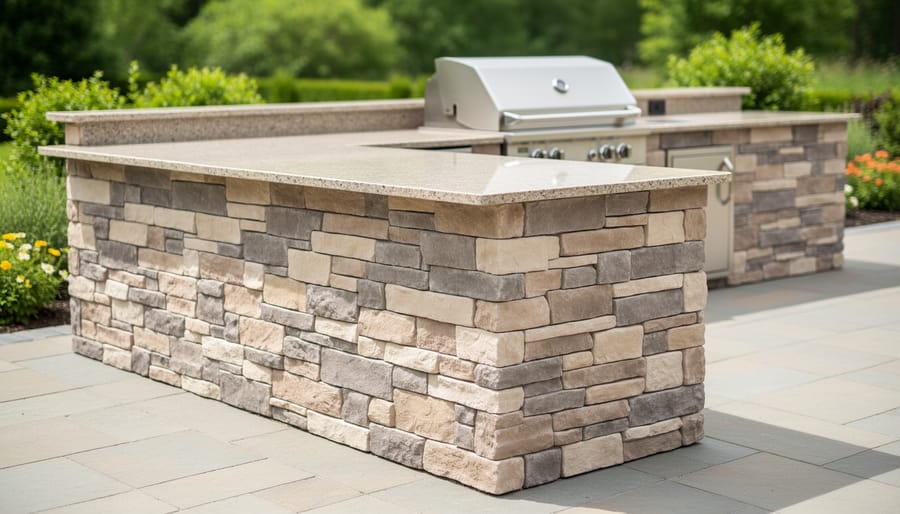
A faux stone outdoor kitchen can work well, but it performs very differently depending on what the product is made of and how it’s installed. Manufactured stone, usually a cast blend of cement, lightweight aggregate, and iron oxide pigments, gives you the look of ledgerstone or fieldstone at a lighter weight and a lower upfront cost than the real thing. That’s the appeal, and it’s a fair one. Stacked veneer on a masonry or framed base can turn a plain grill island into something that looks built to last.
The catch is how that look holds up outdoors. Pigments sit on the surface of many cast products, so sun exposure, freeze-thaw cycles, and moisture near a sink or grill can show up as fading, chipping, or efflorescence over the years. Poor flashing or a missing drainage gap behind the veneer causes more failures than the stone itself. Faux options also include faux panels and polyurethane products, which behave quite differently from cast concrete veneer.
So the real question isn’t whether faux stone is good or bad. It’s whether its trade-offs match how you’ll use the space. This guide breaks down the main types, lays out where manufactured stone delivers and where it falls short, and compares it side by side with natural stone, so you can decide with the full picture in hand.
What Faux Stone Actually Is
How Manufactured Stone Veneer Is Made
Most manufactured stone veneer starts with a simple recipe: Portland cement, lightweight aggregate, and iron oxide pigments. Manufacturers pour that mix into rubber molds cast from real quarried stone, so every ridge, pit, and edge is copied from the original. Once the pieces cure, they come out as light, thin units that mimic ledgerstone, fieldstone, or stacked slate. Patent literature describes the Portland cement and pigments approach in detail, including how color is worked in or applied to the surface.
The weight difference is the big draw. A thin, hollow-backed unit is far easier to fasten to a framed island than solid rock, which is why veneer stone for kitchens shows up so often on backyard builds.
Not every product sold as “faux stone” is made this way, though. The terms get mixed up constantly:
- Manufactured stone veneer
- Molded cement-and-aggregate units, thin enough to adhere to a wall or frame.
- Cultured stone
- A brand name that has become shorthand for manufactured veneer, usually the same cement-based product.
- Stamped concrete
- Poured concrete pressed with patterned tools to imitate stone paving or surfaces.
- GFRC (glass fiber reinforced concrete)
- A thin, strong concrete shell reinforced with glass fibers, often used for sculpted panels and countertops.
- Polyurethane or foam panels
- Lightweight molded panels painted to look like stone, with no cement in them.
Knowing which one you’re looking at matters, because each behaves differently once it’s outside.
Where Faux Stone Shows Up in Outdoor Kitchens
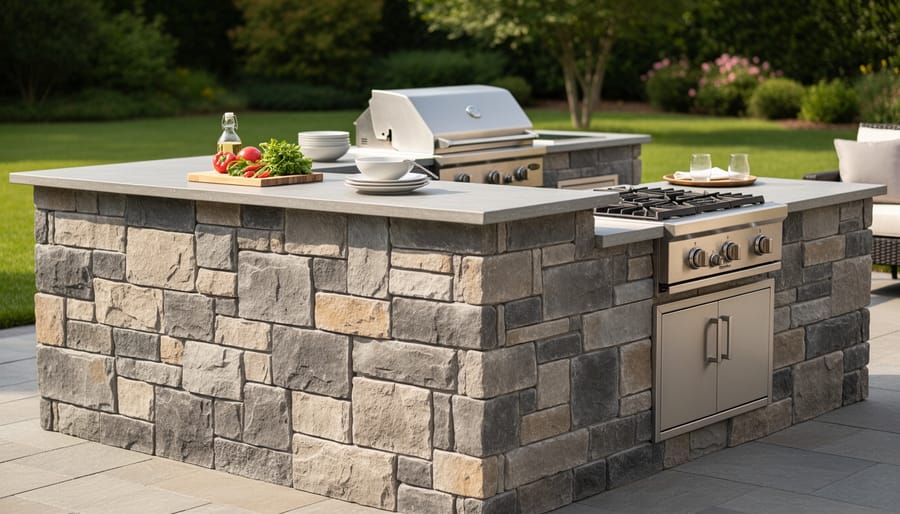
Walk through enough backyard kitchens and you’ll see faux stone in the same handful of places. The most common is cladding on the island and grill surround, where veneer panels or individual pieces wrap a wood or metal frame to mimic a solid stone base. It’s popular here because the frame is already light and the veneer adds no serious structural load.
Backsplashes behind the grill and sink are another frequent spot, since they’re a vertical surface that rarely takes direct abuse. Pizza oven facades follow the same logic, with veneer dressing up the outer shell while the heat-rated interior does the real work.
Dining area columns and low seat walls also get the treatment, giving a patio structure some visual weight.
Countertops are the least common use. Cast concrete and cement-based slabs exist, but they face the harshest conditions in the kitchen, so expect them to be the first place wear shows.
Why Homeowners Choose Faux Stone
Faux stone didn’t get popular by accident. For a lot of homeowners, it solves real problems, and it deserves a fair hearing before we compare it with the real thing.
Cost is the first draw. Manufactured veneer generally costs less to buy up front than quarried stone, and the savings can be meaningful on a project with a lot of surface area, like a long island or a grill surround with several columns. When a budget has to cover appliances, plumbing, gas lines, and lighting too, a lower cladding cost makes the whole project feel more achievable.
Weight is the second. Manufactured veneer is much lighter than solid stone, and that changes what you can build. A wood-framed or metal-stud island doesn’t need the same structural thinking as one carrying heavy slabs and thick cut stone. It’s also easier on decks, patios with limited support, and rooftop spaces where load limits are a concern. If you want to see how this plays out in practice, this guide on veneer that’s lighter than solid stone walks through why the lower weight matters so much for outdoor builds.
Installation is the third. Because the pieces are lighter and sized for easy handling, they can often be applied over properly prepared framing without heavy lifting equipment or specialized masonry crews. That can shorten the schedule, and it opens the door to confident DIYers, though the backing, flashing, and moisture barrier still have to be done right.
Then there’s consistency. Faux stone is made in molds and pigmented in controlled batches, so color and texture are predictable. If you’ve fallen for a particular look and want every panel to match the sample, that predictability is a real advantage. Natural stone, by nature, varies from piece to piece.
None of this makes faux stone a bad choice. Plenty of people use it well, especially for sheltered spaces, tight budgets, or structures that can’t carry much weight. The useful question is how these advantages hold up once sun, rain, heat, and years of use enter the picture, and that’s where the next sections turn.
How Faux Stone Holds Up Outdoors
Fading, Chipping, and Moisture Concerns
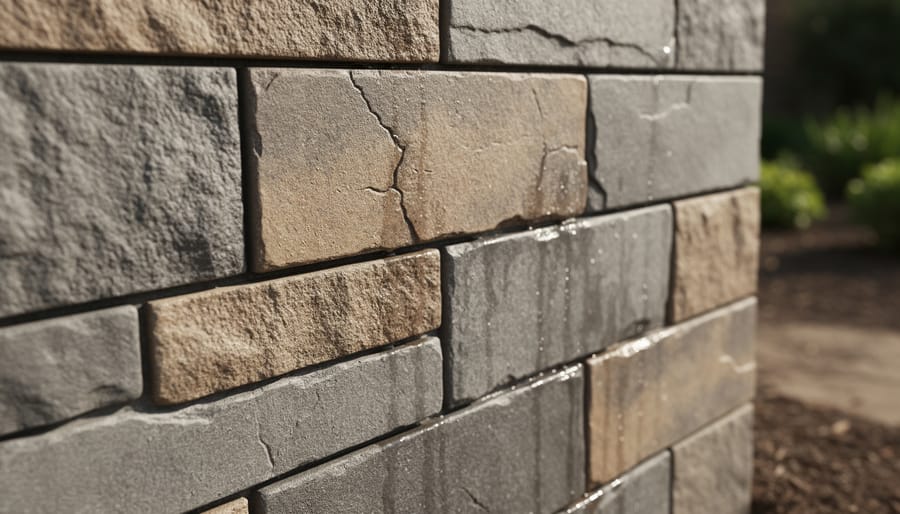
Most manufactured veneer gets its color from iron oxide pigments applied to the surface or mixed into a thin outer layer. Years of direct sun can wear that pigment down, so a wall that looked rich and varied on day one drifts toward a flat, chalky tone, often unevenly where one side of the island gets more afternoon light.
Chips tell the same story from another angle. When a corner is knocked by a grill tool or a chair, the damage often shows a gray, cement-colored core under the painted-looking face. Natural stone is the same material all the way through, so a chip just looks like stone.
Moisture is the quieter problem. Veneer is only one layer of the wall. If flashing is missing at the base or around openings, or if the joints and cut edges aren’t sealed, water gets behind the cladding and sits against the framing. Freeze-thaw cycles then widen the gaps, and the trouble stays hidden until a patch lets go.
| Material | UV and fading | Chip appearance | Moisture behavior |
|---|---|---|---|
| Manufactured stone veneer | Surface pigment can fade over time | Cement core may show through | Depends on flashing and sealing |
| Granite | Color is stable in sunlight | Chips match the surrounding stone | Dense, low absorption |
| Limestone and travertine | Color is stable in sunlight | Chips blend in | More porous, so sealing helps |
| Slate | Color is generally stable | Layers may flake at edges | Low absorption, sheds water well |
None of this makes veneer a bad choice. It means the quality of the installation matters as much as the product itself.
Heat and Grease Around the Grill
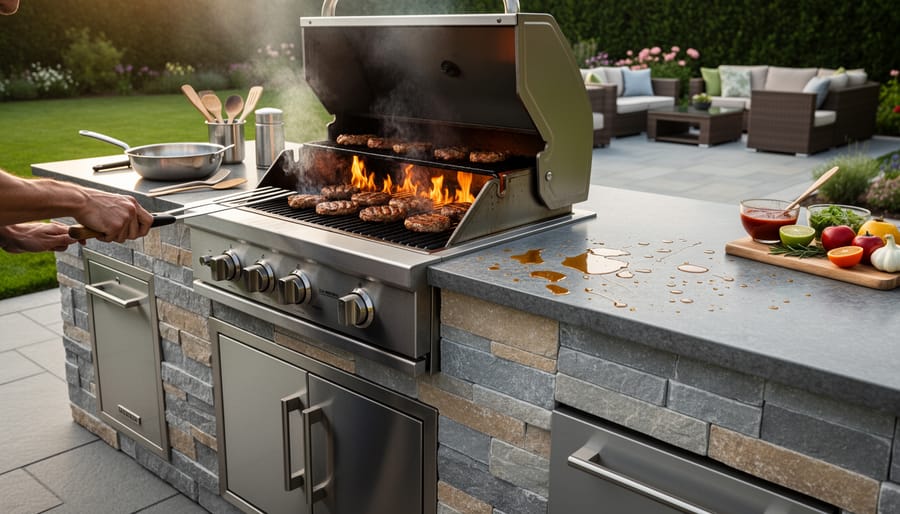
The grill is where an outdoor kitchen takes its hardest daily punishment, so it’s worth getting the details right here. Manufactured veneer is generally non-combustible on its own, but it’s only a surface. What sits behind it matters more. Grill manufacturers specify minimum clearances to combustible materials, and wood or standard sheathing framing needs a non-combustible barrier, such as cement board or steel framing, before any cladding goes on. Always follow the grill maker’s installation manual and your local code.
Heat and grease affect the two materials differently. Faux stone has a porous, cement-based surface that can absorb splatter, leaving dark stains that are hard to lift from textured faces. Repeated high heat can also stress the pigments and the bond to the substrate. Natural stone such as granite or slate handles direct heat comfortably, and a good sealer makes grease easier to wipe away.
Faux Stone vs. Natural Stone: An Honest Comparison
Looks Up Close: Texture, Variation, and Patina
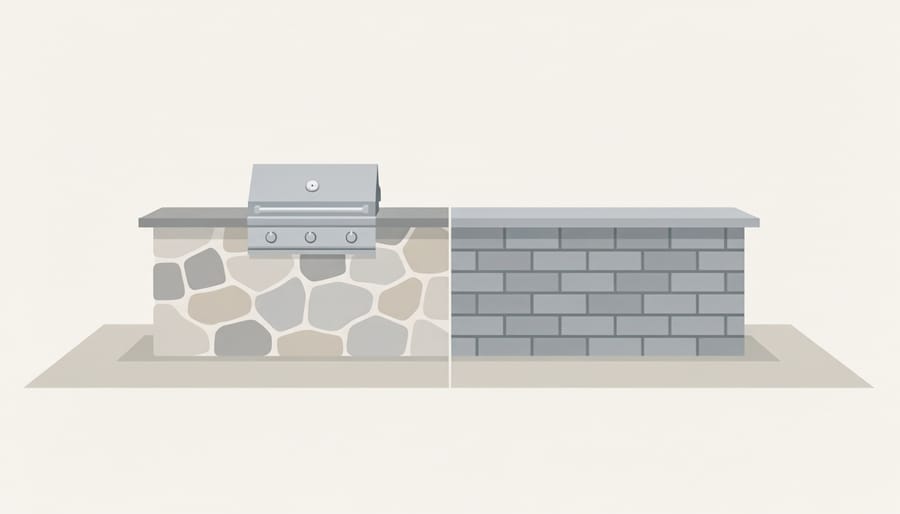
Look closely at a faux stone wall and you’ll often spot the giveaway: the same ledge, the same crack, the same lichen-like speckle repeating every few feet. Manufacturers pour from a limited set of molds, so even a wall with a dozen profiles eventually shows its pattern. Color is pigment applied or mixed in, which gives an even, predictable tone that can read flat in direct light.
Quarried stone has no such repetition. Each piece carries its own mineral veining, grain, and edge character, because nature never poured two alike. That variation is what makes a real stone surface look layered rather than stamped.
Aging widens the gap. Natural stone tends to develop patina, with subtle softening and deepening of tone that most people find attractive. Faux stone ages differently. Surface pigment can lighten under strong sun, and chips may expose a plainer, grayer core. Weathering on faux stone usually reads as wear, while weathering on real stone more often reads as character.
Cost Over the Life of the Kitchen
A low sticker price tells only part of the story. The better question is what the kitchen costs you across ten, fifteen, or twenty years of weather.
Faux stone is cheaper to buy and install, but it tends to be harder to repair. A chipped or faded veneer panel rarely blends back in, because discontinued molds and pigment batches make an exact match difficult. Water damage behind the cladding can mean removing whole sections to fix hidden framing. If problems pile up, replacement may be the only real fix.
Natural stone costs more upfront, but individual pieces can often be cleaned, resealed, or swapped without redoing the whole structure. Its age shows up as patina rather than failure.
Resale is the final factor. Buyers and appraisers tend to read real stone as a lasting feature, while worn veneer can look like a deferred repair. Weigh purchase price against repair effort, expected lifespan, and how the finished kitchen will be perceived when you sell.
A Real-World Look: Two Outdoor Kitchens Compared
The comparison below is an illustrative composite, not a report on two specific homes. It draws on the wear patterns installers, masons, and homeowners commonly describe, so use it as a way to picture the trade-offs rather than as measured data.
Picture two backyard kitchens built the same summer, both in a climate with real winters. Each has a grill island, a bar-height counter, and a small dining area. The first is clad in cement-based manufactured veneer over a wood-framed base. The second is clad in natural limestone ledgestone over a masonry base, with a granite counter.
After the first season, they look nearly identical from the patio. By year three, the differences show up.
On the veneer kitchen, the corners facing the afternoon sun have lightened a shade or two. A few edge pieces near the grill have chipped, exposing a grayer core beneath the surface color. Along the base, a faint stain marks where splashing water and soil have wicked upward. The owner has touched up the chips with color-matched stain and resealed the lower courses twice. Because the veneer sits over framing, a small gap at one joint let moisture behind the cladding, and that needed repair.
The natural stone kitchen has changed, too, but differently. The limestone has picked up a soft, even patina, and its color runs all the way through the stone, so there is nothing to chip away. The granite counter shrugged off grease and heat. The owner’s main chore is an annual sealing of the porous surfaces, and one cracked grout line needed patching.
Asked how they feel, the veneer owner says the savings were real but the upkeep was more than expected. The stone owner says the upfront effort paid off in how little the kitchen demands now.
[Image: side-by-side photo of both kitchens after several seasons of weather exposure]
Where Natural Stone Earns Its Place
Natural stone earns its keep in an outdoor kitchen because it was formed by weather, heat, and pressure long before anyone cut it into a slab. Granite, quartzite, and slate shrug off UV exposure, so the color you pick at the fabricator is the color you’ll still have years later. Because the pigment runs through the whole stone rather than sitting on a surface layer, a chip simply shows more of the same material.
Heat is where the gap widens. A dense stone like granite tolerates hot pans and grill radiation without scorching or softening, which makes it a sensible choice for countertops beside the cooking zone. Limestone and travertine suit cladding and dining surfaces well, offering warm tones and real texture that no mold can repeat. If you’re weighing options, our guide to the best outdoor stones covers how each one handles sun, rain, and foot traffic.
Dining areas benefit too. A honed or flamed finish gives a table or bar top grip and hides minor scuffs, while a polished surface cleans up quickly after a long dinner party. Stone also ages with character, softening into a patina instead of looking tired.
Care is simple. Choose a quality penetrating sealer suited to your stone, reapply it as the manufacturer recommends, and wipe up oil, wine, and acidic spills promptly. Use a pH-neutral cleaner rather than harsh chemicals, which can dull the finish.
[Image: natural stone outdoor kitchen with a granite countertop and stacked-stone island]
[Image: travertine dining surface beside a slate-clad grill surround]
Choosing the Right Material for Your Project
Start with the constraint you can’t negotiate: your climate. In regions with hard freezes, water that gets behind veneer expands and pops pieces loose, so detailing and drainage matter more than the stone itself. In hot, sunny regions, pigment fade and heat near the grill become the bigger concerns. Natural stone generally tolerates both extremes, while faux stone rewards careful installation and sealing.
Next, check structural limits. Natural stone is heavy, and a full stone-clad island or thick slab countertop needs a solid base, usually masonry or reinforced framing. If you’re building over wood or light metal studs, or on a deck, veneer’s lighter weight is a real advantage. Ask your builder to confirm what the structure can carry before you fall in love with a material.
Then be honest about budget and design goals. Faux stone usually lowers the upfront outlay, but think about what you’ll spend if a surface chips, fades, or needs replacing. If you want authentic variation and a surface that ages gracefully, natural stone is the stronger match. If you need a consistent look on a tight timeline, veneer can serve well.
The hybrid approach often resolves the tension. Many homeowners put natural stone where wear and heat are highest, such as countertops and the grill surround, and use veneer cladding on the island base or decorative walls where it takes less abuse. The same logic extends to the surrounding landscape, where a touch of natural stone edging can tie the kitchen to the garden without a huge investment.
Can faux stone be used for outdoor countertops?
It can, but countertops take the most heat, moisture, and stain exposure, so many people choose natural stone for that surface and save faux materials for vertical cladding.
How long does manufactured stone veneer last?
Lifespan depends heavily on installation quality, flashing, and climate. Properly detailed veneer can serve for many years, but surface fading or chipping may show up sooner than with natural stone.
Can you mix natural and faux stone in one kitchen?
Yes. A common pairing is natural stone countertops with veneer on the island base, as long as colors and textures are chosen to complement each other.
Is natural stone too heavy for an outdoor island?
Not if the island is built for it. A properly engineered base handles stone weight well, so confirm the structure with your builder before you commit.
Faux stone earns its spot in some outdoor kitchens. It’s lighter, easier to install, and kinder to a tight budget, and for a covered patio in a mild climate it can look good for years. But the trade-offs are real: pigments fade, chips expose a different core color, and water getting behind poorly flashed veneer causes trouble that’s costly to fix. Heat and grease near the grill push those weaknesses harder.
Natural stone asks for more upfront, yet it brings durability, heat tolerance, and a patina that improves with weather instead of fighting it. Over the full life of the kitchen, that gap often narrows.
So the right choice comes down to your climate, your budget, and how long you plan to enjoy the space. If you want a kitchen that still looks right a decade from now, start by exploring natural stone options for your outdoor cooking and dining areas.