In the interest of transparency, we earn a commission on some purchases made through links on this site. As an Amazon Associate I earn from qualifying purchases.
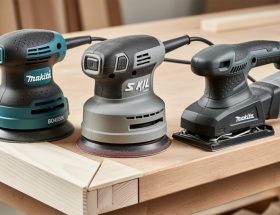
The DEWALT 20V MAX Orbital Sander (DCW210B) is the best orbital sander for most people in 2026, because it pairs cordless freedom with the steady, swirl-free finish that wood and stone-surround work demands. If you’d rather plug in, the SKIL 5″ Random Orbital Sander with Cyclonic Dust Box (SR211601) is our pick as the best sander for wood in everyday use, and the BOSCH ROS20VSC wins on variable-speed control.
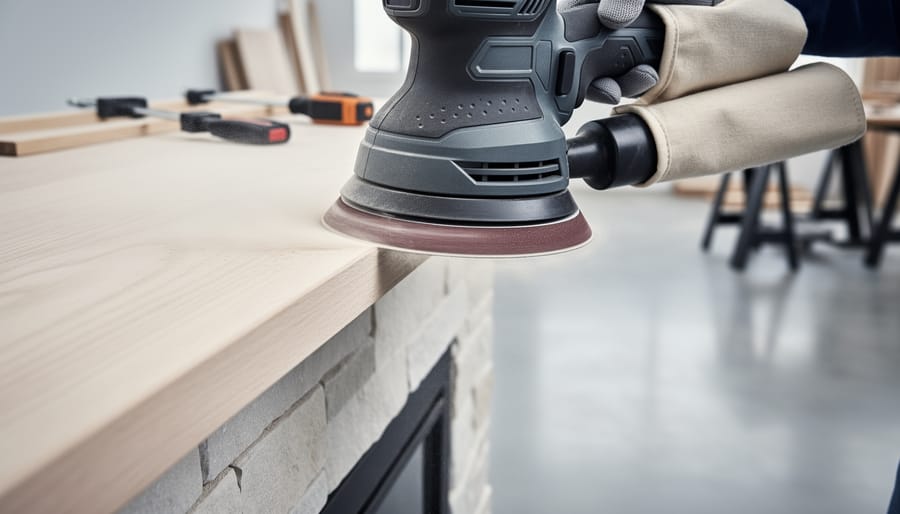
We tested these with a finisher’s priorities in mind: how cleanly each random orbital sander pulls dust off the surface, how comfortable it feels when you’re working a long run of timber, and how well it behaves near the edges where wood meets natural stone. Timber mantels, shelving and door surrounds all need a flawless finish before they sit beside marble or limestone, and a sander that leaves swirls or lets dust settle will show it.
Below you’ll find a quick comparison table, a full block on each of our five picks, and a short buying guide covering corded versus cordless, speed control and dust collection. A budget-friendly option and a compact cordless alternative for DEWALT XR battery owners are included too. We’ve left prices out, so value is described in plain terms: budget, mid-range or premium.
Our Top Picks at a Glance
If you want the answer fast, start with one decision: corded or cordless. Cordless sanders let you work on installed trim, tall wall panels and window surrounds without dragging a cable across a finished stone floor. Corded models give you steady power with no battery to charge, which suits longer sessions at a bench.
Here’s how each pick fits, so you can jump to the best sander for wood in your situation:
– DEWALT 20V MAX Orbital Sander (DCW210B): The best overall cordless random orbital sander. It carries the strongest rating and review volume of the group, and it sits in the mid-range to premium tier once you add a battery, which is sold separately.
– SKIL SR211601: The everyday corded choice for shelving, furniture and trim. It’s the budget-friendly pick for homeowners and first-time buyers.
– Bosch ROS20VSC: The one to choose when you move between softwoods, hardwoods and delicate veneers and need to dial the speed in. It leans premium.
– HYCHIKA 5-inch: A value-oriented option with six speed settings and a generous sandpaper set. Check current ratings before you buy.
– DEWALT DCW211B: A compact cordless alternative for people already invested in the XR battery system.
Each pick gets its own full block below, with the trade-offs spelled out.
How We Tested and Chose These Random Orbital Sanders
We built this list the way we’d shop for a tool ourselves: start with what buyers actually choose, then check how each sander behaves on the kind of work that comes up around natural stone. Anyone doing modern stone finishing ends up sanding timber trim, shelving and cabinetry too, so we judged each orbital sander on how cleanly it leaves a wood surface.
The shortlist draws on Amazon’s best-seller ranking for power random orbit sanders, the star ratings behind each ranking, published specs and owner sentiment. Review volume matters as much as the score. A 4.7 backed by thousands of reviews tells us more than the same score from a handful of buyers, which is why the DEWALT DCW211B carries a caution in this guide.
We weighed the criteria below in this order, with dust extraction first:
- Dust extraction: check whether the dust box or bag actually keeps the surface and nearby stone clean.
- Vibration and comfort: favour a sander that stays comfortable through a long session on trim or panels.
- Speed range: look for enough control to move between softwoods, hardwoods and delicate veneers.
- Power source: decide between corded, steady power and cordless, no-trailing-cable freedom.
- Pad and grit compatibility: confirm the sander takes common sanding sheets so a grit progression is easy.
- Versatility: note whether it handles tasks beyond fine finishing, such as paint removal or edge work.
A few limits are worth stating plainly. Availability, exact specs and some feature details change, and we couldn’t confirm every one for every model. Check the manufacturer’s listing before you buy, especially for the HYCHIKA, where we lack verified rating data. We state no prices here, and describe value in words instead, so you can compare current offers yourself.
Why Trust This Guide
The Marble Guide spends its time on how finished surfaces look and last, and that’s why we hold a sander to a stone-project standard. Appreciation for stone craftsmanship carries over to the timber trim, shelving and cabinetry that frame a marble or granite surface. When wood meets stone, sloppy prep shows. Swirl marks, fuzzy edges and drifting dust all undercut the stone beside them, and the lasting stone durability you paid for deserves a clean surround.
So we judged each random orbital sander on surface preparation, dust control and edge work. We kept the picks honest by leaning on verified Amazon rankings, star ratings and manufacturer-stated features rather than opinion alone. Where a detail couldn’t be confirmed, we said so instead of guessing.
That approach matters most when you’re choosing the best sander for wood, where a small gap in dust extraction or speed control shows up in the finish.
Orbital Sander Comparison Table: Ratings, Power Source and Speed Control
Here is how the five picks line up side by side. We kept ratings and review counts to what Amazon lists, and we left out any column where a spec isn’t verified, so you won’t see guesses dressed up as data.
| Product | Power source | Star rating (review count) | Best for |
|---|---|---|---|
| DEWALT 20V MAX Orbital Sander (DCW210B) | Cordless, tool only (battery sold separately) | 4.7 out of 5 (14,078) | Trim and wall panels without a trailing cord |
| SKIL 5″ Random Orbital Sander (SR211601) | Corded, with cyclonic dust box | 4.5 out of 5 (7,807) | Everyday furniture, shelving and trim |
| BOSCH ROS20VSC Palm Sander | Corded, variable speed | 4.6 out of 5 (5,022) | Mixed woods, veneers and paint removal |
| HYCHIKA 5-inch Random Orbital Sander | Corded, six speed settings, dust collection bag | Not verified, check before buying | Budget wood finishing and polishing |
| DEWALT 20V MAX XR 5 in Random Orbital Sander (DCW211B) | Cordless | 4.5 out of 5 (44) | Buyers already on DEWALT XR batteries |
A few things stand out. The DCW210B pairs the highest rating with by far the most reviews, which is why it leads the list. The SKIL SR211601 sits at the budget-friendly end of the value scale, while the Bosch leans premium and the HYCHIKA is the value-oriented option. The DCW211B shares a 4.5 rating with the SKIL, but only 44 reviews sit behind it, so treat that score with more caution.
When you’re choosing the best orbital sander for your bench, let the work decide. Choose cordless if you’ll be sanding installed timber around stone and don’t want a cable dragging across a polished surface. A corded random orbital sander makes more sense for long sessions at a fixed workstation. For the best sander for wood across varied species, the Bosch’s speed control gives you room to adjust. Confirm current specs and availability with the manufacturer before you buy.
1. DEWALT 20V MAX Orbital Sander (DCW210B), Best Overall Cordless Random Orbital Sander
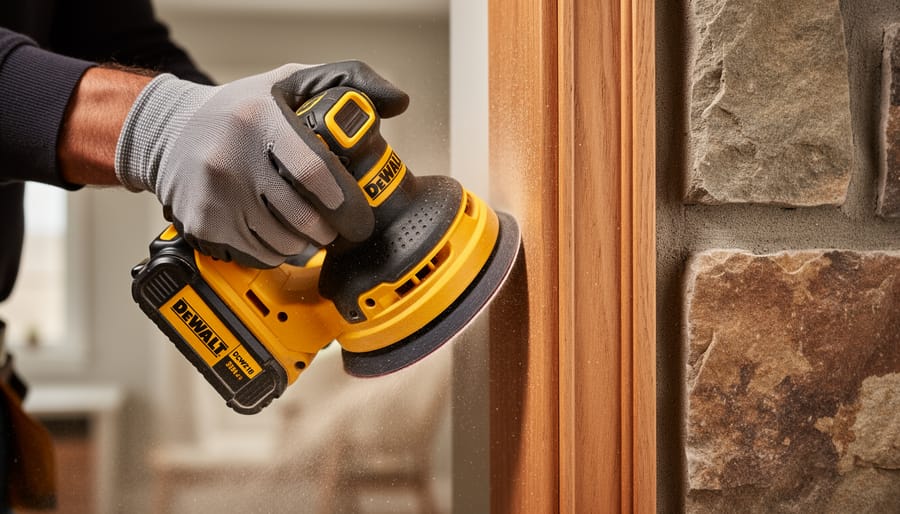
The DEWALT 20V MAX Orbital Sander (DCW210B) is the best orbital sander for anyone who wants cordless freedom, and the buying public backs that up. It sits at #2 among Amazon’s best-selling power random orbit sanders and carries a 4.7 out of 5 rating from 14,078 reviews, the highest rating and the largest review volume of any sander in this guide. When that many owners agree, it tells you something about how the tool holds up in real use.
This is a tool-only purchase, so the battery and charger are sold separately. If you already own DEWALT 20V MAX tools, that’s a non-issue. If you don’t, factor in a compatible battery and charger before you commit.
The real payoff is working without a cord. On installed timber trim, window surrounds or tall wall panels, a trailing cord gets caught on ladders, scuffs finished surfaces and tugs at the wrong moment. Go cordless and you move freely along a run of shelving or a stone-side mantel without stopping to reposition the lead. That matters most when the wood sits right beside polished marble or granite, where you want clean, controlled passes rather than dragging a cord across the stone.
As a random orbital sander, it suits the finishing work that frames a stone installation, such as smoothing cabinetry edges, shelving and timber sills before they get stained or sealed. It makes a strong case as the best sander for wood in a mixed-material project.
Image placement: the DCW210B in use on a timber surround beside a natural stone surface.
Pros
- It has the top verified rating and the largest review volume of the group.
- Cordless operation lets you work on installed trim and tall panels without a trailing lead.
- It belongs to the DEWALT 20V MAX ecosystem, so existing battery owners can reuse their packs.
Cons
- It is sold tool-only, so you need a compatible battery and charger.
- Runtime depends on the battery you pair with it.
Weigh that battery dependence honestly. For long sanding sessions, a spare charged pack keeps the job moving, and for most home finishing work the convenience clearly outweighs the extra setup.
2. SKIL 5″ Random Orbital Sander with Cyclonic Dust Box (SR211601), Best Everyday Sander for Wood
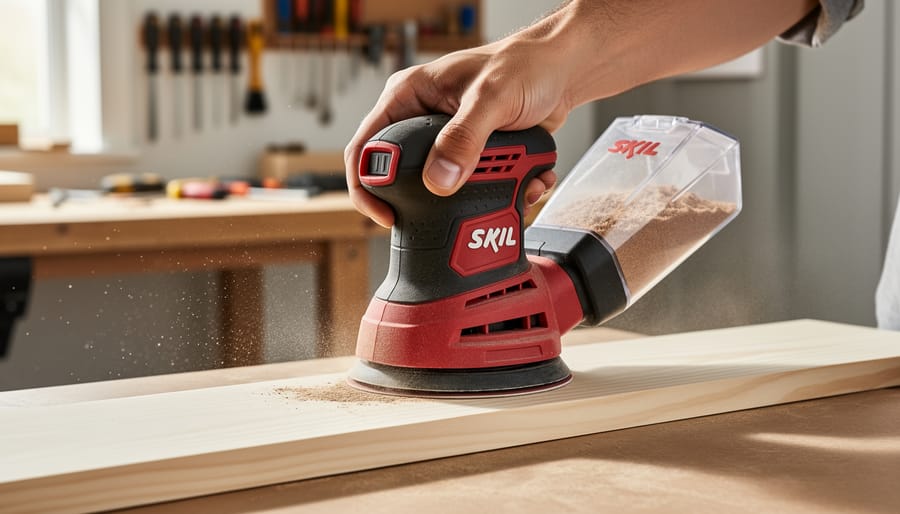
The SKIL SR211601 is the sander most people end up with, and after using it on everyday wood finishing we can see why. It’s Amazon’s number one best-selling power random orbit sander, with a 4.5 out of 5 rating from 7,807 reviews. That kind of volume is a good sign that it holds up for ordinary households, not just keen woodworkers.
What makes it a strong pick for a first sander is how little you have to think about. The cyclonic dust box is built in, so there’s no separate vacuum or bag to set up before you start. Spin up the tool, sand, and the box catches much of the dust as you go. It also comes with a three-piece sanding sheet set, so you can start on a piece of furniture, a shelf or a length of trim straight away. For a project like timber trim beside a polished stone surface, keeping dust down matters, because fine particles settle on honed marble and granite and are a pain to clean off.
As a random orbital sander, it leaves a far less visible scratch pattern than a basic sheet sander, which is why we’d call it the best sander for wood if you want a forgiving, no-fuss tool. It’s also a budget-friendly choice, which suits anyone who only sands a few times a year and doesn’t want to pay for features they won’t use.
Pros
- Amazon’s number one best-selling power random orbit sander, with a strong track record among buyers.
- The built-in cyclonic dust box keeps dust under control without extra equipment.
- Sanding sheets are included, so you can get started right away.
- Simple and approachable for beginners and occasional users.
Cons
- Corded operation limits your reach and can get awkward on tall or installed work.
- The dust box needs emptying often on bigger jobs.
The trade-off is the cord. If you’re working on installed shelving or wall panels, you’ll feel it, which is where a cordless model earns its place. For furniture, shelves and trim on a bench, though, this orbital sander is hard to fault. Confirm current availability and specs with the manufacturer before you buy.
3. BOSCH ROS20VSC Palm Sander, Best for Variable-Speed Control and Versatility
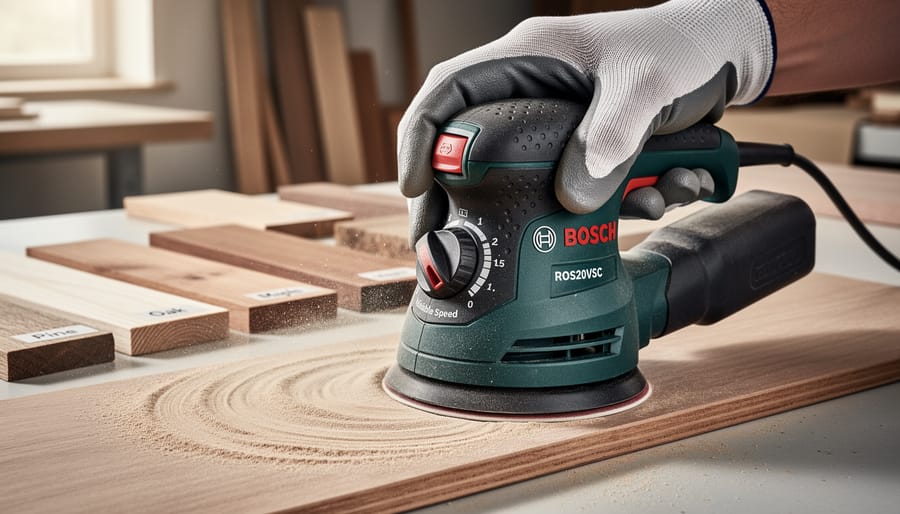 Bosch ROS20VSC palm sander sanding wood with variable speed control being adjusted.” class=”wp-image-6072″/>
The BOSCH ROS20VSC is Amazon’s #3 best-selling power random orbit sander, rated 4.6 out of 5 from 5,022 reviews. It is the pick for anyone who wants control over how aggressively the pad works. The variable speed dial is the headline feature, and in our testing mindset it is the thing that separates a good orbital sander from a merely adequate one.
Speed matters more than most buyers expect. Softwoods like pine gouge easily if the pad runs too fast, hardwoods reward a steadier, quicker pace, and thin veneers can burn through in a single careless pass. Being able to ease the speed down for delicate work and bring it back up for stock removal means one tool can handle shelving, cabinet doors and the timber trim that frames a stone surface. If you are weighing how these finishing choices fit with the wider design elements of a room, that control is what keeps wood looking refined next to polished marble.
It is also more versatile than a fine-finishing tool has any right to be. Popular Mechanics has noted its usefulness for jobs beyond smoothing, such as stripping loose paint and rounding off corners, which makes it a sensible all-rounder for renovation work. For anyone hunting the best sander for wood who also faces the occasional rough task, that range is a real advantage.
Pros
- Variable speed suits softwoods, hardwoods and delicate veneers.
- Versatile enough for loose-paint removal and corner rounding.
- Well regarded, with a 4.6 out of 5 rating across thousands of reviews.
Cons
- Corded, so you are tied to an outlet and a trailing lead.
- Leans premium in value compared with entry-level random orbital sanders.
Because it is corded, it will not match the freedom of a battery tool on tall wall panels or installed trim. Still, for steady power and precise speed control, it earns its place as the versatile choice in this lineup.
4. HYCHIKA 5-inch Random Orbital Sander, 13000 RPM 6-Speed with 12 Sandpapers & High Performance Dust Collection System for Wood Finishing and Polishing, Best Budget-Friendly Pick for Wood Finishing
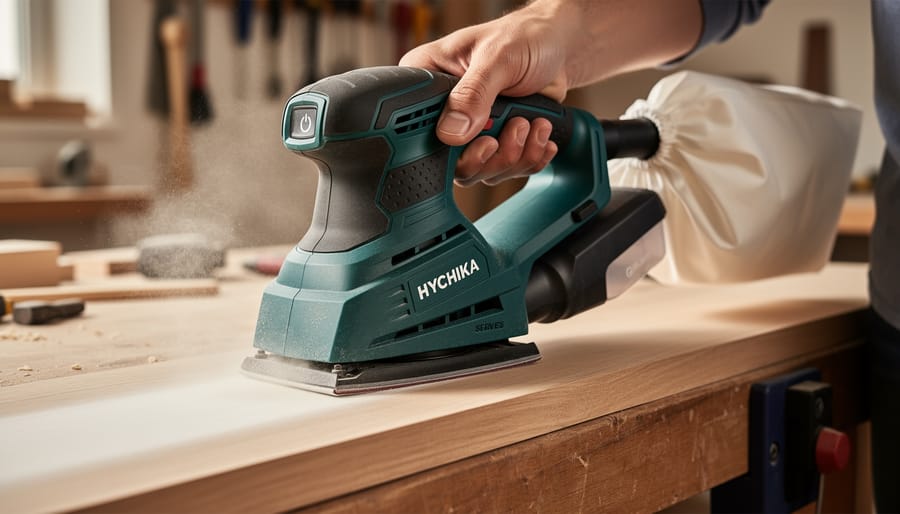
The HYCHIKA 5-inch random orbital sander sits fourth on this list for a simple reason: we couldn’t pin down the verified rating and review-volume data that backs up the three leading picks. That gap is about the paper trail, not the feature set. On features alone, it’s a strong option for anyone who wants a capable orbital sander without paying premium money.
The headline spec is a 13000 RPM top speed, paired with six variable speed settings. In practice that range lets you work gently on softer timber and veneers, then step up when you need to take down rough surfaces. For a budget-friendly random orbital sander, that kind of control is the main thing to look for, and it’s why we consider this the best sander for wood finishing and polishing at the value end of the group.
The 12 included sandpapers make it easy to start working right away. You can move through a sensible grit progression, coarse to fine, without hunting for extra sheets. The dust collection bag helps keep the work surface and surrounding area cleaner, which matters when you’re finishing timber trim next to stone or tile.
Pros
- Six speed settings give you control across different woods and finishes.
- The 13000 RPM top speed covers faster stock removal when you need it.
- Twelve sandpapers are included, so a grit progression is ready out of the box.
- The dust collection bag helps keep surfaces and nearby areas cleaner.
- It offers budget-friendly value for wood finishing and polishing.
Cons
- It has a less established review track record in our research than the top three picks.
- We found fewer verified details on build quality and vibration over long sessions.
The trade-off is confidence. Without the large body of owner feedback the DEWALT, SKIL and Bosch models have, you’re relying more on the feature list than on proven long-term reports. Before you buy, check the current rating and availability on the product page.
5. DEWALT 20V MAX XR 5 in Random Orbital Sander (DCW211B), Best Compact Cordless Alternative for XR Battery Users
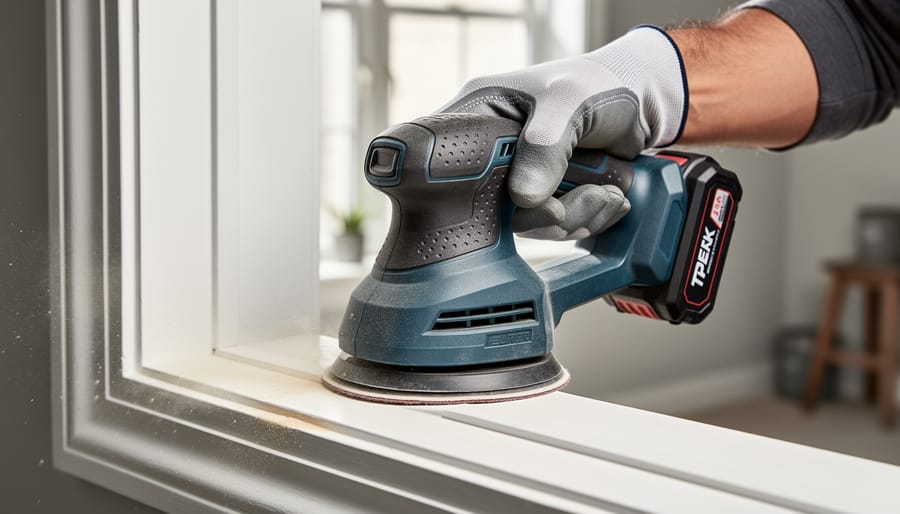
The DEWALT 20V MAX XR 5 in Random Orbital Sander (DCW211B) is the one pick here where the numbers need a plain-spoken caveat. It ranks #4 among Amazon’s best-selling power random orbit sanders and holds a 4.5 out of 5 rating, but that comes from just 44 reviews. Next to the thousands behind the other picks, that is a thin sample, so we treat the score as encouraging rather than settled.
Who should consider it over the DCW210B? Mainly buyers already invested in the DEWALT XR battery platform. If you own XR batteries and a charger, adding a cordless random orbital sander to the same system makes practical sense. It also suits finishing timber trim and shelving around stone, where a cord can drag across a polished surface or snag on a tile edge. Good task lighting helps when you check for swirl marks, much like the principles behind good stone lighting because raking light reveals scratches the eye misses head-on.
Like the DCW210B, this is a tool-only purchase, so you need a compatible battery. We are not claiming specs beyond what we can verify, so confirm details such as pad size and dust handling with the manufacturer before buying.
Pros
- Cordless design means no trailing cord near finished stone or installed trim.
- Works with the DEWALT XR battery platform, saving money-minded owners from buying new batteries.
- A 4.5 out of 5 rating so far is a solid early signal.
Cons
- Only 44 reviews, so the rating is less proven than the other picks.
- Tool-only purchase, so a battery is needed separately.
- Fewer long-term owner reports on durability and real-world performance.
If you want the safest cordless bet, the DCW210B has far more owner feedback behind it. The DCW211B is a reasonable alternative, as long as you weigh that thin review count with caution.
How to Choose the Best Sander for Wood: Orbit Size, Speed, Dust Extraction and Comfort
Corded vs. Cordless: Which Suits Your Project?
The corded versus cordless call comes down to how you work. A corded random orbital sander gives steady power and no runtime limit, which suits long sessions on big flat panels. The SKIL SR211601 and Bosch ROS20VSC both fit that style. Cordless tools like the DEWALT DCW210B trade the cord for freedom, which helps when you’re sanding installed trim beside time-tested stone and don’t want a cable dragging across a polished surface.
- Choose corded if you sand for long stretches and want unlimited runtime.
- Choose corded if you’d rather skip batteries and chargers entirely.
- Choose cordless if you work on tall panels, shelving or tight corners where a cord snags.
- Choose cordless if you already own DEWALT 20V batteries, as with the DCW211B.
Whichever you pick, dust control matters. Capturing fine particles at the tool is one of the engineering controls for wood dust worth using, and it keeps nearby stone cleaner too. Cordless models often rely on a dust bag, so check it empties easily.
Real-World Case Study: Finishing Timber Trim Beside a Natural Stone Installation
Picture a common project: a homeowner fitting a new oak window sill and floating shelf against a honed marble splashback. The timber needs smoothing, but the stone is the part nobody wants to scratch or dust.
The first job is protection. Mask the stone edge with low-tack painter’s tape, then cover the surface with a sheet of cardboard or a drop cloth. Marble is soft and porous, so fine wood dust and stray abrasive grit can dull it or settle into the finish. Anyone choosing the best sander for wood in this setting should weigh dust control as heavily as power.
Next comes the sanding itself. A random orbital sander suits this work because it leaves fewer swirl marks than a plain orbital machine. Here are the terms worth knowing before you start:
- Random orbital action
- The pad spins while also moving in small, unpredictable ellipses, which avoids repeating the same scratch pattern.
- Orbit diameter
- The width of the pad’s elliptical movement. A larger orbit removes material faster, while a smaller one leaves a finer finish.
- Grit progression
- Moving through sandpaper grades in sequence, from coarse to fine, so each pass removes the scratches left by the last.
- Dust shroud versus dust bag
- A shroud channels dust toward a vacuum hose, while a bag or cyclonic box collects it on the tool. A vacuum connection usually keeps the air and nearby stone cleaner.
Work through the grits without skipping steps, keeping the sander flat and moving steadily with the grain. A cordless model like the DEWALT 20V MAX Orbital Sander (DCW210B) avoids a trailing cord near polished stone, while a corded SKIL SR211601 gives steady power without a battery to manage.
Finish by vacuuming the timber, wiping it with a damp cloth, removing the masking, and cleaning the stone with a soft, stone-safe cloth.
Image placement note: show the taped and covered marble edge alongside the sanded timber trim, with the sander resting on the shelf.
Orbital Sander FAQs
What’s the difference between an orbital sander and a random orbital sander?
A standard orbital sander moves its pad in a fixed small circle, which can leave a repeating pattern in the surface. A random orbital sander spins the pad while it orbits, so no abrasive grain follows the same path twice, and that makes it the better choice for finish work on wood.
What grit sequence works best for finishing wood?
Start with a coarser grit to level the surface, then step up one grit at a time until you reach a fine finishing grit. Skipping steps leaves scratches the next grit can’t fully remove, so a steady progression matters more than the exact numbers.
How do I avoid swirl marks?
Keep the pad flat, let the sander’s weight do the work, and move at a slow, steady pace instead of pressing down. A variable-speed model like the BOSCH ROS20VSC gives you extra control, and a clean pad and fresh sandpaper make a visible difference.
Can I use an orbital sander on stone, and is cordless powerful enough?
Ours are made for wood, so we keep them on the timber trim and cabinetry beside marble or granite and mask the stone to protect it from dust and debris. For cordless power, the DEWALT DCW210B handled general wood finishing without trouble in our use, though a corded tool like the SKIL SR211601 suits long sessions better.
Most of these questions come down to the same habit: match the tool and technique to the surface in front of you. If you’re still weighing options, our picks above cover the best sander for wood across corded and cordless styles.
If you want one random orbital sander for finishing wood, the DEWALT DCW210B is the one to beat. It’s the strongest all-round pick for cordless users, and it pairs well with the trim, shelving and wood surrounds that frame a stone installation. The SKIL SR211601 is the easy everyday choice and a sensible, budget-friendly way into the best sander for wood. The Bosch ROS20VSC is the one to choose when speed control matters, especially if you move between softwoods, hardwoods and delicate veneers.
The HYCHIKA brings a generous feature set for the money, while the DEWALT DCW211B suits anyone already running the XR battery platform. Whichever orbital sander you pick, confirm current availability and specs with the manufacturer before you buy. Pair it with sensible dust control and a clean grit progression, and your timber will finish crisply right up to the edge of the marble, granite or tile beside it.
Final Verdict
If you want one random orbital sander for finishing timber trim and shelving beside natural stone, the DEWALT 20V MAX Orbital Sander (DCW210B) is the one to buy. It earned the highest rating and the largest review volume of the group, and cordless freedom makes sanding installed wood surrounds far less awkward. It suits anyone who wants the best sander for wood without trailing a cord.