
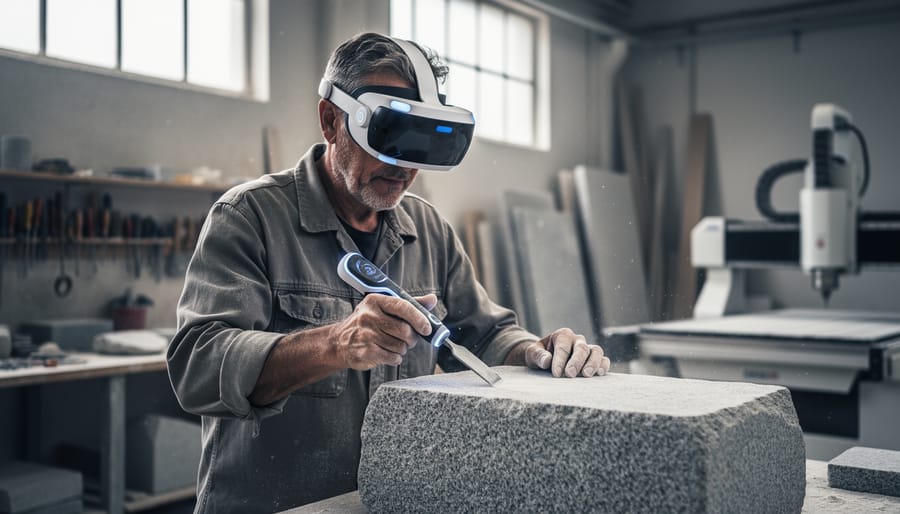
Traditional stone craft training demands years of hands-on practice, expensive materials, and acceptance of irreversible mistakes on costly natural stone. Virtual reality training simulation is transforming this centuries-old learning model by allowing masons, carvers, and fabricators to master complex techniques in immersive digital environments before touching actual stone.
VR training systems now replicate the precise weight, texture, and resistance of granite, marble, and limestone while trainees practice cutting, shaping, and finishing techniques. Students develop muscle memory for chisel angles, learn to read stone grain patterns, and understand how different stone types respond to tools without generating waste or risking injury. When a virtual block cracks incorrectly, the simulation simply resets, turning costly errors into valuable learning opportunities.
The technology addresses the stone industry’s most pressing challenge: a shrinking pool of skilled craftspeople as master artisans retire. Apprentices who train with VR simulations demonstrate 40% faster skill acquisition compared to traditional methods, while training costs drop by eliminating material waste and reducing supervision requirements. Architecture firms and stone fabrication facilities are adopting these systems to evaluate whether candidates possess the spatial reasoning and hand-eye coordination necessary for stone work before investing in lengthy traditional apprenticeships.
This article examines how virtual reality training simulation works for stone craft applications, explores real-world implementation results from fabrication facilities and trade schools, and provides practical guidance for organizations considering this technology to preserve and advance stone craftsmanship skills.
The Training Crisis Facing Stone Craft Today
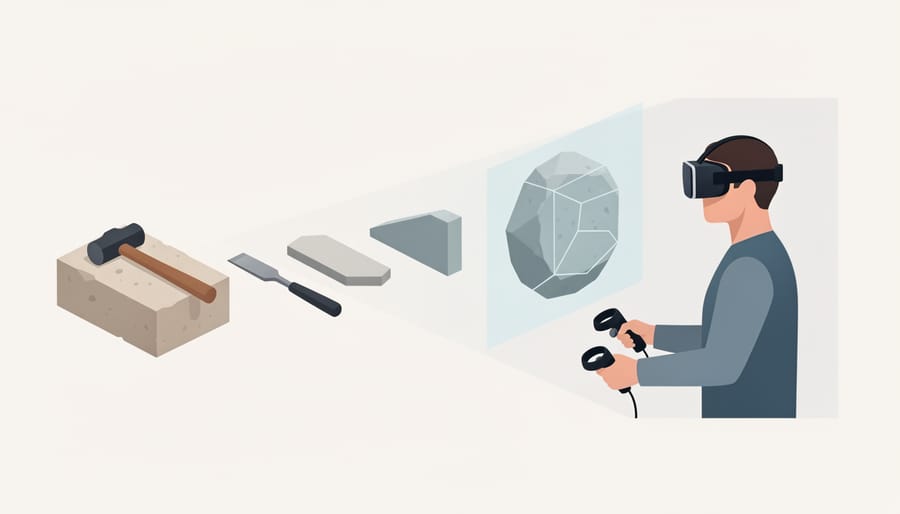
Why Traditional Training Methods Fall Short
Traditional apprenticeship models in stone craft have served the industry for centuries, but they come with significant limitations that impact both training efficiency and business operations. Understanding these challenges reveals why many organizations are exploring alternative training solutions.
Material waste represents one of the most substantial costs in conventional training programs. Novice stone workers learning techniques on actual marble, granite, or limestone can waste thousands of dollars worth of premium materials before mastering fundamental skills. A single error in cutting or shaping can render an expensive slab unusable, and beginners inevitably make multiple mistakes during their learning curve. This financial burden often forces training programs to use lower-quality materials, which doesn’t adequately prepare trainees for working with the high-grade stone they’ll encounter professionally.
Time constraints further complicate traditional training. Developing proficiency in stone craft typically requires months or years of hands-on practice. Master craftspeople must dedicate considerable time supervising apprentices, reducing their own productivity. Many workshops can only accommodate a limited number of trainees simultaneously due to space and equipment restrictions, creating bottlenecks in workforce development.
Geographic barriers also limit access to quality training. Not every region has experienced stone craftspeople available for instruction, forcing aspiring professionals to relocate or travel extensively. This accessibility issue particularly affects smaller businesses in rural areas or emerging markets.
Safety concerns present another critical challenge. Stone working involves heavy materials, powerful cutting tools, and techniques that can cause serious injury when performed incorrectly. Beginners face elevated risk during their initial learning phase, potentially leading to accidents that result in injury, liability issues, and lost work time. These collective limitations drive the need for more efficient, accessible, and safer training alternatives.
How Virtual Reality Transforms Stone Craft Learning
Realistic Tool Handling Without the Risk
One of the most significant advantages of virtual reality training simulation is its ability to replicate the physical characteristics of stoneworking tools with remarkable accuracy. Modern VR systems incorporate haptic feedback technology that mimics the weight, resistance, and vibration patterns trainees experience when handling chisels, angle grinders, polishers, and other essential equipment.
Through force-feedback controllers and specialized gloves, trainees feel the resistance as a chisel meets granite versus limestone, experiencing how different stone densities require varying pressure and technique. The system simulates the vibration of powered tools, teaching proper grip techniques and body positioning that prevent fatigue and injury during extended work sessions. This tactile feedback proves essential for developing the muscle memory necessary for precision work.
The controlled virtual environment allows beginners to make mistakes without costly consequences. A trainee can practice hammer and chisel techniques repeatedly, learning to control force and angle without risking damaged materials or injured hands. When working with simulated grinders or polishers, students develop proper handling techniques and safety awareness before touching actual equipment that could cause serious harm if mishandled.
This approach accelerates the learning curve significantly. Trainees build foundational skills and confidence in VR before progressing to physical tools, reducing material waste and workplace accidents. The technology tracks performance metrics, showing instructors exactly where students need additional practice, whether in maintaining consistent pressure, achieving proper tool angles, or developing steady hand control essential for quality stonework.
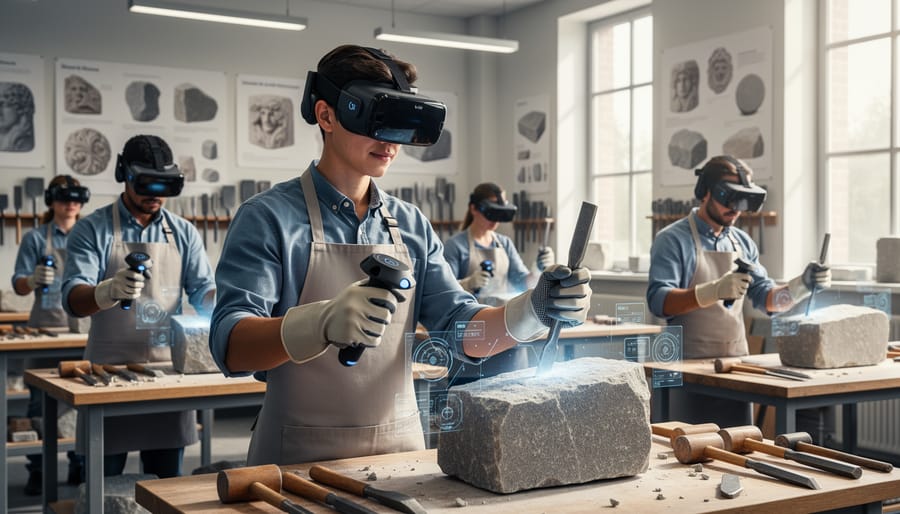
Material Properties in the Digital World
Modern VR training platforms have revolutionized stone craft education by accurately replicating the distinct characteristics of various stone materials. These simulations recreate the visual and physical properties that make each stone type unique, providing trainees with realistic practice opportunities before handling actual materials.
Marble simulations capture the crystalline structure and characteristic veining patterns that define this metamorphic rock. The virtual environment accounts for marble’s moderate hardness and its tendency to chip along natural cleavage planes. Trainees can observe how the material responds to different cutting angles and tool pressures, learning to work with rather than against the stone’s natural grain structure.
Granite simulations present the challenges of working with one of the hardest natural stones. The virtual models reproduce its coarse-grained texture and the significant tool wear that occurs during fabrication. Users experience how granite requires slower cutting speeds and consistent pressure to achieve clean edges without causing thermal stress cracks.
Limestone simulations represent softer sedimentary stone, demonstrating its more porous nature and susceptibility to surface damage. The VR environment shows how limestone absorbs moisture differently than harder stones and requires gentler handling techniques to prevent unnecessary breakage.
These digital material properties extend beyond visual appearance. Advanced haptic feedback systems allow users to feel resistance differences when cutting through various stone densities. The simulations also model realistic breakage patterns, teaching trainees to recognize warning signs of structural weakness and adjust their techniques accordingly. This comprehensive approach ensures students develop material-specific skills that directly transfer to real-world fabrication scenarios.
Instant Feedback and Performance Tracking
One of VR training simulation’s most transformative advantages is its ability to deliver instant, objective feedback that traditional apprenticeship methods simply cannot match. During a stone cutting or fabrication exercise, the system continuously monitors trainee performance through sensors embedded in controllers or haptic gloves, tracking metrics such as cutting angle precision, pressure application consistency, tool movement speed, and adherence to safety protocols.
Trainees receive immediate visual and auditory cues when their technique deviates from optimal standards. For example, if a worker applies excessive pressure while cutting marble—risking fracture or tool damage—the system alerts them instantly rather than after costly material waste occurs. The VR platform records detailed performance data across multiple sessions, enabling instructors to identify patterns, pinpoint specific skill gaps, and customize training modules accordingly.
This granular tracking extends beyond basic technique assessment. Modern VR systems measure hand steadiness during precision work, reaction times during safety scenarios, and decision-making accuracy when selecting appropriate tools for different stone types. Progress dashboards visualize improvement over time through clear metrics and comparative analytics against industry benchmarks.
Similar to how AR visualization technology revolutionizes project planning, VR’s analytical capabilities transform how craftspeople develop expertise. This data-driven approach accelerates skill acquisition, ensures consistent quality standards, and provides concrete evidence of competency—addressing liability concerns while building trainee confidence through measurable achievement milestones.
Real-World Applications for Stone Industry Professionals
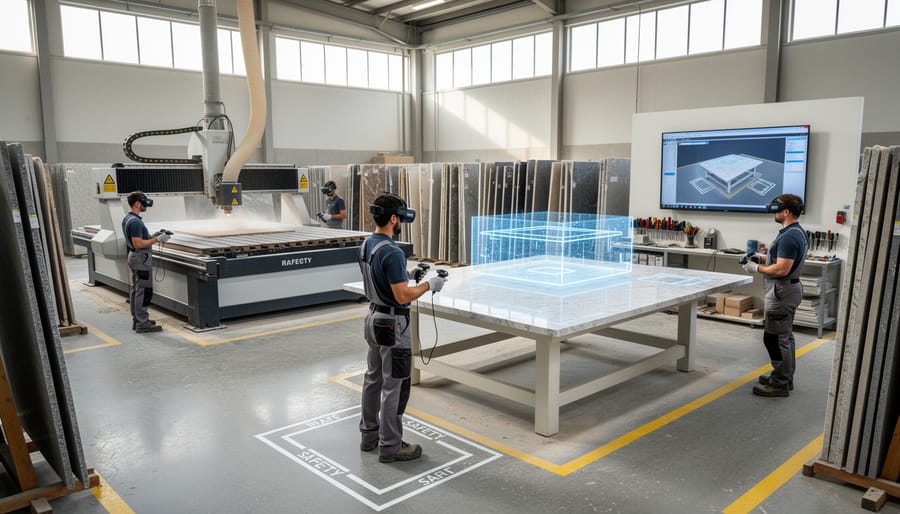
Fabrication Shops Building Safer Training Programs
Stone fabrication companies are discovering that virtual reality training dramatically reduces workplace injuries while preparing employees more effectively than traditional methods. Midwestern Marble Works, a family-owned fabrication shop in Illinois, implemented VR training in 2022 and saw a 60% reduction in first-year employee accidents within six months. Their VR program simulates hazardous scenarios like slab handling failures and equipment malfunctions without putting trainees at risk.
Colorado Stone Solutions reduced onboarding time from three weeks to ten days using VR simulations that teach proper techniques for operating bridge saws, polishers, and modern fabrication technologies. New hires practice cutting patterns on virtual slabs, eliminating the waste of expensive stone materials during the learning process. The company reports saving approximately $8,000 annually in damaged materials and reduced insurance premiums due to fewer workplace incidents.
Atlantic Fabricators in Massachusetts integrated VR modules specifically addressing their most common safety violations: improper lifting techniques and inadequate personal protective equipment usage. Trainees experience realistic consequences of unsafe practices in virtual environments, creating lasting behavioral changes. Their workers’ compensation claims dropped 45% in the first year after implementation.
These case studies demonstrate that VR training programs deliver measurable returns through reduced accidents, faster skill development, and lower material costs. Small to mid-sized fabrication shops find the technology particularly valuable for standardizing training across multiple locations while maintaining consistent safety protocols.
Educational Institutions Embracing Digital Apprenticeships
Trade schools and community colleges are pioneering the integration of VR technology into stone craft education, recognizing that digital simulations can effectively complement traditional hands-on training. These institutions are implementing VR systems that allow students to practice complex masonry techniques, learn stone identification, and master tool handling in virtual environments before working with actual materials.
Several community colleges have established hybrid curricula where students alternate between VR practice sessions and physical workshops. This approach addresses common challenges in vocational education, including material costs, safety concerns during initial learning phases, and limited access to expensive equipment. Students can repeat difficult procedures in VR without wasting stone or risking injury, building confidence before transitioning to real-world applications.
The National Center for Construction Education and Research has documented programs where VR training reduced material waste by 40 percent while maintaining skill proficiency standards. Students practice cutting patterns, joint preparation, and mortar application virtually, receiving instant feedback on technique and precision. This immediate assessment helps instructors identify learning gaps quickly and provide targeted guidance.
Educational institutions are also discovering that VR platforms integrate seamlessly with AI-powered design tools, creating comprehensive learning ecosystems. Students can design stone installations digitally, then practice the actual construction techniques in VR, bridging the gap between conceptual design and physical execution. This integration prepares graduates for modern industry expectations where digital literacy complements traditional craftsmanship skills.
The Tangible Benefits Beyond Safety
Cost Savings That Actually Matter
Virtual reality training simulation delivers measurable financial benefits that extend well beyond initial equipment costs. For stone fabrication shops and masonry training programs, the return on investment becomes evident across multiple operational areas.
Material waste reduction represents one of the most immediate savings. Traditional training requires apprentices to practice cuts, finishes, and installations on actual stone—an expensive learning curve when premium materials can cost hundreds of dollars per slab. VR simulation allows unlimited practice on virtual materials, preserving physical inventory for revenue-generating projects. Training facilities report material cost reductions of 40-60% when incorporating VR into their programs.
Insurance premiums often decrease when businesses demonstrate comprehensive safety training protocols. Some commercial insurers now offer reduced rates for companies utilizing VR safety training, recognizing the correlation between simulated hazard exposure and fewer workplace incidents. This translates to annual savings ranging from several hundred to several thousand dollars, depending on workforce size.
Training timelines compress significantly with VR technology. Traditional apprenticeships in stone craft typically span three to four years. VR-supplemented programs demonstrate competency development 30-35% faster by allowing trainees to experience diverse scenarios without waiting for specific job conditions to arise naturally. This accelerated timeline means productive workers enter the workforce sooner.
Equipment longevity improves when expensive saws, grinders, and polishing tools aren’t subjected to beginner mistakes. Reducing premature tool wear and breakage during the learning phase protects capital investments while maintaining equipment performance for experienced craftspeople who maximize its potential.
Skill Standardization Across Your Workforce
Traditional training methods in stone fabrication and installation often face significant inconsistencies. An experienced craftsperson in one location may teach techniques differently than another instructor elsewhere, leading to varying skill levels across your workforce. Virtual reality training simulation eliminates this variability by delivering identical training experiences to every employee, regardless of their geographic location or when they complete the program.
With VR training, each participant follows the same step-by-step procedures, receives identical safety protocols, and practices techniques using standardized virtual environments. A stone installer in California learns the exact same diamond blade handling procedures as a colleague in New York, ensuring company-wide competency standards. This consistency extends to assessment as well—the VR system evaluates performance using objective metrics rather than subjective instructor opinions.
The technology proves particularly valuable for organizations with multiple job sites or training facilities. Rather than depending on the availability of master craftspeople to demonstrate proper stone cutting, polishing, or installation techniques, companies can deploy VR headsets that replicate expert instruction consistently. New hires receive the same quality training as seasoned employees seeking skills updates, creating a uniform foundation of knowledge across your entire team. This standardization ultimately translates to more predictable work quality and reduced error rates in actual stone projects.
What VR Training Cannot Replace
The Irreplaceable Feel of Real Stone
While virtual reality training simulations offer remarkable benefits for stone craft education, they cannot fully replicate the irreplaceable experience of working with actual stone. Understanding these limitations helps organizations create balanced training programs that leverage both technologies.
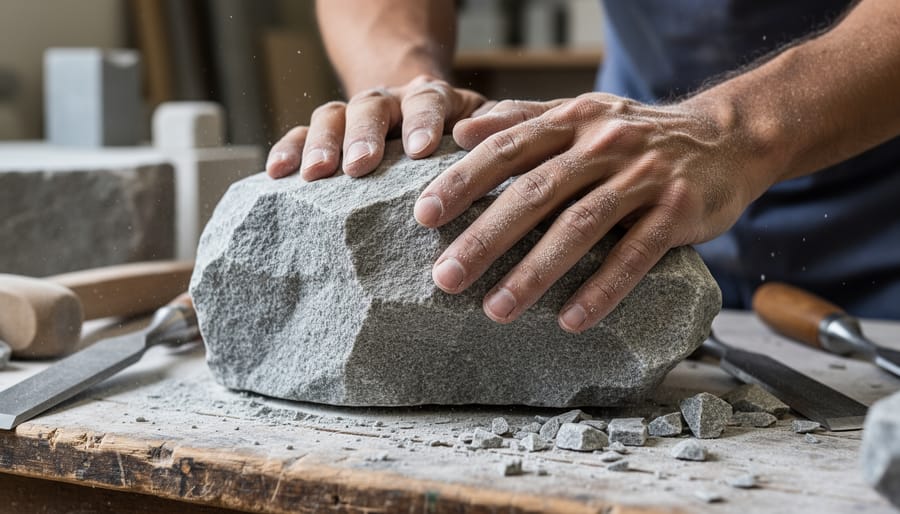
The most significant gap lies in tactile feedback. Real stone provides constant sensory information through your hands—the texture variations, temperature changes, and subtle vibrations that communicate how material responds to different tools and techniques. VR haptic gloves, though advancing rapidly, still cannot reproduce the nuanced resistance you feel when a chisel meets a hard inclusion in marble or the satisfying give when splitting granite along its natural grain.
Environmental factors also play a crucial role in authentic stone craft. Real workshops expose trainees to stone dust, which affects visibility and requires proper respiratory protection habits. They experience the physical weight of materials, the ambient noise of machinery, and the spatial awareness needed to navigate active work areas safely. These elements shape professional instincts that virtual environments struggle to impart.
Physical endurance represents another critical dimension. Sculpting, cutting, and finishing stone demands sustained strength, proper body mechanics, and stamina that only develops through repeated physical practice. While VR can teach technique, it cannot build the muscle memory and physical conditioning essential for professional stone work.
Most experienced stone craftspeople emphasize that VR training serves best as a complementary tool—excellent for introducing concepts, practicing decision-making, and reducing material waste during early learning—but never as a complete replacement for hands-on experience with natural stone.
Getting Started With VR Training in Your Operation
Equipment and Software Requirements
Implementing VR training for stone craft requires careful consideration of hardware, software, and spatial needs. Understanding these requirements helps businesses make informed decisions about initial investments and long-term sustainability.
The foundation of any VR training program is quality headset hardware. Current industry-standard options include the Meta Quest 3, HTC Vive Pro 2, or Valve Index, ranging from $500 to $1,400 per unit. While standalone headsets like the Quest series offer portability and ease of setup, PC-tethered systems provide superior graphics quality essential for detailed stonework visualization. Each workstation should include hand controllers, which typically come bundled with headsets, enabling trainees to manipulate virtual tools with precision.
Software platforms designed specifically for stone craft training remain relatively specialized. Several companies now offer customizable VR training modules that simulate cutting, polishing, and installation processes. These platforms often integrate with existing laser imaging technology to create realistic material representations. Expect annual licensing fees between $2,000 and $10,000 per seat, depending on features and customization levels.
Space requirements vary based on training scenarios. Basic workstations need approximately 6.5 by 6.5 feet of clear floor space for safe movement, while fabrication simulations may require 10 by 10 feet. Adequate lighting, ventilation, and minimal reflective surfaces ensure optimal tracking performance.
Initial investment typically ranges from $5,000 to $15,000 per training station, including hardware, software, and setup costs. While substantial, this investment often yields returns within 18-24 months through reduced material waste, accelerated training timelines, and decreased workplace incidents.
Integrating VR Into Existing Training Programs
Successfully integrating VR into existing training programs requires a strategic, phased approach that complements rather than replaces hands-on experience. The most effective implementation follows a blended learning model, where VR serves as a foundational tool before progressing to physical materials.
Begin with 20-30% of initial training time allocated to VR simulation. New apprentices should spend their first two weeks in virtual environments, mastering basic tool handling, safety protocols, and understanding stone properties without material waste or injury risk. This preparatory phase builds muscle memory and confidence before touching actual stone.
The transition phase blends both methods, dedicating alternating sessions between VR practice and supervised physical work. Trainees can rehearse complex cuts or techniques virtually in the morning, then apply those skills to real stone under expert guidance in the afternoon. This reinforcement accelerates learning while providing immediate feedback on translating virtual experience to tangible results.
Progression to advanced real-world work should occur when trainees consistently demonstrate proficiency in VR assessments, typically after 40-60 hours of combined training. However, VR remains valuable throughout careers for practicing rare techniques, exploring new tools, or maintaining skills during off-seasons.
Industry leaders recommend maintaining ongoing VR access even for experienced craftspeople, allocating 5-10% of continuing education time to simulation-based skill refinement. This approach maximizes the technology’s benefits while ensuring practitioners develop the tactile expertise and material intuition that only hands-on stonework can provide.
Virtual reality training simulation represents a powerful complement to traditional stone craft apprenticeship, not a replacement for the time-honored methods that have shaped this industry for centuries. The technology serves as a bridge, making the initial stages of learning more accessible while reducing material waste and safety risks for beginners. Novice stone workers can develop foundational skills, spatial awareness, and tool familiarity in virtual environments before progressing to hands-on work with actual materials.
The true artistry of stone craft remains grounded in physical experience—the subtle variations in natural stone, the tactile feedback of tools meeting material, and the nuanced judgment that comes from years of working with real granite, marble, and limestone. VR training accelerates the learning curve and builds confidence, but it ultimately prepares apprentices to excel in traditional settings rather than replacing them.
By embracing both approaches, the stone industry can preserve its rich heritage while attracting a new generation of craftspeople. This balanced integration ensures that centuries-old techniques and artistic traditions continue thriving, supported by modern technology that makes skilled stone working safer, more efficient, and increasingly accessible to dedicated learners worldwide.