
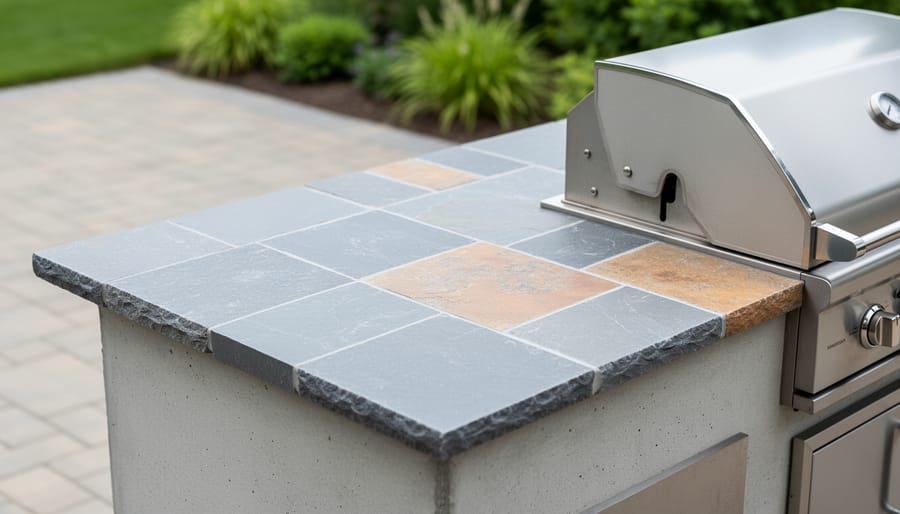
Inexpensive outdoor countertops range from $15 to $110 per square foot installed, with materials like pressure-treated tile, concrete, and select natural stones offering the best balance of affordability and weather resistance. The key is distinguishing between genuinely outdoor-rated budget options and cheap indoor materials that will crack, fade, or delaminate within a season.
Most homeowners approach this search backwards. They find an attractive laminate or faux-granite surface at a big-box retailer, see the low price tag, and assume it will work for their patio kitchen. It won’t. Indoor countertop materials are engineered for climate-controlled environments. Outdoor installations face freeze-thaw cycles, UV exposure, thermal expansion, and moisture infiltration that indoor surfaces never encounter.
The lowest-cost option, laminate, works indoors but fails spectacularly outdoors. Water seeps through seams, particleboard cores swell, and adhesives break down. Faux-granite countertops, while lightweight, stain-resistant, and easier to install than real stone, share similar outdoor durability concerns unless specifically rated for exterior use.
True budget-friendly outdoor performance starts with materials engineered or naturally suited for the elements. Ceramic tile over concrete backer, poured concrete with sealed finishes, and select natural stones like bluestone and limestone ($25 to $70 per square foot) deliver years of service without the premium price of granite ($56 to $80 per square foot installed). Each material demands different installation approaches, maintenance commitments, and climate considerations.
This guide compares proven outdoor countertop materials within realistic budget constraints, provides scenario-specific recommendations for different climates and uses, and identifies the costliest mistakes that turn an initially inexpensive project into an expensive replacement cycle. Whether you’re building a basic grilling station or a full outdoor kitchen, understanding which budget materials actually perform outdoors will save both money and frustration.
What Makes a Countertop Suitable for Outdoor Use
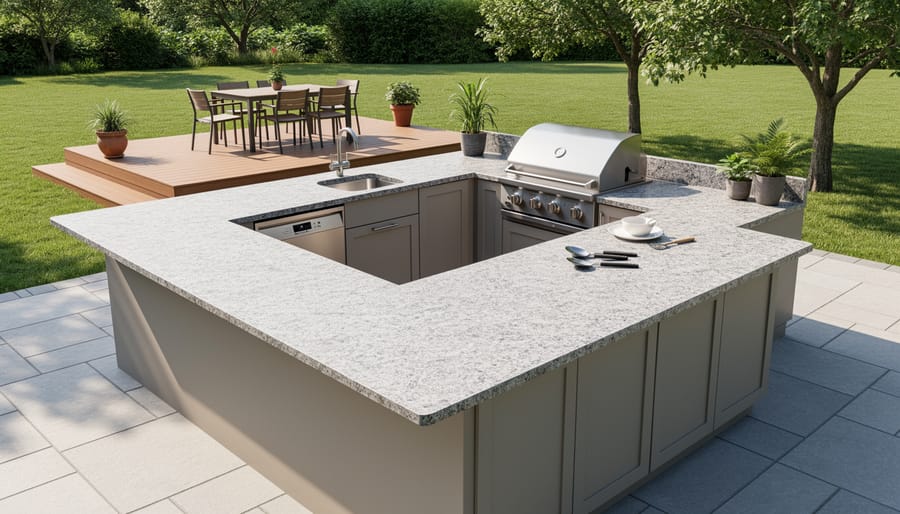
Outdoor countertops face conditions no indoor surface ever encounters. Rain, snow, direct sunlight, freezing nights followed by scorching afternoons, spilled marinades, and harsh UV rays all test materials in ways your kitchen never will. An outdoor countertop must survive these stresses year after year without warping, cracking, fading, or falling apart.
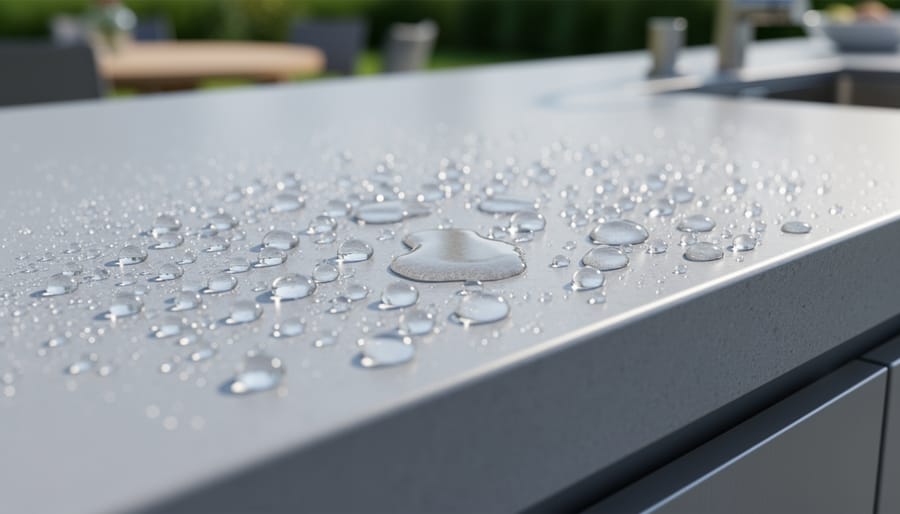
Weather resistance means the material can handle rain, snow, and humidity without deteriorating. Porous materials that absorb water will crack when that moisture freezes and expands. UV stability prevents fading and surface degradation from constant sun exposure. Many materials that look fine indoors turn chalky, brittle, or discolored after a few seasons in direct sunlight.
Temperature fluctuation tolerance matters more outdoors than almost anywhere else. A countertop in Phoenix might swing from 40°F at dawn to 150°F in afternoon sun. Materials expand and contract with these changes; weak ones crack or separate from their base. Moisture resistance goes beyond simple water exposure. Outdoor surfaces face standing water, constant humidity, and freeze-thaw cycles that force water into tiny cracks and pores.
Stain resistance protects against spills that sit longer outdoors than they would in a kitchen, plus organic matter like leaves and pollen. Even materials marketed for kitchens can fail this test; questions like do granite stain highlight concerns that apply differently indoors versus out in the elements.
Laminate costs less than any outdoor-worthy material, but it delaminates in moisture and heat. That indoor bargain becomes worthless outside. The cheapest functional outdoor option starts around $25 per square foot because anything less simply can’t meet these performance requirements.
Inexpensive Outdoor Countertop Materials Compared
Natural Stone Options Under $80 Per Square Foot
Natural stone delivers authentic outdoor appeal and decades-long performance in the $25-$80 range. These materials handle weather extremes, resist UV fading, and age gracefully rather than deteriorating like synthetic alternatives.
Granite ($56-$80 per square foot installed) sits at the higher end but justifies its cost through exceptional durability. This igneous rock handles freeze-thaw cycles, resists scratches from outdoor cookware, and maintains its polished finish under direct sun. The granite cost per sq ft reflects professional fabrication and installation, but you’re investing in a surface that performs identically outdoors as it does in high-traffic kitchens. Colors range from speckled grays to warm browns, with darker tones showing fewer water spots between rainstorms. Plan to reseal annually in harsh climates.
Bluestone ($25-$70 per square foot) offers the most budget-friendly natural stone option. This dense sedimentary stone naturally resists moisture absorption and tolerates temperature swings without cracking. The blue-gray surface develops a weathered patina over time that many homeowners prefer to its initial appearance. Bluestone works particularly well for rustic or traditional outdoor kitchens where a lived-in look enhances the design. Texture varies from smooth honed finishes to naturally cleft surfaces with dimensional character.
Outdoor limestone ($25-$70 per square foot) provides warm, neutral tones that complement Mediterranean and contemporary designs. Select dense varieties specifically rated for outdoor use, as not all limestone withstands freeze-thaw exposure. Limestone scratches more easily than granite but buffs out minor marks with fine-grit sandpaper. The stone darkens slightly when wet, creating subtle visual interest after rain.
Soapstone delivers unmatched stain resistance since it’s naturally non-porous, eliminating sealing requirements entirely. Though harder to source in some regions, it handles acidic spills and harsh cleaners without etching. The charcoal-gray surface darkens over time as natural oils rise to the surface.
Engineered and Alternative Materials
Engineered alternatives bring manufactured consistency and predictable performance to outdoor applications, often with simpler installation than natural stone.
Faux-granite surfaces use polymer resins or composite materials to replicate stone’s appearance while weighing considerably less. At roughly $30-$55 per square foot installed, they cost less than mid-tier granite and ship in ready-to-install slabs that one or two people can handle without heavy equipment. These surfaces resist stains better than unsealed natural stone and need minimal maintenance beyond basic cleaning. The tradeoff is authenticity: close inspection reveals repetitive patterns, and the material lacks the depth and variation of genuine stone. Faux-granite works well for smaller outdoor bars or accent counters where light weight matters, but it cannot match the weathering characteristics or lifespan of real granite.
Porcelain tile rated for exterior use costs $20-$45 per square foot installed and delivers excellent weather resistance and UV stability. Modern large-format tiles minimize grout lines, creating a more cohesive surface than traditional small tiles. Porcelain handles freeze-thaw cycles better than ceramic and resists staining without sealing. The disadvantage is grout maintenance: outdoor exposure gradually degrades grout joints, requiring periodic cleaning and resealing to prevent moisture infiltration. Porcelain suits DIY-friendly projects and straight-line layouts where tile’s modular nature simplifies installation and future repairs.
Concrete countertops offer complete customization in shape, color, and finish at $50-$100 per square foot installed. While concrete shares similarities with an engineered countertop in its manufactured nature, unlike quartz vs granite care requirements, concrete demands frequent sealing to prevent staining and moisture damage. Skilled fabrication is essential; poor workmanship leads to cracking and surface deterioration. Concrete makes sense for custom outdoor kitchens where unique design justifies the higher maintenance commitment.
Budget Options That Don’t Work Outdoors
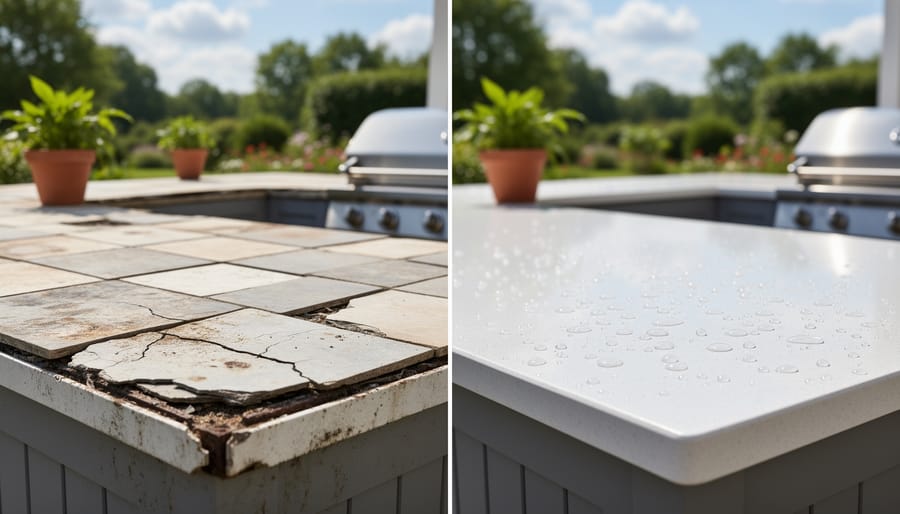
While laminate countertops offer the lowest entry cost for indoor kitchens, sometimes under $15 per square foot, they simply aren’t built for outdoor exposure. The particleboard core absorbs moisture and swells when water penetrates the laminate surface, causing warping, delamination, and eventual failure. UV rays fade and crack the plastic surface layer within months, and temperature swings make the adhesive bond deteriorate rapidly.
Similarly, standard butcher block, MDF-based materials, and basic tile with standard grout all break down quickly outdoors despite their indoor affordability. Moisture infiltration is the common killer: these materials lack the sealed, non-porous structure that outdoor conditions demand. What looks like a bargain at $15-25 per square foot becomes expensive when you’re replacing it within a year or two, whereas proper outdoor materials in the $25-80 range last decades with basic maintenance.
Key Factors to Consider When Buying
Selecting an inexpensive outdoor countertop requires more than just comparing price tags. The material that seems cheapest today can cost you significantly more over five years if it demands frequent resealing, fails in your climate, or requires professional installation that doubles your budget.
Total Installed Cost Matters More Than Material Price
Material-only pricing misleads buyers. A bluestone slab at $35 per square foot looks attractive until you add fabrication, edge finishing, delivery, and installation, costs that can push your final bill to $55 or $70 per square foot. Concrete poured in place might quote at $25 per square foot for materials but require skilled labor that adds another $40. Always get installed pricing for accurate comparisons, and if you’re sourcing materials separately, budget 50-80% more than the material cost for professional installation. DIY-friendly options like tile let you capture those savings yourself, but only if you have the skills and time.
Climate Determines Which Materials Will Last
Your local weather patterns directly affect outdoor countertop performance. Freeze-thaw cycles in northern climates demand materials with low water absorption, dense granite and bluestone excel here, while limestone and concrete can crack after repeated freezing. Desert heat and intense UV fade some materials and cause others to expand and contract, making porcelain and granite better choices than faux-granite in extreme sun exposure. Coastal environments require resistance to salt air and humidity, where sealed natural stone outperforms materials with exposed seams. Match the material’s durability profile to your specific climate rather than assuming all outdoor-rated options work everywhere.
Installation Complexity Affects Your Real Budget
Some materials demand professional fabrication and installation, while others suit confident DIYers. Natural stone slabs require specialized cutting tools, precise measurements, and two-person lifting, mistakes are expensive. Tile installation is more forgiving and cuts total project cost by 40-50% if you do it yourself. Poured concrete needs proper forms, mixing, and finishing technique. Faux-granite panels offer easier handling than stone but still require accurate cutting. Assess your skill level honestly: hiring professionals for complex materials often costs less than fixing a failed DIY attempt.
Before purchasing, answer these questions:
- What is the total installed cost, not just the material price?
- Will this material withstand my area’s specific weather extremes?
- Do I have the skills and tools for DIY installation, or must I hire professionals?
- How much annual maintenance will this material require?
- Does the aesthetic match my outdoor space and home style?
- What realistic lifespan can I expect given my climate and maintenance commitment?
Maintenance Requirements Compound Over Time
Low purchase prices can mask high ongoing costs. Natural stone typically requires annual or biannual sealing, a task you can do yourself for $50-75 in materials or pay $200-400 to professionals. Concrete needs similar sealing plus occasional patching. Porcelain demands almost no maintenance beyond cleaning, making it cheaper over a decade despite higher initial cost. Calculate five-year total ownership: a $2,000 granite install plus $1,000 in sealing costs $3,000, while a $2,800 porcelain install with minimal upkeep stays at $2,900. Factor in your willingness to perform maintenance yourself versus hiring help.
Aesthetic and Longevity Balance Your Investment
The countertop should complement your outdoor kitchen’s style and your home’s architecture. Natural stone offers authentic texture and color variation that suits traditional and upscale designs. Porcelain provides clean, contemporary lines. Tile allows creative patterns but shows grout lines. Consider whether you want this outdoor space to last 10 years or 25, granite and bluestone can outlast your home, while budget alternatives may need replacement in 7-12 years. Sometimes spending $60 per square foot on a 20-year solution beats replacing a $30-per-square-foot option twice.
Our Top Recommendations for Different Budgets and Needs
For homeowners balancing cost and performance, granite in the $56, $80 range delivers the best overall value. It checks every box, heat-resistant, weather-proof, low maintenance once sealed, and widely available from local fabricators. The material’s proven track record explains why granite lasts decades outdoors with minimal upkeep, making the upfront investment worthwhile compared to materials that need frequent replacement.
If you’re installing countertops yourself, faux-granite offers the most forgiving learning curve. Its lightweight construction eliminates the heavy lifting and specialized tools required for stone, while built-in stain resistance removes the sealing step that often trips up first-timers. You’ll still need proper support framing, but the material itself is easier to cut, fit, and secure than tile or real stone slabs.
For extreme weather climates with harsh winters or desert heat cycles, granite again takes the lead. It handles freeze-thaw expansion without cracking, resists UV fading better than engineered surfaces, and tolerates temperature swings from below freezing to direct summer sun. Porcelain tile runs a close second for weather durability, though grout lines remain a weak point in climates with severe freeze-thaw cycles.
When maintenance time matters most, porcelain delivers the lowest ongoing commitment. It requires no sealing, resists stains without treatment, and cleans with basic soap and water. Faux-granite follows closely for hands-off convenience, needing only occasional cleaning with no protective treatments. Both options suit weekend homeowners or anyone prioritizing ease of care over authentic stone appearance.
As the best natural stone under $70, bluestone combines genuine stone durability with budget-friendly pricing starting at $25 per square foot. You get weather resistance comparable to granite, distinctive color that won’t fade, and thermal mass that stays cool underfoot, all at roughly half the cost of mid-range granite installations.
Common Mistakes to Avoid
The allure of saving money can easily lead buyers down paths that cost far more in the long run. Each year, thousands of homeowners invest in outdoor countertops that fail within a single season because they prioritized the lowest upfront price over outdoor performance.
Choosing Indoor Materials for Outdoor Applications
Laminate offers the lowest entry cost among countertop materials, but it’s engineered exclusively for indoor use. Moisture penetrates the seams and edges, causing swelling and delamination. Even “water-resistant” indoor materials rarely withstand months of rain, humidity, and temperature swings. If a material isn’t explicitly rated for outdoor use, assume it will fail.
Common Pitfalls That Undermine Value
- Comparing material-only prices without factoring installation costs, a $25 per square foot material can easily reach $70 installed, changing the budget calculation entirely
- Underestimating maintenance demands, particularly for natural stone that needs annual sealing in harsh climates
- Skipping initial sealing or resealing schedules for porous stones like limestone, leaving them vulnerable to stains and moisture damage
- Ignoring your specific climate, Phoenix heat requires different materials than Seattle rain or Chicago freeze-thaw cycles
- Assuming all natural stone is expensive when bluestone and outdoor limestone start at $25 per square foot, competing directly with many synthetic options
The Installation Reality Check
Faux-granite’s lightweight construction makes it easier to install than real stone, potentially saving hundreds in labor costs. Buyers who focus solely on material pricing often discover that difficult-to-install options erase any initial savings. Get complete installed quotes for fair comparisons, and consider whether your skill level matches DIY options. A botched installation on cheap material costs more than professional installation of quality material.
Main Options Compared
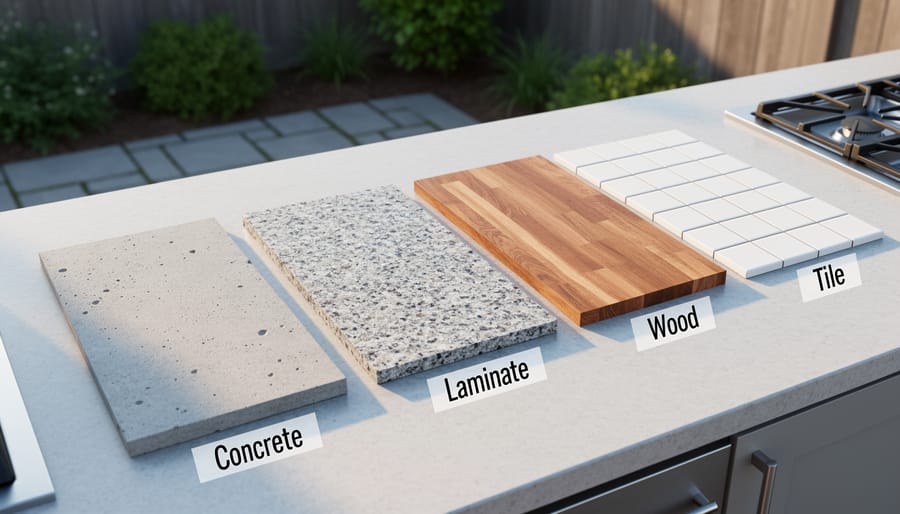
When weighing your options, the clearest distinctions emerge between natural stone, engineered alternatives, and traditional budget materials. Granite delivers authentic aesthetics and decades of proven outdoor performance but commands the highest price in this comparison at $56, $80 per square foot installed. Bluestone and limestone both occupy the $25, $70 range, offering excellent weather resistance and a more rustic appearance that suits many outdoor spaces, though they require periodic sealing.
Faux-granite presents an interesting middle ground: it mimics natural stone’s look while staying lightweight, stain-resistant, and easier to install, typically landing below true granite in cost. Porcelain tile runs $15, $40 installed and handles freeze-thaw cycles well, but grout lines demand regular attention. Concrete ($50, $100 poured-in-place) offers design flexibility yet needs expert installation and ongoing sealing to prevent cracks and stains in harsh climates.
The critical trade-off isn’t simply price, it’s upfront cost versus maintenance burden and lifespan. Natural stone requires sealing every one to three years but can last thirty-plus years outdoors; engineered options often need less upkeep but may not age as gracefully.
Frequently Asked Questions
Homeowners shopping for budget outdoor countertops often have similar concerns about durability, installation, and true costs. Here are answers to the most common questions.
What is the cheapest outdoor countertop material?
Outdoor-rated concrete and bluestone offer the lowest entry points at $25 per square foot installed, though basic tile installations can start around $15 per square foot. Laminate is cheaper for indoor use but fails quickly outdoors due to moisture penetration and UV damage.
Can you use laminate countertops outdoors?
No, laminate is not suitable for outdoor use despite its low indoor cost. The particleboard core swells and deteriorates when exposed to moisture, and the laminate surface cracks under temperature fluctuations and UV exposure.
How do faux-granite and real granite compare for outdoor use?
Real granite costs $56 to $80 per square foot installed and offers authentic stone durability with minimal maintenance. Faux-granite countertops mimic the look at lower cost, are lightweight and easier to install, and resist stains well, but lack the heat tolerance and longevity of natural stone.
Do natural stone countertops need sealing?
Yes, porous natural stones like granite, limestone, and bluestone require initial sealing after installation and periodic resealing every one to three years depending on the stone type and climate exposure. Following proper countertop cleaning steps helps maintain the seal.
What’s included in installed pricing versus material-only cost?
Installed pricing covers the stone or material, fabrication with edge profiles and cutouts, delivery, professional installation, and initial sealing for natural stone. Material-only pricing excludes these services and typically represents 40 to 60 percent of the total installed cost, making DIY projects more complex than the material price suggests.
Understanding these fundamentals helps you avoid costly mistakes and set realistic expectations for your outdoor countertop project. The gap between material cost and installed cost matters significantly when comparing options, and choosing outdoor-rated materials from the start prevents premature replacement expenses that erase any initial savings.
Finding a durable outdoor countertop that fits your budget is entirely achievable. Homeowners working within the $25, $80 per square foot range have access to genuine natural stone options like bluestone and outdoor limestone, alongside engineered alternatives such as faux-granite and porcelain. Each material brings distinct advantages: some excel in harsh climates, others simplify installation for DIY enthusiasts, and several demand minimal upkeep once sealed properly.
The lowest upfront price rarely delivers the best value outdoors. A countertop that degrades after two seasons or requires constant resealing costs more than a mid-range natural stone that performs reliably for decades. Factor in your climate, how much maintenance you’re willing to handle, and whether you’ll install it yourself or hire a professional. These decisions shape total cost far more than the initial price tag.
Natural stone in the mid-price range offers a particularly compelling balance: authentic appearance, proven weather resistance, and long-term durability without stretching to premium granite pricing. Choose the material that matches your specific conditions and commit to proper installation and maintenance. That combination will give you an outdoor kitchen or bar surface you can count on for years.