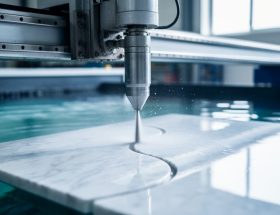
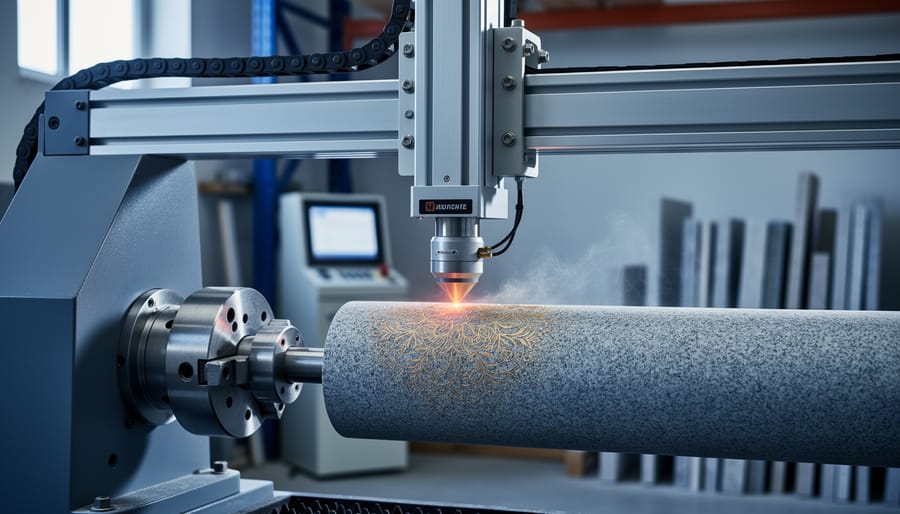
Precision stone engraving has evolved beyond flat surface work. Four-axis laser engravers add rotational capability to traditional three-axis movement, enabling fabricators to engrave curved surfaces, cylindrical columns, spherical objects, and complex three-dimensional stone pieces with remarkable accuracy. Unlike conventional laser engraving technology limited to flat materials, these advanced systems rotate the workpiece while the laser head moves along X, Y, and Z axes, opening new possibilities for architectural details, custom monuments, decorative columns, and artistic installations.
This technology addresses a fundamental limitation in stone fabrication: creating consistent, intricate engravings on non-flat surfaces. Traditional manual engraving methods require extensive labor and struggle with repeatability on curved marble, granite, or limestone pieces. Rotary engraving tools can handle some curved work but lack the precision and design flexibility that digital laser systems provide. The four-axis configuration eliminates these constraints, allowing fabricators to wrap detailed patterns around columns, engrave personalized text on spherical garden orbs, or create relief carvings that follow contoured surfaces.
Understanding four-axis capabilities helps stone professionals evaluate whether this investment aligns with their project portfolio. Architects designing custom stone elements, monument fabricators seeking competitive advantages, and specialty stone shops pursuing high-value decorative work will find particular value in this technology. The following sections examine how these systems function, their practical applications in natural stone work, material compatibility considerations, and the financial factors influencing adoption decisions.
Understanding 4-Axis Laser Engraving Technology
How the Fourth Axis Changes Everything
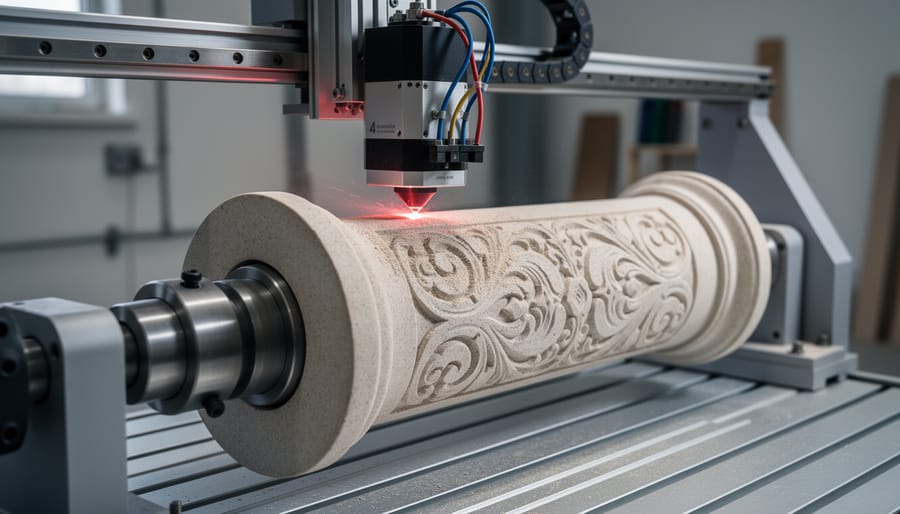
Traditional 3-axis laser engravers operate along three linear directions: left-right, forward-backward, and up-down. While effective for flat surfaces, they face significant limitations when working with cylindrical or curved stone objects. The fourth axis introduces rotational capability, transforming how these machines interact with three-dimensional stone pieces.
This rotational axis functions like a lathe, securely holding cylindrical objects and rotating them precisely as the laser head moves. The synchronized movement between the rotating workpiece and the laser beam allows for seamless engraving around the entire circumference of columns, balusters, or decorative stone elements. Rather than requiring multiple setups or hand-finishing techniques, the fourth axis maintains consistent engraving quality throughout the rotation.
For stone fabrication, this capability opens remarkable possibilities. Architectural columns can receive intricate decorative bands, historical inscriptions, or ornamental patterns that wrap completely around their surface. Stone balusters gain personalized details impossible to achieve with traditional methods. Curved monuments and memorial pieces accommodate text and imagery that follows the natural contours of the stone.
The technology proves particularly valuable for custom residential and commercial projects where architects specify detailed cylindrical elements. A marble column destined for a luxury home entrance can feature custom fluting or decorative motifs. Granite bollards for commercial spaces receive company logos or wayfinding information visible from any angle.
Beyond simple rotation, advanced systems coordinate all four axes simultaneously, enabling complex helical patterns and varied depth engraving on curved surfaces. This synchronized control ensures precision typically measured in fractions of a millimeter, maintaining the exacting standards natural stone applications demand.
Key Components and Specifications That Matter
Understanding the technical specifications of a 4-axis laser engraver helps stone professionals make informed equipment decisions. Laser type significantly impacts results: fiber lasers excel at marking granite and marble with precise detail, while CO2 lasers work better for certain stone types requiring different wavelengths. Power requirements typically range from 30 to 100 watts for most natural stone applications, with higher wattage enabling faster processing and deeper engraving.
Precision tolerances define quality outcomes. Professional systems should maintain positioning accuracy within 0.001 inches across all four axes, ensuring intricate patterns and text remain sharp even on curved surfaces. Rotary axis capacity matters too—verify the system accommodates your typical stone piece dimensions, from small tiles to substantial sculptural elements.
Software compatibility proves essential for modern workflows. Look for systems supporting standard CAD file formats and offering intuitive digital design integration. Quality control systems with real-time monitoring prevent costly errors by pausing operations if alignment shifts during multi-hour engraving sessions. Consider cooling systems and ventilation requirements, as stone engraving generates significant dust and heat that demand proper management for consistent results and equipment longevity.
Revolutionary Applications for Natural Stone Projects
Architectural Stone Elements
Four-axis laser engraving technology has revolutionized architectural stonework by enabling artisans to create complex decorative elements that were previously labor-intensive or simply impossible to produce. This advanced capability allows fabricators to work on cylindrical and curved surfaces with precision that rivals traditional hand-carving, while dramatically reducing production time and costs.
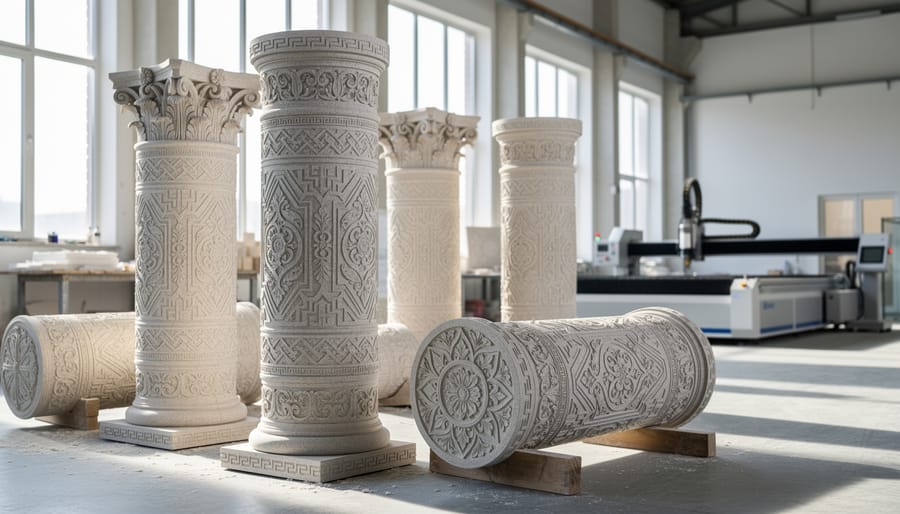
Column engravings represent one of the most impressive applications of this technology. 4-axis systems can spiral intricate patterns around marble, granite, or limestone columns, creating everything from classical fluting to contemporary geometric designs. The rotating axis maintains consistent depth and detail as the column turns, ensuring uniform results that would require weeks of skilled manual labor using conventional methods.
Decorative balusters benefit significantly from this technology. Custom staircase components featuring twisted designs, relief patterns, or personalized motifs can be produced with mathematical precision. The laser can accommodate various stone types, adapting its power and speed settings to achieve clean cuts in both hard granites and softer limestones without cracking or chipping.
Custom moldings and ornamental stonework have become more accessible to designers and architects. Crown moldings with repeating patterns, corbels with intricate relief work, and decorative finials can all be produced efficiently. The technology excels at reproducing historical details for restoration projects while maintaining dimensional accuracy across multiple pieces.
This precision manufacturing doesn’t eliminate craftsmanship but rather enhances it, allowing artisans to focus on design innovation and finishing work while the machine handles repetitive cutting tasks with unwavering consistency.
Custom Memorial and Commemorative Work
Four-axis laser engraving technology has transformed the memorial industry by enabling unprecedented detail and artistic expression in memorial stone engraving. Unlike traditional flat engraving methods, 4-axis systems rotate the stone while the laser precisely etches the surface, allowing for complete 360-degree designs on cylindrical monuments, rounded headstones, and sculptural memorial pieces.
The rotary capability produces photographic-quality portraits with remarkable depth and tonal gradation, capturing fine details like facial features, clothing textures, and background elements that honor loved ones with dignity and accuracy. This technology excels at rendering complex imagery including landscapes, religious symbols, and personalized scenes that wrap seamlessly around curved surfaces.
For monument fabricators, 4-axis engraving reduces production time while eliminating the physical strain and inconsistency of hand-carved lettering. The precision ensures uniform depth across intricate designs, even on challenging materials like polished granite and marble. Families benefit from greater customization options, transforming traditional memorials into unique tributes that tell personal stories through detailed imagery and elegant typography that remains legible for generations.
Interior Design and Art Installations
Four-axis laser engravers have revolutionized interior design possibilities with natural stone, enabling designers and architects to create stunning focal points that were previously impossible or prohibitively expensive. These systems excel at producing three-dimensional relief patterns on flat surfaces, transforming marble or granite panels into textured feature walls with intricate depth variations. The rotating capability allows fabricators to engrave cylindrical columns with seamless patterns that wrap completely around the circumference, ideal for luxury hotel lobbies and high-end residential entryways.
In commercial applications, designers use 4-axis technology to create custom stone art installations that serve as signature pieces. Museums and corporate headquarters often commission relief sculptures that combine traditional stone beauty with contemporary digital precision. The technology enables replication of historical patterns with exact accuracy while also facilitating entirely new artistic expressions that push creative boundaries.
For residential projects, homeowners can incorporate personalized cylindrical lamp bases, decorative pilasters, or carved stone vessels that feature continuous designs around their entire surface. The precision of laser engraving ensures consistent depth and detail that hand-carving cannot match at comparable costs, making bespoke stone artwork accessible to a broader market while maintaining the timeless appeal of natural material.
Advantages Over Traditional Stone Cutting Methods
Precision and Consistency Gains
The shift to 4-axis laser engraving technology delivers measurable precision improvements that fundamentally change what’s possible in stone fabrication. These systems routinely achieve tolerances down to 0.001 inches, a level of accuracy that traditional stone cutting methods simply cannot match consistently. For architects and designers specifying intricate stone installations, this precision translates directly into better-fitting components and cleaner assembly on-site.
Repeatability represents another critical advantage. Once a design is programmed, a 4-axis system can reproduce identical pieces hundreds or thousands of times with zero variation. This consistency proves invaluable for production runs requiring multiple matching elements, such as decorative columns, balustrades, or custom tile patterns. Each piece emerges with identical dimensions and surface characteristics.
Perhaps most significantly, these systems eliminate human error in complex patterns. Intricate geometric designs, detailed relief work, and compound curves that would challenge even master craftsmen are executed flawlessly every time. The computer-controlled process ensures that complexity doesn’t compromise accuracy, opening new creative possibilities for stone applications while maintaining the exacting standards professional projects demand.
Design Freedom and Complexity
The integration of digital design software with 4-axis laser engraving technology has revolutionized what’s possible in stone fabrication. Unlike traditional chiseling methods that require exceptional manual skill and weeks of labor, or water jet cutting which excels at flat profiles but struggles with dimensional depth, 4-axis systems translate complex CAD files directly into precise stone engravings.
This digital workflow enables fabricators to produce intricate geometric patterns, flowing organic designs, and detailed reliefs that would be prohibitively expensive or simply impossible using conventional techniques. The rotating axis allows the laser to follow curved surfaces seamlessly, creating three-dimensional textures on columns, spheres, and irregular stone shapes. Architects can now specify custom relief patterns for building facades, while designers create personalized memorials with photographic-quality portraits etched into granite.
The technology particularly shines in producing consistent repeating patterns across multiple pieces, ensuring perfect uniformity in large installations. What once required master craftsmen weeks to complete can now be programmed once and replicated precisely, making bespoke stone elements accessible to broader markets while maintaining artistic integrity.
Cost and Time Efficiency Considerations
Four-axis laser engravers represent a significant upfront investment, typically ranging from $50,000 to $200,000 depending on capabilities and specifications. However, this initial cost is balanced by substantial long-term efficiencies. The technology dramatically reduces labor hours by automating complex engraving tasks that would otherwise require skilled artisans working for days. Material waste drops considerably since the precision cutting minimizes errors and allows fabricators to optimize stone slab usage more effectively. Project completion times accelerate notably—what might take a week using traditional methods can often be accomplished in one to two days. For high-volume stone fabricators and design firms handling custom architectural projects, the return on investment typically materializes within two to three years through increased production capacity, reduced labor costs, and the ability to command premium pricing for intricate custom work that competitors cannot efficiently produce.
Best Stone Types for 4-Axis Laser Engraving
Ideal Candidates: Marble, Granite, and Limestone
Marble, granite, and limestone represent the most responsive natural stones for 4-axis laser engraving, each offering distinct advantages for different design applications. These materials consistently produce exceptional results due to their mineral composition and how they react to concentrated laser energy.
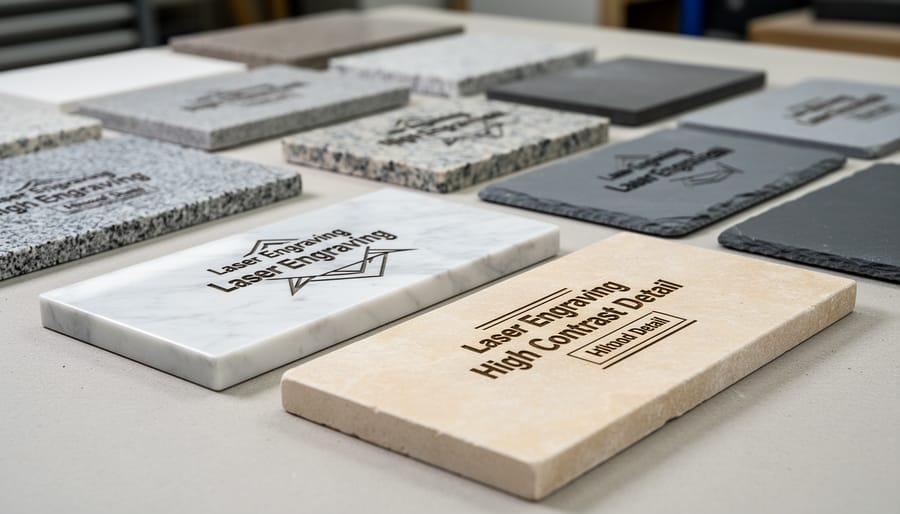
Marble excels in creating dramatic color contrast. When the laser removes the polished surface layer, it reveals the stone’s lighter, unpolished interior, producing striking white-on-dark effects on varieties like Nero Marquina or subtle tone-on-tone designs in Carrara. The technology allows engravers to control depth precisely, typically ranging from 0.5mm to 3mm, enabling multi-dimensional artwork and text that catches light beautifully. The finished surface maintains a smooth, professional quality without the micro-fracturing sometimes seen with traditional sandblasting.
Granite’s dense crystalline structure responds exceptionally well to laser technology, producing clean, permanent markings that resist weathering. Black and dark granites yield the highest contrast, as the laser exposes lighter minerals beneath the surface. The 4-axis capability proves particularly valuable for granite monuments and architectural elements, allowing continuous engraving around curved surfaces and cylindrical columns without repositioning.
Limestone offers softer, more subtle engraving results ideal for textured finishes and detailed architectural ornamentation. Its uniform composition ensures consistent depth control, making it perfect for intricate patterns and lettering. The laser creates a slightly roughened surface that adds tactile interest while maintaining the stone’s natural character.
All three stones benefit from the laser’s non-contact process, eliminating chipping risks and preserving structural integrity even on delicate edges and thin sections.
Challenging Materials and Workarounds
While 4-axis laser engravers excel with most stones, certain materials demand specialized approaches. Highly polished surfaces like black granite can reflect laser energy, reducing engraving depth and contrast. The solution involves applying specialized masking compounds or temporary coatings that absorb laser energy more effectively, creating crisp, visible marks even on mirror-finished surfaces.
Dark granites present visibility challenges since the laser-etched areas may appear only slightly lighter than the surrounding stone. Operators can address this by adjusting laser parameters to create deeper engravings or by filling etched areas with contrasting pigments or metallic compounds after engraving. White or gold fills dramatically enhance readability on dark materials.
Porous stones like certain limestones and sandstones require careful power calibration. Excessive energy can cause surface fracturing or unwanted discoloration beyond the intended design area. Running test engravings at lower power settings with multiple passes typically yields better results than single high-power applications. Pre-treating porous materials with penetrating sealers can also stabilize the surface, allowing more consistent engraving depth and cleaner edges. Understanding these material-specific techniques ensures your 4-axis system delivers professional results across the full spectrum of natural stone varieties.
Investment Considerations for Professionals
Equipment Costs and Maintenance Requirements
Professional-grade 4-axis laser engravers suitable for stone work represent a significant investment, with entry-level systems starting around $15,000 to $25,000 for smaller desktop units. Mid-range industrial models typically cost between $40,000 and $80,000, while high-end production systems can exceed $150,000 depending on laser power, bed size, and automation features.
Beyond the initial purchase price, budget for ongoing operational expenses. Maintenance requirements include regular lens cleaning, mirror alignment checks, and periodic replacement of consumables like focusing lenses ($200-$500) and protective windows ($100-$300). Laser tubes have finite lifespans, typically requiring replacement every 2,000 to 10,000 hours of operation, costing $1,000 to $8,000 depending on the system.
Additional considerations include electrical consumption (varying by laser wattage), ventilation system maintenance, and cooling water or chiller upkeep for water-cooled systems. Many manufacturers offer service contracts ranging from $2,000 to $8,000 annually, providing preventive maintenance and priority support. When evaluating total cost of ownership, factor in software licensing fees, operator training, and potential facility modifications for proper ventilation and power requirements. These investments typically prove worthwhile for businesses producing consistent volumes of custom stone work.
When This Technology Makes Business Sense
A 4-axis laser engraver represents a significant capital investment that makes sense for specific business models and production scenarios. High-volume fabricators producing custom architectural elements, decorative panels, or commemorative pieces will benefit most from bringing this technology in-house. If your operation processes more than 50 custom stone pieces monthly with intricate detailing requirements, the efficiency gains and quick turnaround times typically justify the investment within 18-24 months.
Design firms and fabricators specializing in premium residential projects, luxury commercial spaces, or artistic installations where curved or cylindrical stone elements are frequently specified will find the technology indispensable. The ability to engrave curved columns, rounded countertop edges, or dimensional signage without outsourcing provides competitive advantages in both pricing and delivery schedules.
Conversely, occasional users or businesses handling primarily flat engraving work should consider outsourcing to specialized laser cutting services. If your projects require complex curved engraving fewer than once monthly, partnering with service providers offers access to the technology without maintenance overhead, operator training costs, or equipment depreciation. The decision ultimately hinges on production volume, project complexity, and your market positioning as either a full-service fabricator or specialized design provider.
Real-World Case Study: Historic Restoration Project
When the historic Merchant’s Exchange Building in Philadelphia required restoration of its weathered Carrara marble columns, preservation architects faced a significant challenge. The 1830s-era columns featured intricate Corinthian capitals with acanthus leaf details that had deteriorated beyond repair. Traditional hand-carving would take months and cost over $50,000 per column, while finding artisans capable of matching the original craftsmanship proved difficult.
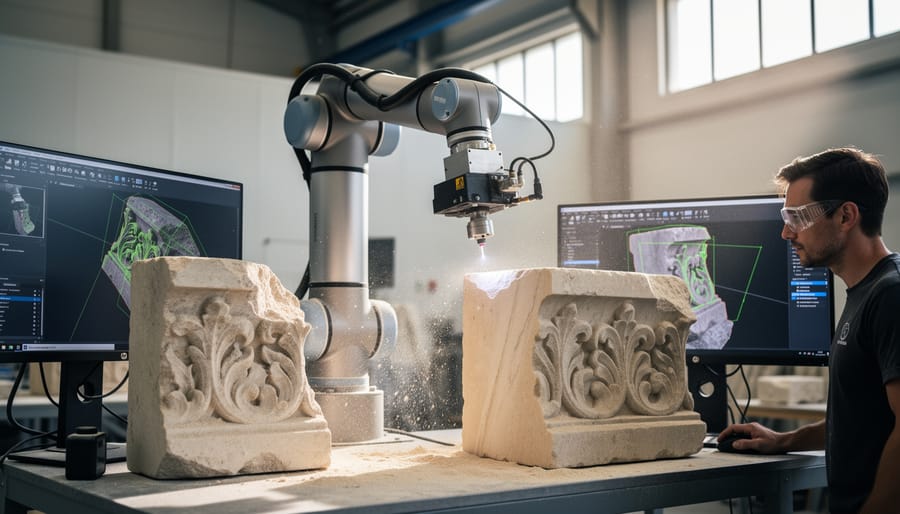
The solution came through 4-axis laser engraving technology. The restoration team used high-resolution 3D scanning to capture the intact portions of the original columns, creating a precise digital model. This data was then fed into a 4-axis laser engraver equipped with a 150-watt CO2 laser system, capable of working with the dense marble material.
The rotary axis proved essential for this project, allowing the cylindrical column capitals to rotate continuously while the laser head carved the ornamental details. Each capital took approximately 18 hours of machine time to complete, compared to an estimated 200 hours for manual carving. The precision achieved was remarkable, with details accurate to within 0.1mm of the original specifications.
The project yielded several tangible benefits. First, material waste dropped by 60 percent compared to traditional methods, as the laser’s precision eliminated the need for excess stock removal. Second, the team produced four matching capitals in three weeks rather than six months. Third, the digital files now serve as a permanent archive, ensuring future repairs can maintain absolute consistency with the originals.
This restoration demonstrates how 4-axis laser technology bridges the gap between historical authenticity and modern efficiency, making complex heritage preservation projects more accessible and sustainable.
The emergence of 4-axis laser engraving technology represents a significant milestone in natural stone craftsmanship, bridging the gap between centuries-old traditions and modern precision manufacturing. This advanced approach enables artisans and fabricators to execute complex designs on cylindrical and irregular stone surfaces with accuracy previously unattainable through conventional methods, opening new creative possibilities for architectural elements, decorative pieces, and custom installations.
For professionals evaluating this technology, the decision hinges on specific project requirements and production goals. Those frequently working with columns, balusters, curved surfaces, or intricate three-dimensional designs will find 4-axis systems particularly valuable. The investment delivers substantial returns through reduced production time, minimized material waste, and the ability to undertake projects that differentiate your portfolio in a competitive marketplace.
Rather than replacing traditional stone carving techniques, 4-axis laser engraving complements them, offering precision and repeatability for certain applications while preserving the irreplaceable value of handcrafted artistry. This technology empowers stone professionals to expand their capabilities without compromising the aesthetic integrity and timeless appeal that define quality natural stone work. As the industry continues evolving, embracing such innovations positions businesses to meet contemporary design demands while honoring the enduring legacy of stone craftsmanship.