# Understanding Different Slab Types for Your Natural Stone Project
Selecting natural stone slabs isn’t just about picking a beautiful pattern. The type of slab you choose fundamentally determines where seams will appear, how many you’ll need, and ultimately what your finished surface will look like.
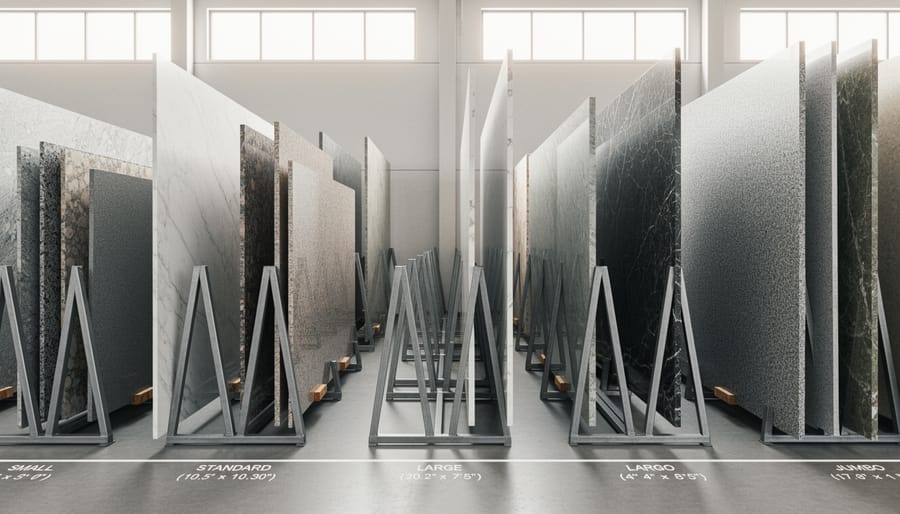
Natural stone comes in three primary slab formats, each with distinct dimensions that directly impact your project. Standard slabs typically measure around 56″ x 120″, while jumbo slabs extend to approximately 63″ x 126″ or larger. Some fabricators also offer remnants and custom-cut pieces from larger blocks. These size differences might seem minor on paper, but they create dramatically different outcomes on your countertop, flooring, or wall application.
A kitchen island that fits seamlessly on one jumbo slab might require two standard slabs with a visible seam running through the center. That seam doesn’t just affect aesthetics. It introduces a potential weak point, requires skilled fabrication to minimize visibility, and adds labor costs to your project budget.
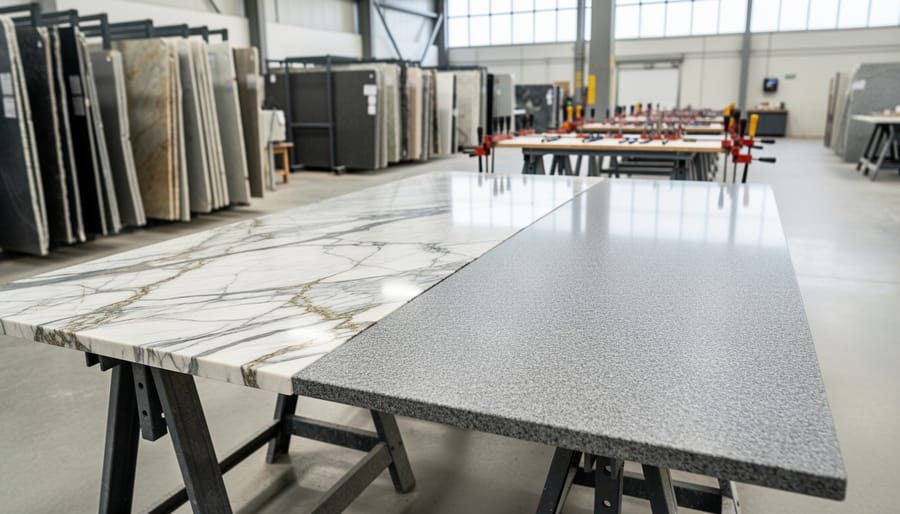
The decision becomes more complex with heavily veined or patterned materials like marble or quartzite. A seam cutting through dramatic veining can disrupt the visual flow you’re trying to achieve. Meanwhile, more uniform stones like certain granites forgive seam placement more readily.
This guide breaks down how different slab types affect your specific application. You’ll learn which format works best for common installations, how to calculate the right size for minimal seaming, and what trade-offs exist between slab types in terms of cost, availability, and final appearance. Whether you’re planning a residential kitchen renovation or specifying materials for a commercial project, understanding these distinctions helps you make decisions that align with both your design vision and practical constraints.
Standard Slab Types in Natural Stone
Standard Slabs
Standard slabs represent the most common format in the natural stone industry, with dimensions typically ranging from 110 to 120 inches in length and 60 to 70 inches in width. These measurements align with industry design manual standards and accommodate the extraction and processing capabilities of most quarries worldwide.
The widespread availability of standard slabs across virtually all stone types makes them the go-to choice for residential applications. Whether you’re selecting marble, granite, quartzite, or limestone, you’ll find the broadest range of colors and patterns in this size format. Fabricators stock standard slabs regularly, which translates to shorter lead times and more predictable project timelines.
For kitchen countertops, standard slabs typically cover most layouts with one or two pieces, depending on the kitchen’s configuration. A 10-foot slab can handle many island installations in a single piece, while perimeter counters may require strategic seaming. Bathroom vanities almost always fit within a single standard slab, eliminating seams entirely.
The pricing structure for standard slabs tends to be more competitive than specialty sizes because of their high production volume and established supply chains. This makes them an economical choice without sacrificing material quality or aesthetic impact in your project.
Jumbo Slabs
Jumbo slabs represent the premium tier of slab types, with dimensions reaching 130 inches by 75 inches or larger. These oversized formats have transformed how designers approach stone installations, particularly in applications where minimizing seams is a priority.
Several major quarries and fabricators now produce jumbo slabs, primarily in quartz and porcelain materials, though some natural stone varieties like quartzite and granite are also available in larger formats. The manufacturing process requires specialized equipment and handling capabilities, which limits production to facilities with advanced technology.
The growing popularity of jumbo slabs in commercial lobbies, hotel feature walls, and luxury residential projects stems from one key advantage: fewer seams. A standard kitchen island that might require two or three conventional slabs can often be fabricated from a single jumbo piece, creating an uninterrupted visual flow that showcases the stone’s natural veining patterns.
Architects and designers increasingly specify jumbo formats for book-matched and quartered installations, where the dramatic symmetry of mirrored slabs creates striking focal points. These applications work best when the full slab dimensions remain visible without interruption.
The trade-off? Jumbo slabs cost more per square foot and require specialized fabrication equipment, transportation logistics, and installation expertise. Not every fabricator can handle these formats, so confirming capabilities early in the planning process prevents complications during project execution.
Book-Matched and Specialty Slabs
For designers pursuing architectural-level installations, specialty slab arrangements transform individual stones into unified artistic statements. Book-matched slabs are cut sequentially from the same block and opened like pages in a book, creating a mirror image across adjacent pieces. This technique produces stunning symmetry, particularly effective in shower surrounds, fireplace surrounds, and feature walls where the veining pattern flows seamlessly across the matched seam.
Quarter-matched sets take this concept further by arranging four slabs in a radial pattern, meeting at a central point. The result is a kaleidoscopic effect that’s become increasingly popular for lobby floors and dramatic backsplashes. You’ll also find vein-matched arrangements, where fabricators carefully select slabs with similar veining characteristics and align them to create continuous pattern flow across multiple pieces.
These specialty arrangements require meticulous planning and significantly more material waste, as only certain slabs from a block will work together. Expect to pay a premium of 30-50% over standard slab pricing for book-matched pairs. The investment often proves worthwhile for high-visibility applications, particularly in luxury residential and commercial projects. Many of these techniques align perfectly with current countertop trends emphasizing bold, statement-making natural stone installations.
Slab Size and Seaming: The Critical Connection
How Slab Dimensions Determine Seam Placement
Understanding how different slab types align with your project dimensions is fundamental to predicting seam locations. Start by measuring your countertop runs in their longest continuous spans. A standard kitchen perimeter layout often includes a 10-foot run along the main wall, a 6-foot perpendicular section, and possibly an island measuring 4 feet by 8 feet.
Compare these measurements against available slab dimensions. If you have a 10-foot countertop run and you’re working with standard slabs (typically 9-10 feet long), you might achieve a seamless installation along that wall. However, the same run would require at least one seam with smaller metric slabs measuring around 8 feet in length.
Islands present unique challenges. A large island measuring 5 feet by 10 feet can often be cut from a single jumbo slab but would need multiple pieces from standard-sized material. The seam placement becomes critical here because island surfaces receive viewing from all angles.
Backsplash areas add another layer of planning. Full-height backsplashes (18-24 inches) consume significant slab width. If your countertop depth is 25 inches and you need a matching backsplash, that’s nearly 4 feet of slab width before cutting waste. This calculation becomes especially important with book-matched installations where you need mirror-image pieces from the same slab.
Professional fabricators typically add 10-15% for cutting waste and edge details. A project requiring 50 square feet of finished countertop might need 55-60 square feet of raw slab material. These calculations directly influence whether you’ll need one large slab or multiple smaller pieces, which determines your final seam count and placement options.

Seam Minimization Strategies
Experienced fabricators employ several proven techniques to minimize seam visibility across different slab types. The primary strategy involves careful layout planning before any cutting begins. Fabricators create detailed templates of the countertop area and then arrange the slabs to position seams where they’ll be least noticeable or most structurally logical.
One effective approach places seams behind cooktops or sinks, where the appliance naturally breaks up the visual line. For L-shaped countertops, positioning the seam at the corner rather than mid-span creates a more natural transition. Many professionals also align seams with cabinet separations, making them appear as intentional design breaks rather than fabrication necessities.
Kitchen islands present an ideal opportunity for seam minimization. Because islands are often the focal point of the space, fabricators prioritize using full slabs here whenever possible. A jumbo slab can cover most standard islands in one piece, eliminating seams entirely on this high-visibility surface. When budgets allow, saving the largest, most uniform slabs for islands produces the cleanest results.
Strategic slab selection also plays a role. Fabricators examine the veining pattern and color variation across available slabs to find pieces that will create book-matched or flowing transitions at seams. Some stone varieties with busy, multi-directional patterns naturally camouflage seams better than materials with strong linear veining, where misalignment becomes immediately apparent.
The direction of slab placement matters too. Running the primary dimension of the slab parallel to the longest countertop run reduces the number of seams required. This planning stage, though time-intensive, separates quality installations from rushed ones.
Comparing Slab Types: Size, Seaming, and Selection Criteria
Standard Slabs: When Smaller Works Better
Standard slabs, typically measuring 105 by 55 inches, remain the industry workhorse for good reason. They’re perfectly suited for bathroom vanities, smaller kitchen installations, and budget-conscious projects where functionality meets financial reality.
For bathrooms, standard slabs shine. A typical 60-inch vanity fits comfortably within these dimensions, often requiring no seams at all. This seamless approach creates a cleaner aesthetic and reduces fabrication complexity. The same logic applies to powder rooms, laundry spaces, and compact kitchens where total linear footage stays under 10 feet.
Even in larger kitchens, standard slabs can work surprisingly well if you adjust your expectations. Yes, you’ll have seams. The question becomes whether strategic seam placement matters more to you than the cost savings. A skilled fabricator can position seams at sink cutouts or along natural break points, minimizing visual impact.
The layout flexibility with standard slabs deserves mention too. Because they’re industry standard, fabricators stock them widely and work with them daily. This familiarity translates to competitive pricing and shorter lead times. You’ll also find broader material selection, since many exotic and rare stones are only available in standard dimensions.
For projects where seams won’t dominate sightlines or where budget constraints guide decisions, standard slab types deliver excellent value without compromise.
Jumbo Slabs: Minimizing Seams in Large Spaces
Jumbo slabs represent a significant innovation in natural stone fabrication, with dimensions reaching up to 130 inches by 78 inches compared to standard slabs at 110 inches by 65 inches. These oversized pieces dramatically reduce or eliminate seams in applications where traditional slabs would require multiple pieces.
For large kitchen islands exceeding 100 inches, a jumbo slab can provide a continuous surface without interruption. The aesthetic advantage is substantial. Waterfall edges on islands benefit particularly from seamless construction, as the grain flows uninterrupted from horizontal to vertical surfaces. Commercial applications like hotel reception desks, restaurant bars, and conference room tables achieve a more refined, high-end appearance with fewer visible seams.
The cost considerations require careful evaluation. Jumbo slabs typically command 15-30% price premiums over standard sizes. However, reducing seam count decreases fabrication labor by 2-4 hours per eliminated seam, partially offsetting the material cost. Transportation and handling require specialized equipment and insurance, adding another layer of expense.
The financial equation tips favorably for projects where seam visibility would compromise design intent or where material characteristics make matching problematic. Dramatic veining patterns, bookmatched designs, and highly figured stones justify the premium. For simpler patterns or budget-conscious projects, standard slabs with strategically placed seams often deliver comparable results at lower total investment.
Specialty Slabs: Design-Driven Selection
Sometimes the decision to choose a particular slab type has nothing to do with practicality and everything to do with visual impact. Book-matched and four-way matched slabs create mirror-image patterns that transform stone from a building material into architectural art. These specialty arrangements require selecting consecutive slabs from the same block and orienting them to create symmetrical designs.
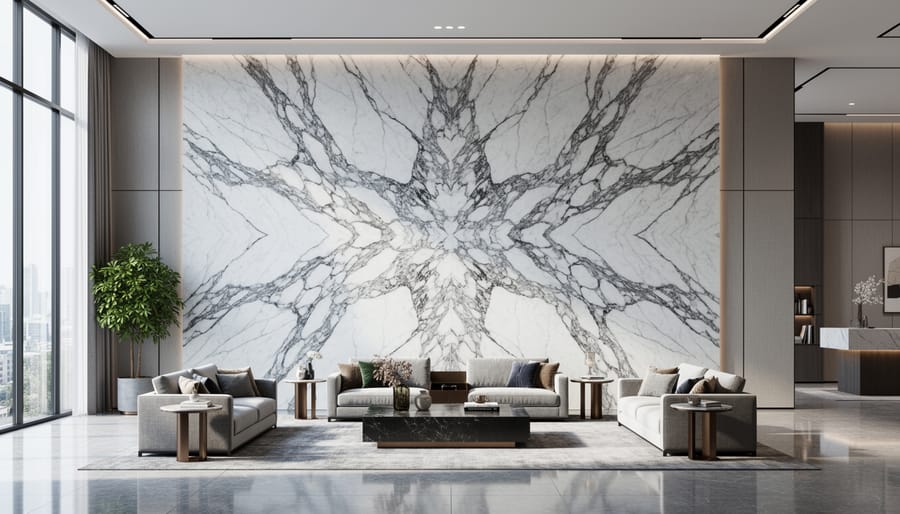
The most dramatic applications appear in feature walls, fireplace surrounds, and kitchen islands where the stone becomes the room’s focal point. A book-matched Calacatta wall in a luxury hotel lobby, for instance, creates a butterfly effect with veining that draws the eye upward and makes a 12-foot installation feel monumental. Four-way matching works particularly well for square or rectangular islands, where the pattern radiates from a center point.
These approaches typically require larger format slabs to minimize seams within the matched pattern. You’ll also need to purchase multiple slabs from the same bundle, which limits your ability to cherry-pick individual pieces. The additional material cost and specialized fabrication make this route 30-50% more expensive than standard installations.
The investment makes sense when the stone itself is the design statement. A single dramatic stone wall can anchor an entire interior design concept, eliminating the need for additional art or decorative elements. Consider this approach for spaces where first impressions matter and where the architectural budget allows for standout features rather than uniform finishes throughout.
Real-World Application: Slab Selection for Common Projects
Standard Kitchen Layouts (10-12 Linear Feet)
A typical 10-12 linear foot kitchen represents the most common residential layout, making it an ideal scenario to understand how different slab types impact your project. This configuration usually includes an L-shaped counter with one longer run (around 8 feet) and a shorter perpendicular section (3-4 feet).
With standard slabs measuring approximately 120 inches by 56 inches, you’ll typically need at least one seam in this layout. The challenge lies in minimizing visibility. A standard slab can cover your longer run completely if positioned lengthwise, but the perpendicular section requires a second piece, creating a seam at the corner junction.
Jumbo slabs change the equation significantly. At 130 inches by 75 inches, these larger formats can often accommodate both runs from a single slab, eliminating seams entirely. If you’ve selected a highly veined material like Calacatta marble or dramatic quartzite, this seamless approach maintains pattern continuity and enhances the stone’s natural movement.
Cost differences matter here. While jumbo slabs carry a 20-30% premium per square foot, you’re purchasing less total material and reducing fabrication complexity. For a 40-square-foot kitchen, two standard slabs might cost $3,200 versus one jumbo at $2,600, making the seamless option both aesthetically superior and more economical.
Your stone’s pattern intensity should guide this decision. Subtle materials like Absolute Black granite work fine with standard slabs and visible seams, while statement stones demand the uninterrupted canvas that jumbo formats provide.
Large Islands and Waterfall Edges
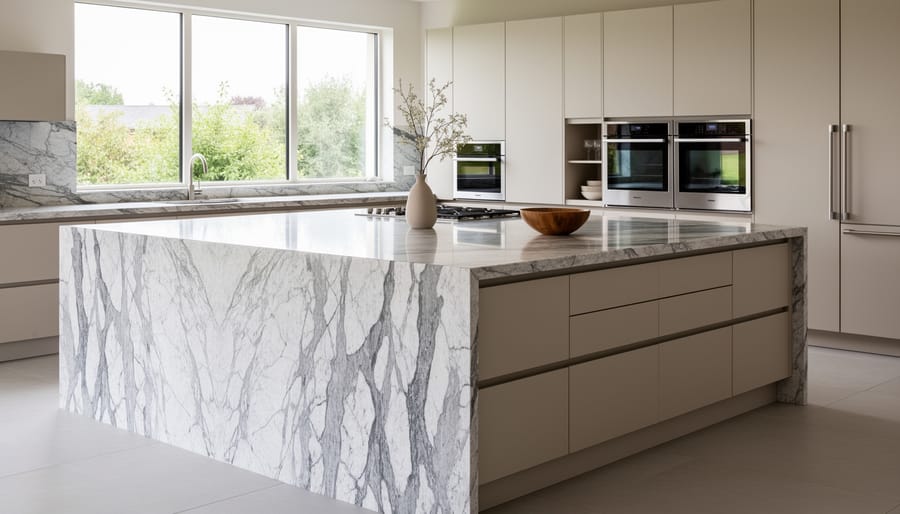
Large kitchen islands with waterfall edges present one of the most challenging applications for standard slab sizes. The waterfall design requires stone to flow continuously from the horizontal countertop surface down the vertical side, creating a striking visual effect. However, this effect only works when executed without visible seams.
Consider a typical kitchen island measuring 96 inches long with an 18-inch waterfall edge on one or both ends. Standard slabs measuring 110 to 120 inches won’t accommodate this layout without introducing seams on the horizontal surface or, worse, across the waterfall itself. A visible seam running down a waterfall edge destroys the entire design concept.
Jumbo slabs measuring 130 inches or longer eliminate this problem entirely. The extended length allows fabricators to cut both the horizontal surface and waterfall edge from a single piece, maintaining uninterrupted veining patterns throughout. This becomes even more critical with dramatic stone patterns like bookmatched marble or quartzite with bold movement.
The visual comparison is striking. Islands fabricated from standard slabs typically show one or more seams near the waterfall transition, breaking the flow of the stone. Jumbo slab installations showcase continuous patterns that appear to cascade naturally from top to bottom. For high-end residential projects and showpiece commercial installations, this seam-free execution justifies the additional material cost. The result looks intentional rather than compromised by material limitations.
Commercial Installations and Feature Walls
Commercial spaces demand visual impact, and slab type selection plays a decisive role in achieving memorable interiors. Large-format slabs have revolutionized feature wall installations in hotel lobbies and corporate reception areas, where uninterrupted veining patterns create dramatic focal points impossible with standard slabs. The Ritz-Carlton properties frequently showcase book-matched jumbo slabs in their elevator banks, allowing the natural stone to flow seamlessly across expansive vertical surfaces.
Retail environments benefit differently from slab type choices. High-end boutiques often select quarter slabs for display counters and cash wraps, balancing visual interest with budget constraints while maintaining the luxury aesthetic customers expect. Corporate boardroom tables present another scenario where slab selection proves critical. Full slabs minimize seams on conference surfaces, projecting the refinement and attention to detail that defines executive spaces.
Restaurant and bar installations demonstrate how slab types influence both form and function. Waterfall islands using stunning countertop designs require jumbo slabs to achieve continuous veining from horizontal to vertical planes. Standard slabs would introduce visible seams that compromise the flowing aesthetic central to this popular design approach. The choice between slab types ultimately determines whether commercial installations achieve their intended architectural statement or fall short due to unavoidable interruptions in the stone’s natural beauty.
Cost Implications of Different Slab Types
Understanding the financial impact of different slab types helps you budget appropriately and make informed decisions for your project. Material costs vary significantly based on slab dimensions, with standard slabs typically representing the baseline price point for any given stone variety. Jumbo slabs command premium pricing, often 20-40% higher than their standard counterparts due to quarrying difficulties, specialized equipment requirements, and increased transportation costs.
The initial material expense represents just one component of total countertop costs. Fabrication complexity adds another layer of financial consideration. Standard slabs integrate easily into most workshop workflows, while jumbo slabs demand specialized machinery, larger work surfaces, and sometimes additional manpower. These requirements translate to higher fabrication fees, typically adding 15-25% to your invoice compared to standard slab processing.
Installation presents another cost differential. Standard slabs can usually be managed by a two-person crew with conventional equipment. Jumbo slabs require specialized lifting equipment, additional installers, and sometimes crane services for upper-floor installations. Budget an extra $500-1,500 for jumbo slab installation in residential projects, with commercial applications potentially doubling these figures.
- Jumbo slabs eliminate seams in most residential kitchens, creating a premium appearance
- Fewer seams reduce long-term maintenance and potential failure points
- Single-slab installations can be completed faster, reducing labor hours
- Higher resale value due to seamless aesthetic in luxury markets
- Initial material costs run 20-40% higher than standard slabs
- Fabrication and installation premiums add 15-35% to total project costs
- Limited fabricator availability in some markets increases complexity
- Greater financial risk if damage occurs during handling or installation
Long-term value considerations shift the equation beyond upfront expenses. Seamless installations minimize grout lines and joints where moisture infiltration occurs, potentially reducing maintenance costs over decades. In high-end residential and commercial applications, the visual impact of continuous stone surfaces can justify premium pricing. However, standard slabs offer excellent value for budget-conscious projects, smaller spaces, or applications where seams can be strategically placed in low-visibility areas. Your specific project scope, aesthetic priorities, and budget constraints should guide your selection between these slab types.
Making Your Selection: A Practical Framework
Selecting the right slab type for your natural stone project requires a systematic approach that balances multiple factors. Here’s how to make an informed decision.
Start by measuring your space carefully. For kitchen islands, bathroom vanities, or smaller applications under 10 feet in length, standard slabs typically provide adequate coverage. Larger kitchens with extended runs, commercial installations, or spaces where visual continuity matters most benefit from jumbo slabs. Document exact dimensions, including any unusual angles or cutouts that might influence seam placement.
Next, assess your seam tolerance honestly. Walk through showrooms and examine installed projects with both seamless and seamed surfaces. Some clients find book-matched seams at a kitchen island visually appealing, while others view any seam as a compromise. Your personal preference here directly impacts which slab size you need. If you can’t accept visible seams in primary viewing areas, jumbo slabs become necessary rather than optional.
Budget considerations require transparency with your fabricator. Request itemized quotes comparing standard versus jumbo slabs for your specific project. A jumbo slab might cost 30-40% more in material, but if it eliminates challenging seam placement or reduces installation complexity, the premium can prove worthwhile. Factor in the longevity of your installation too. Residential projects you’ll live with for 20 years justify different investments than rental properties or flip projects.
Material selection influences slab size availability. Some exotic stones only arrive in standard dimensions, while popular granites and quartzites come in jumbo sizes. If you’ve fallen for a specific stone available only in standard slabs, you’ll need to plan seam locations strategically rather than pursuing seamless installation.
Create a decision matrix. List your priorities: budget constraints, size requirements, seam visibility concerns, and material preferences. Rank them honestly. A client prioritizing a rare marble over seam elimination might choose standard slabs of their dream stone. Another prioritizing clean sightlines in an open-concept kitchen might select jumbo slabs in a more readily available material.
Work collaboratively with experienced fabricators early in your selection process. They can template your space, suggest optimal seam locations if needed, and show you how different slab types perform in installations similar to yours. This partnership prevents costly mismatches between expectations and reality.
Understanding the relationship between different slab types and seam placement transforms the stone selection process from overwhelming to strategic. The size variations between standard and jumbo slabs directly determine where seams appear in your finished installation, affecting both visual flow and long-term satisfaction with your project.
Selecting the right slab format requires honest assessment of your priorities. If minimizing seams tops your list and budget allows, jumbo slabs offer clear advantages for large islands and expansive countertops. For smaller applications or projects where budget constraints matter more, standard slabs deliver exceptional beauty without unnecessary expense. The key lies in matching slab dimensions to your specific layout rather than defaulting to the largest option available.
Before committing to any slab type, request detailed layout drawings from your fabricator. These mockups reveal exactly where seams will fall based on the dimensions of your chosen material. A skilled fabricator can show you multiple scenarios, comparing how a standard slab layout differs from a jumbo option for your particular space. This visual comparison often clarifies whether the additional cost of larger slabs justifies the seaming benefits for your project.
The most successful stone installations result from collaboration between informed clients and experienced professionals. Ask questions about slab dimensions. Review proposed seam locations critically. Consider how your choice of slab type aligns with your countertop design, traffic patterns, and aesthetic vision. These conversations early in the selection process prevent disappointment and ensure your investment delivers the results you envision.