
CNC machining has transformed stone fabrication from a labor-intensive craft into a precision manufacturing process capable of executing designs that would be impossible by hand. Computer Numerical Control technology guides cutting tools along programmed paths with microscopic accuracy, carving intricate patterns, three-dimensional reliefs, and complex architectural elements from marble, granite, limestone, and other natural stone materials. This modern technology revolutionizing stone production enables fabricators to produce everything from kitchen countertops with perfectly beveled edges to ornate building facades with repeatable precision.
The technology operates through specialized software that converts digital designs into machine instructions, controlling multiple axes of movement simultaneously. Five-axis CNC machines can rotate and tilt the cutting head while moving in three dimensions, accessing virtually any surface angle on a stone slab. This capability opens possibilities for waterjet cutting that produces zero heat damage, diamond tooling that achieves mirror-polished finishes, and robotic arms that sculpt full-scale statuary.
Whether you’re an architect specifying custom stone elements for a project, a designer exploring fabrication possibilities, or a fabricator evaluating equipment investments, understanding CNC capabilities directly impacts what you can achieve with natural stone. The technology bridges the gap between digital creativity and physical reality, making previously cost-prohibitive custom work economically viable while maintaining the timeless appeal of natural stone materials.
What CNC Technology Means for Stone Work
From Computer to Carved Stone: The Basic Process
The journey from digital design to finished stone piece involves several interconnected steps that showcase the precision of modern stone manufacturing. Understanding this process helps designers and consumers appreciate the capabilities and limitations of CNC technology.
The process begins with CAD (Computer-Aided Design) software, where designers create detailed 3D models or 2D drawings of the desired stone piece. This digital file contains exact measurements, curves, and specifications that define every aspect of the final product. Popular CAD programs used in stone fabrication include AutoCAD, SolidWorks, and specialized stone industry software.
Once the design is complete, CAM (Computer-Aided Manufacturing) software converts the CAD file into machine-readable instructions called G-code. This translation step is critical because it determines the tool paths, cutting depths, and speeds the CNC machine will follow. The CAM software accounts for factors like stone hardness, tool diameter, and desired surface finish.
The prepared file is then loaded into the CNC machine’s control system. Operators secure the stone slab onto the machine bed using clamps or vacuum systems, ensuring it remains stable during cutting. They also install appropriate cutting tools—diamond-tipped bits, saw blades, or grinding wheels—based on the job requirements.
When activated, the CNC machine follows the programmed instructions with remarkable precision. Multiple axes of movement allow the cutting head to approach the stone from various angles, creating complex three-dimensional shapes, intricate relief patterns, or simple edge profiles. Water continuously flows over the cutting area to cool the tools and minimize dust.
Why Stone Requires Specialized CNC Equipment
Natural stone presents unique challenges that standard CNC equipment simply cannot handle effectively. Understanding these challenges explains why specialized machinery is essential for quality stone fabrication.
The primary factor is hardness. Granite, for instance, ranks 6-7 on the Mohs hardness scale, making it significantly harder than most woods and metals typically machined with conventional CNC equipment. This extreme hardness requires industrial-grade spindles capable of generating substantial torque, specialized diamond-tipped cutting tools, and robust machine frames that can withstand the considerable forces involved without deflection or vibration.
Brittleness adds another layer of complexity. Unlike metals that deform under stress, stone fractures. This means cutting parameters must be precisely calibrated to prevent chipping, cracking, or catastrophic breakage. Stone CNC machines incorporate advanced control systems that regulate feed rates, spindle speeds, and cutting depths with exceptional accuracy to manage these material characteristics.
Natural stone’s inherent variability further complicates machining. No two slabs are identical—even within the same quarry batch. Variations in mineral composition, veining patterns, and internal fissures require operators to adjust cutting strategies for each piece. This demands programming flexibility and often necessitates pre-scanning technology to map the stone’s structure before machining begins.
Water delivery systems are also critical, as continuous cooling prevents thermal stress and manages the substantial dust generated during cutting. Standard CNC machines lack these water-management capabilities, making them unsuitable for stone fabrication.
Types of CNC Machines Used in Stone Fabrication

CNC Bridge Saws: The Workhorse of Stone Cutting
Bridge saws represent the backbone of stone fabrication shops, handling the heavy-duty cutting tasks that transform raw slabs into usable pieces. These CNC-controlled machines feature a large cutting table with a movable bridge that spans across it, supporting a powerful diamond blade capable of slicing through granite, marble, quartzite, and other natural stones with precision.
The primary function of CNC bridge saws is making straight cuts for slab sizing and breakdown. When a large stone slab arrives at a fabrication shop, the bridge saw performs the initial cuts to create blanks for countertops, backsplashes, and other components. Modern CNC systems allow operators to input exact dimensions and cutting patterns, ensuring consistent results and minimizing material waste.
Mitering capabilities set advanced bridge saws apart from basic models. The cutting head can tilt to create precise angled cuts, essential for creating seamless corner joints in countertop installations. A perfectly mitered edge creates the appearance of a continuous stone surface wrapping around corners, a hallmark of professional fabrication.
In countertop production, bridge saws excel at cutting kitchen islands, bathroom vanities, and commercial surfaces to exact specifications. The CNC programming ensures that multiple pieces from the same project maintain consistent dimensions, critical for proper installation. For tile fabrication, bridge saws can efficiently cut large format tiles and create custom sizes from full slabs, meeting specific design requirements while maintaining clean, chip-free edges.
CNC Routers and Machining Centers
CNC routers and machining centers represent the most versatile category of stone fabrication equipment, capable of transforming flat slabs into intricate architectural elements and decorative masterpieces. These multi-axis machines have revolutionized what’s possible in custom stonework, making complex designs accessible for both residential and commercial applications.
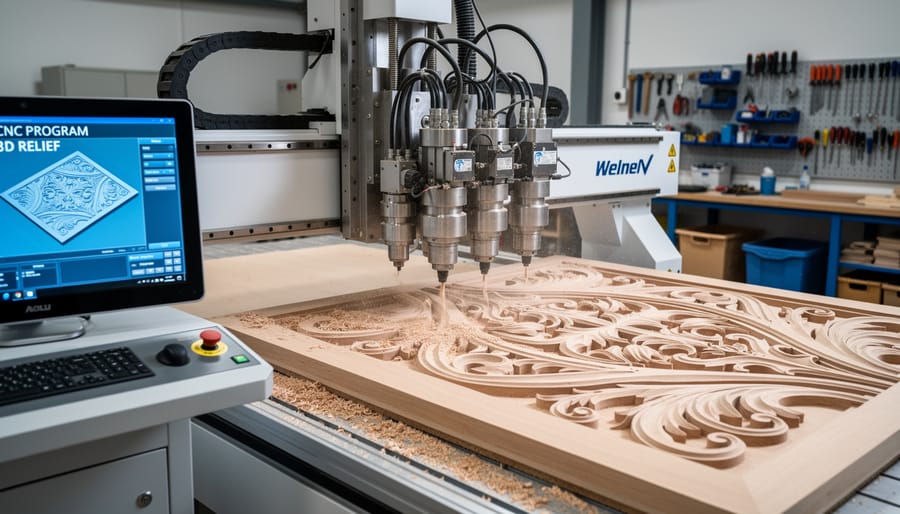
Modern CNC routers typically feature three to five axes of movement, with each additional axis expanding creative possibilities. A standard three-axis router handles basic cutting and routing operations, moving along X, Y, and Z planes. Four and five-axis machines add rotational capabilities, allowing the cutting head to approach stone from multiple angles without repositioning the material. This advanced mobility enables sophisticated edge profiles, seamless three-dimensional sculpting, and precision work that would be extremely time-consuming or impossible by hand.
Edge profiling stands among the most common applications for CNC routers in stone fabrication. These machines can execute dozens of standard edge profiles from simple bevels and bullnoses to elaborate ogee and waterfall edges with perfect consistency across multiple pieces. Custom edge designs that match historical architecture or unique aesthetic visions can be programmed and reproduced exactly, ensuring continuity across large installations.
Decorative carving capabilities have opened new markets for stone applications in residential and hospitality design. CNC routers excel at creating relief carvings, textured wall panels, and ornamental details that add visual interest to otherwise plain surfaces. From classical motifs in marble fireplace surrounds to contemporary geometric patterns in limestone feature walls, these machines deliver crisp details with production efficiency that makes custom stonework more affordable.
Three-dimensional sculpting pushes CNC technology into artistic territory, producing curved surfaces, columns, spheres, and freeform shapes. Five-axis machining centers can rough out complex sculptures and architectural elements, significantly reducing the manual labor required while maintaining the design integrity envisioned by artists and architects.
Intricate inlays represent another specialty where CNC routers demonstrate exceptional precision. By cutting perfectly matched recesses and corresponding pieces from contrasting stone types, fabricators create medallions, borders, and decorative accents with tight tolerances measured in fractions of a millimeter. This capability has revived traditional stone inlay techniques with improved accuracy and expanded design possibilities.
Waterjet Cutting Systems
Waterjet cutting represents one of the most versatile CNC technologies for stone fabrication, using high-pressure water mixed with abrasive particles to cut through material with exceptional precision. Unlike saw-based systems, waterjet cutters operate as a cold-cutting process, meaning they generate no heat during operation. This characteristic makes them ideal for delicate materials that might crack under thermal stress or for projects where heat-induced discoloration could compromise the stone’s appearance.
The technology excels at producing intricate patterns and complex geometries that would be challenging or impossible with traditional cutting methods. Waterjet systems can execute tight radiuses, sharp internal corners, and elaborate decorative elements without chipping edges or creating micro-fractures. The cutting stream typically measures between 0.020 to 0.050 inches in diameter, allowing for remarkably detailed work while minimizing material waste.
Common applications for waterjet cutting in stone fabrication include decorative floor medallions, where multiple stone types are precisely cut and assembled into intricate patterns. Custom inlays for tabletops, fireplace surrounds, and wall features benefit from the technology’s ability to create perfectly fitted components. Waterjet systems are particularly valuable for working with exotic materials like semi-precious stones, shell, or thin stone veneers that require gentle handling. The absence of tool wear also ensures consistent cut quality throughout production runs, making waterjets ideal for projects demanding multiple identical pieces or complex matching elements.
Wire Saws and Specialized Equipment
For quarrying operations and large-scale stone cutting projects, wire saws represent specialized CNC technology that dramatically extends beyond typical bridge saw capabilities. These systems use diamond-embedded wires pulled through stone blocks at high speeds, allowing fabricators to make cuts measuring several meters in length. Wire saws excel at extracting massive stone sections from quarries and cutting thick slabs that would be impossible with conventional blades.
The technology has evolved to include CNC control systems that precisely guide cutting paths through complex three-dimensional shapes. This makes wire saws invaluable for architectural projects requiring curved sections or unusual geometric forms in materials like marble and granite.
Emerging robotic arm technology is pushing stone fabrication into new territory. Six-axis robotic systems equipped with specialized cutting and finishing tools can navigate complex three-dimensional surfaces with precision previously unattainable. These robots excel at sculptural work, intricate relief carving, and organic forms that challenge traditional CNC equipment. While currently more common in high-end fabrication shops and artistic applications, robotic stone cutting systems are becoming increasingly accessible as the technology matures and costs decrease.
Real-World Applications: What CNC Makes Possible
Kitchen and Bathroom Countertops
CNC technology has revolutionized kitchen and bathroom countertop fabrication, delivering precision that was impossible to achieve with traditional hand-cutting methods. The most visible benefit appears in sink and cooktop cutouts, where CNC machines create perfectly sized openings with tolerances within 0.1mm. This level of accuracy ensures that undermount sinks fit seamlessly without gaps, while cooktops drop into place without the shimming and adjusting that once consumed installation time. Faucet holes align precisely with plumbing fixtures, eliminating the frustration of misaligned components.
Beyond functional cutouts, CNC excels at creating sophisticated edge profiles and architectural features. Waterfall countertops, where stone cascades vertically from the counter surface to the floor, require perfectly mitered corners that meet at exact 45-degree angles. CNC machines cut these joints with such precision that the stone’s veining appears to flow continuously around the corner, creating a visually stunning effect. Similarly, mitered edges on countertop perimeters achieve tight, nearly invisible seams that enhance the stone’s natural beauty.
The precision-fit approach dramatically reduces installation time and eliminates costly field adjustments. Fabricators can confidently pre-cut every opening and profile in their shop, knowing pieces will fit correctly on-site. This predictability benefits homeowners through faster installations and fewer opportunities for installation errors that could damage expensive stone slabs.

Architectural Elements and Cladding
CNC technology has revolutionized how architectural elements are produced for commercial buildings, hotels, museums, and public spaces. When projects require dozens or hundreds of identical columns, balustrades, or façade panels, CNC machining ensures every piece matches perfectly, eliminating the inconsistencies inherent in hand-carving.
For large-scale projects, this consistency is invaluable. A hotel lobby needing twenty fluted columns can have each one machined to identical specifications, with the same depth of fluting, spacing, and proportions. Façade panels with repeating geometric patterns maintain perfect alignment across entire building exteriors, creating the seamless appearance architects envision.
CNC systems excel at producing intricate balustrades and railings where safety standards demand precise dimensions. Each baluster can feature decorative profiles while meeting exact spacing requirements for building codes. The technology also enables complex undercuts and three-dimensional reliefs that would be prohibitively expensive to hand-carve across multiple pieces.
Beyond replication, CNC allows architects to explore natural stone innovations in façade design. Parametric patterns, where each panel varies slightly within programmed parameters, create dynamic surfaces while maintaining structural consistency. This capability has opened new possibilities for contemporary architecture, allowing stone to compete with modern materials in achieving bold, distinctive designs that define landmark buildings.
Decorative and Artistic Work
CNC technology has revolutionized stone as an artistic medium, transforming what was once weeks of painstaking hand carving into precisely executed digital artistry. Multi-axis CNC machines, particularly 4-axis and 5-axis systems, can produce three-dimensional reliefs and sculptures with extraordinary detail that would be nearly impossible to achieve consistently by hand.
Custom signage represents one of the most popular decorative applications. CNC routers can carve company logos, address numbers, and decorative text into granite, marble, or limestone with perfect dimensional accuracy and repeatability. The technology excels at creating subtle depth variations, allowing designers to achieve sophisticated shadow effects and visual hierarchy within a single piece.
Memorial stones and monuments have particularly benefited from CNC precision. Fabricators can now incorporate photorealistic portraits, intricate religious symbols, and personalized imagery into headstones and memorial plaques. The technology ensures consistency across multiple pieces while maintaining the dignity and craftsmanship these applications demand.
Floor medallions showcase the full potential of multi-axis machining, combining multiple stone types in complex geometric or organic patterns. These centerpiece installations can incorporate raised relief elements, inlaid contrasting materials, and precise radius cuts that would take traditional artisans months to complete.
Architectural sculptures and decorative panels now push creative boundaries that were previously constrained by hand-carving limitations. Designers can specify organic flowing forms, interconnected lattice patterns, and naturalistic textures knowing that CNC technology can faithfully reproduce their digital vision in permanent stone.

Restoration and Historical Reproduction
CNC technology has become invaluable for preserving architectural heritage by enabling precise reproduction of damaged or deteriorated stone elements. When historic buildings require restoration, CNC machines can scan existing ornamental details, capitals, moldings, or decorative features and reproduce them with accuracy that would be extremely difficult to achieve through traditional hand-carving alone. This capability is particularly important for matching intricate patterns, maintaining dimensional consistency across multiple replacement pieces, and ensuring new elements integrate seamlessly with original stonework. Museums and restoration specialists increasingly rely on CNC fabrication to create faithful reproductions that honor the craftsmanship of original artisans while meeting modern structural requirements and timelines.
The Advantages of CNC Stone Fabrication
Precision and Repeatability
One of CNC stone fabrication’s most significant advantages is its exceptional precision and repeatability. Modern CNC machines can consistently achieve tolerances within 0.1 to 0.5 millimeters, a level of accuracy virtually impossible to replicate with traditional hand-fabrication methods. This precision proves crucial for projects requiring seamless stone joints, intricate inlays, or components that must interface perfectly with other materials like metal or glass.
For architects and designers, this accuracy translates directly into better fit and finish. Stone countertops mate seamlessly with cabinetry, decorative wall panels align without visible gaps, and multi-piece installations come together as intended. The precision is particularly valuable in restoration projects where new stone elements must match historical dimensions exactly.
Perhaps equally important is CNC’s ability to reproduce identical pieces with complete consistency. Whether producing two matching fireplace surrounds or two hundred balustrade components, each piece emerges from the machine with identical dimensions and surface characteristics. This repeatability eliminates the variation inherent in handwork, ensuring uniform appearance across large installations and enabling cost-effective replacement of damaged components years after the original fabrication.
Material Efficiency and Waste Reduction
Modern CNC stone fabrication represents a significant advancement in resource efficiency. Traditional stone cutting methods typically generate 20-30% material waste, but CNC systems equipped with sophisticated nesting software reduce this dramatically to 5-10% or less. The software analyzes each slab’s dimensions and characteristics, then calculates the most efficient arrangement of cuts to maximize usable pieces from every stone block.
This precision translates directly to cost savings for both fabricators and clients. When a kitchen countertop project wastes less material, the savings pass through the supply chain. Additionally, minimizing waste means fewer quarrying demands and reduced transportation of unused stone to landfills, making CNC technology an integral part of sustainable stone technology.
The environmental benefits extend beyond waste reduction. CNC machines use water recycling systems that filter and reuse cutting fluids, while dust collection systems capture stone particles for potential reuse in composite materials or landscaping applications. This closed-loop approach significantly reduces the ecological footprint of stone fabrication compared to traditional methods, making CNC an increasingly important tool for environmentally conscious design projects.
Design Complexity Without Constraints
CNC technology has fundamentally transformed what’s achievable in stone fabrication by removing the physical and economic barriers that once limited design possibilities. Traditional hand-cutting methods restricted stonework to straight lines, simple curves, and basic geometric patterns due to the immense labor required for complex shapes. CNC machines eliminate these constraints entirely, executing elaborate three-dimensional forms, organic curves, and microscopic detail with consistent precision.
The technology excels at producing intricate inlays, relief carvings, and decorative patterns that would have taken master craftsmen weeks or months to complete manually. Flowing arabesque designs, nested geometric patterns, and botanical motifs can now be reproduced flawlessly across multiple pieces. Three-dimensional sculptures and architectural elements like ornate columns, custom corbels, and decorative panels become economically viable for projects beyond luxury estates and public monuments.
Perhaps most significantly, CNC enables designers to explore forms previously considered impossible in stone. Parametric designs with variable patterns, interlocking components with precise tolerances, and complex surface textures are now routine fabrication tasks. This capability opens stone applications to contemporary architecture and modern design aesthetics while preserving the material’s timeless appeal. What once required extraordinary budgets and rare artisan skills is now accessible to a broader range of projects, democratizing sophisticated stonework without compromising quality or detail.
Faster Production and Project Turnaround
CNC technology dramatically accelerates stone fabrication timelines while maintaining exceptional precision and quality. What might take days or weeks using traditional hand tools can often be completed in hours with CNC equipment. For intricate designs featuring detailed relief work, inlays, or complex edge profiles, the time savings become even more pronounced. A skilled artisan might spend several days hand-carving decorative elements that a CNC machine can replicate perfectly in a fraction of the time.
This efficiency proves particularly valuable for projects requiring multiple identical pieces, such as balusters, columns, or repeating architectural elements. Once programmed, CNC machines produce consistent results piece after piece without fatigue or variation. Commercial projects with tight deadlines benefit significantly from this capability, allowing fabricators to meet demanding schedules without compromising craftsmanship.
It’s important to understand that faster production doesn’t mean reduced quality. CNC machines execute cuts with micron-level accuracy that equals or exceeds the precision of manual work. The technology eliminates human error in measurements and repetitive tasks while allowing artisans to focus their expertise on design, finishing touches, and quality control. This combination of speed and precision makes modern stone fabrication both efficient and exceptional.
What to Consider When Working With CNC-Fabricated Stone
Choosing a Fabricator With CNC Capabilities
Selecting the right fabricator requires careful evaluation of both their equipment and expertise. Start by asking about the specific CNC machinery they operate. A well-equipped shop should have bridge saws with CNC capabilities for precision cutting, waterjet systems for intricate patterns, and CNC routers for edge profiling and three-dimensional work. The age and maintenance history of their equipment matters significantly, as newer machines with regular calibration deliver more consistent results.
Request to see examples of completed projects similar to yours in complexity and material type. A fabricator experienced with marble may approach granite or quartzite differently due to varying hardness levels. Ask about their familiarity with your specific stone selection, as different materials present unique challenges during CNC processing.
Inquire about their design capabilities and software proficiency. The best fabricators can work from architectural drawings, convert hand sketches into CAD files, or optimize your existing digital designs for fabrication. Understanding their file format requirements and design-to-production workflow prevents costly miscommunications.
Quality control procedures reveal a shop’s professionalism. Ask how they verify dimensions, test-fit components, and handle imperfections in the stone. Reputable fabricators should provide detailed quotes, realistic timelines, and clear communication about potential material limitations.
Finally, discuss their experience with installation coordination. CNC precision during fabrication means little if installation lacks equal care, so ensure they work with skilled installers who understand their digitally-fabricated components.
Design Files and Technical Requirements
Successful CNC stone projects begin with proper design files and clear communication with your fabricator. Most CNC machines for stone accept standard CAD file formats, with DXF (Drawing Exchange Format) and DWG (AutoCAD Drawing) files being the industry standard. These vector-based formats preserve precise measurements and can be directly translated into machine toolpaths. Some advanced systems also work with 3D formats like STL or STEP files, particularly for sculptural or three-dimensional work.
When preparing designs, collaborate early with your fabricator to optimize for CNC production. They can advise on appropriate tolerances, material thickness requirements, and which design elements will translate best to stone. For instance, extremely fine details under 3mm may not be achievable depending on tool size and stone characteristics, while relief depths should typically range between 5-20mm for optimal visual impact without compromising structural integrity.
Understanding realistic expectations prevents disappointment. While CNC technology enables remarkable precision, natural stone’s inherent characteristics like veining, mineral deposits, and hardness variations affect final results. Complex undercuts, extremely sharp internal corners, and very thin projecting elements may require design modifications. Professional fabricators will review your files and suggest adjustments that maintain design intent while ensuring successful production. This collaborative approach, combining your creative vision with their technical expertise, produces the best outcomes for CNC stone projects.
The Future of Stone Automation and Robotics
The stone fabrication industry stands at an inflection point where several technologies are converging to reshape how shops operate. While fully automated factories remain years away for most fabricators, several developments are already making measurable impacts on efficiency and capability.
AI-assisted programming represents one of the most immediate advances. Modern software can now analyze digital stone slabs, identify natural features like veining or fissures, and automatically generate optimal cutting paths that maximize yield while minimizing waste. These systems learn from thousands of previous projects, suggesting nesting patterns that human programmers might overlook. Some platforms can recognize stone types from photos and recommend appropriate tooling and feed rates, reducing setup time and programming errors.
Robotic handling systems are addressing one of stone fabrication’s persistent challenges: the physical demands of moving heavy slabs. Collaborative robots now work alongside human operators, handling loading and unloading tasks while fabricators focus on quality control and finishing work. These systems integrate directly with CNC machines, creating semi-automated workflows that improve both safety and throughput without requiring complete facility redesigns.
Building Information Modeling (BIM) integration is transforming how architects and fabricators collaborate. Stone elements can now flow directly from architectural models to CNC machines with minimal manual intervention. This digital thread reduces errors, accelerates project timelines, and enables more complex geometric designs. When combined with 3D stone fabrication techniques, these integrated workflows open new creative possibilities for designers while maintaining the precision required for modern construction.
These technologies aren’t replacing skilled craftspeople but rather augmenting their capabilities, allowing fabricators to take on more complex projects while maintaining competitive pricing and delivery schedules.
CNC technology has fundamentally transformed how we work with stone, making intricate designs and precise fabrications accessible to a broader range of projects and budgets. What once required months of specialized hand-carving can now be accomplished in days without sacrificing the inherent beauty, durability, and timeless appeal of natural stone materials. This democratization means that homeowners, designers, and architects can now incorporate sophisticated stone elements that would have been prohibitively expensive or technically impossible just decades ago. The marriage of advanced digital fabrication with natural materials represents not a replacement of stone’s organic qualities, but rather an enhancement of what makes stone so remarkable. CNC machining preserves every unique vein, color variation, and textural characteristic while unlocking new possibilities for customization and creative expression. Whether you’re considering a statement kitchen countertop, an architectural feature wall, custom furniture pieces, or decorative accents, CNC-fabricated stone offers unparalleled precision paired with nature’s artistry. As you plan your next project, explore the possibilities that CNC stone fabrication presents and work with experienced fabricators who understand both the technology and the material itself to bring your vision to life with accuracy, efficiency, and respect for the stone’s natural character.