Tensile strength measures how much pulling or stretching force rock can withstand before it fractures. Unlike compressive strength, which reflects a stone’s ability to resist crushing forces, tensile strength reveals how the material performs under tension, a critical property when stone is used in applications like cladding, spanning elements, or thin-profile installations where bending and pulling forces come into play.
For architects, designers, and engineers specifying natural stone, understanding tensile strength isn’t just a technical checkbox. It directly impacts safety margins, installation methods, and the long-term durability of stone in real-world conditions. A limestone beam supporting an architectural overhang, a marble slab spanning between cabinets, or granite anchored to a building facade all depend on adequate tensile capacity to resist the forces they’ll encounter over decades of service.
Natural stone typically exhibits tensile strength values that range from 5 to 25 MPa, significantly lower than its compressive strength, which can exceed 100 MPa for many varieties. This disparity shapes how stone is used. Where compression dominates, such as in columns or paving, stone excels. Where tension or bending occurs, engineers must account for the material’s relative weakness in tension through thicker sections, mechanical reinforcement, or careful design.
The challenge lies in the nature of stone itself. As a brittle material formed through geological processes, rock contains microfissures, grain boundaries, and compositional variations that make it inherently more vulnerable to tensile failure than compression. These characteristics are rooted in the same mineral properties that determine overall stone performance, from hardness and cleavage to crystalline structure.
This article explores how tensile strength works in natural stone, the testing methods used to measure it, and how this property guides material selection across commercial and residential projects. You’ll gain practical insight into why certain stones perform better under tension and how to specify appropriately for your application.
What Tensile Strength Means in Natural Stone
Tensile strength measures how much pulling or stretching force a natural stone can withstand before it breaks or cracks. Unlike compressive strength, which tells you how much weight a stone can bear when squeezed or pressed, tensile strength reveals how the material performs when forces try to tear it apart. This matters because real-world installations subject stone to both types of stress, often simultaneously.
When you hang a stone countertop over a kitchen island with no support underneath, tension develops in the unsupported section. The weight of the stone itself creates pulling forces on the top surface while the bottom experiences compression. If the tensile strength is insufficient, cracks will radiate from the bottom surface upward, even though the stone might easily support much greater compressive loads when fully supported.
Most natural stones resist compression far better than tension. Granite might withstand 150-250 MPa in compression but only 7-25 MPa in tension. This fundamental asymmetry shapes how we design with stone, dictating maximum spans, required thicknesses, and where reinforcement becomes necessary.
- Tensile Strength
- The maximum pulling or stretching force per unit area that a stone can resist before fracturing, typically measured in megapascals (MPa). This value determines safe spans, minimum thicknesses, and suitability for applications involving bending or unsupported sections.
- Tensile Stress
- The internal force per unit area created within stone when external forces try to pull it apart. When tensile stress exceeds tensile strength, the stone fails.
- Tensile Failure
- The point at which a stone cracks or breaks under pulling forces, usually occurring suddenly once the material’s tensile strength limit is reached. In natural stone, this typically happens along grain boundaries, veins, or pre-existing micro-fractures.
- Direct Tension
- A testing method where opposite ends of a stone specimen are pulled apart along a single axis to measure pure tensile strength. This approach proves difficult with brittle materials like stone and is rarely used in commercial testing.
- Indirect Tension (Brazilian Test)
- A widely used method that applies compressive force across a cylindrical stone disc to create tensile stress perpendicular to the load. This easier, more reliable approach produces consistent results for comparing different stones.
- Modulus of Rupture
- A measure of tensile strength obtained through three-point or four-point bending tests, representing the stone’s flexural strength. This practical measurement reflects how stone behaves in typical installations better than pure tensile tests.
Understanding these terms helps you evaluate technical data sheets and communicate effectively with fabricators. When a specification calls for a stone with a minimum modulus of rupture of 10 MPa, you’re reading a tensile strength requirement disguised as a bending test result. Recognizing that connection lets you assess whether your selected stone will perform reliably in applications where tension matters, countertop overhangs, thin cladding panels, or flooring over substrates that flex.
How Tensile Strength Works in Rock
The Role of Natural Defects
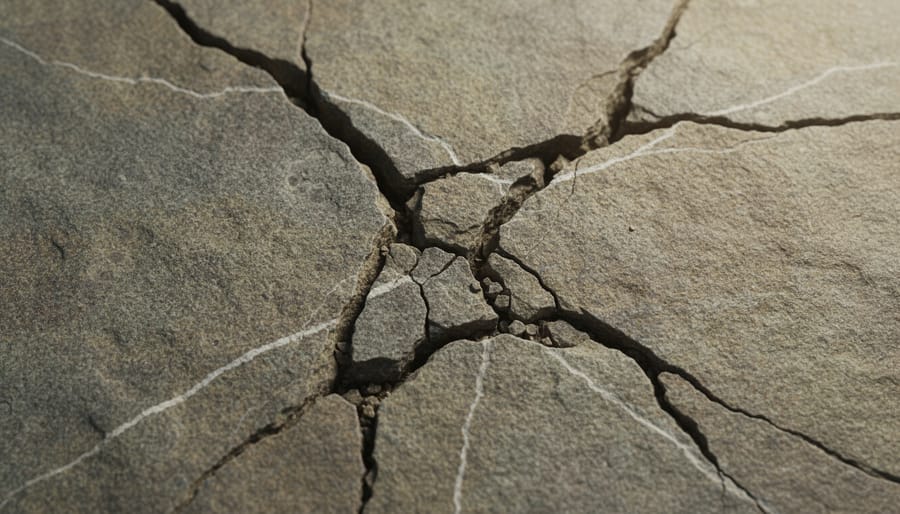
Natural stone arrives with built-in imperfections, veins, micro-fissures, bedding planes, and grain boundaries, that create weak points where tensile forces concentrate. These features act as stress concentrators, meaning tension applied to the stone doesn’t distribute evenly but instead amplifies at these natural discontinuities. A hairline fissure perpendicular to a pulling force can initiate failure at loads far below the stone’s theoretical tensile strength, while the same fissure oriented parallel to the stress may have minimal impact.
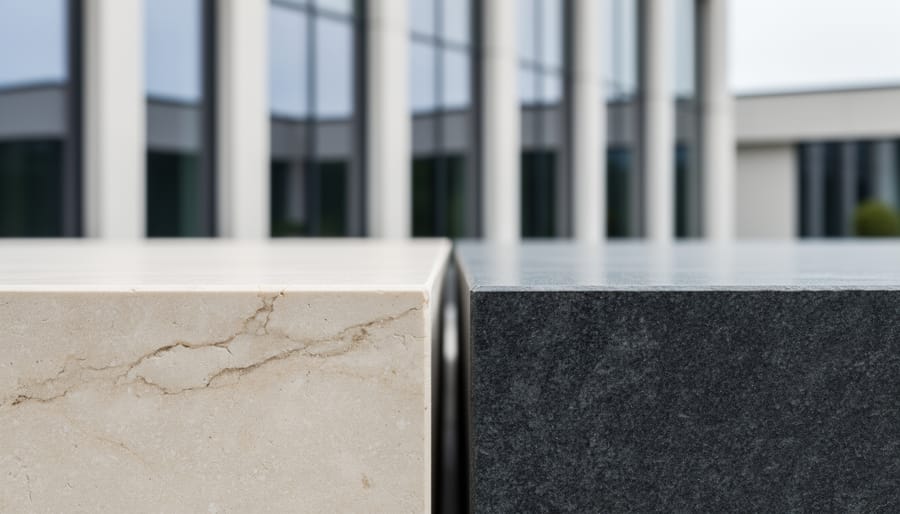
Veining presents a particularly interesting case. The mineral-filled seams that give marble and granite their distinctive appearance often consist of calcite, quartz, or other materials with different mechanical properties than the surrounding matrix. When tension pulls across a vein, failure typically occurs at the interface where dissimilar minerals meet, not through the vein itself. Yet stones with prominent veining perform reliably in countless installations because fabricators orient slabs so major veins run parallel to expected stress directions, along the length of a countertop overhang rather than across it.
Bedding planes in sedimentary stones like limestone and sandstone create similar directional weakness. These layers, formed as sediment accumulated over geological time, separate more readily under tension than the stone fractures perpendicular to bedding. Professional installers account for this anisotropy by positioning stone so bedding planes don’t align with tensile loads.
Chemical weathering compounds these vulnerabilities. When salt crystallization induces stress within pore spaces near existing fissures, the internal pressure widens defects and reduces the stone’s effective tensile capacity. Proper sealing and maintenance preserve tensile performance by limiting moisture and salt intrusion into these natural weak points.
Connection to Chemical Resistance
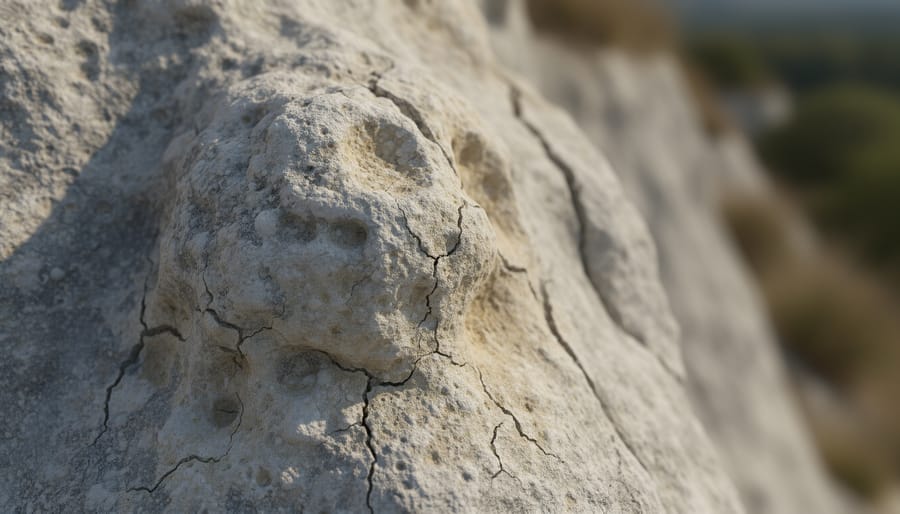
Chemical resistance and tensile strength interact in ways that directly affect stone longevity. When acidic substances contact natural stone, think vinegar, citrus juice, or acid rain, they don’t just etch the surface. These chemicals penetrate through pores and micro-fractures, dissolving mineral bonds and creating internal voids. As the stone absorbs water carrying dissolved salts or aggressive chemicals, the reaction zone expands deeper into the material.
Salt crystallization proves particularly destructive. When saltwater evaporates within stone pores, growing crystals exert surprising pressure against surrounding material. This internal expansion creates tensile stresses from the inside out, exactly where stone is weakest. A marble countertop might show excellent tensile strength when new, but years of acidic spills gradually dissolve calcite crystals along grain boundaries. Each microscopic dissolution site becomes a stress concentrator where cracks can initiate under tension.
Freeze-thaw cycles compound the problem. Water absorbed into chemically-weakened zones expands roughly nine percent when freezing, generating tensile forces that exploit compromised areas. The stone doesn’t fail from a single exposure but from cumulative damage. Chemical attack reduces the effective cross-section carrying tensile loads, lowering the practical tensile capacity well below laboratory test values for pristine samples.
Types of Tensile Strength Measurements
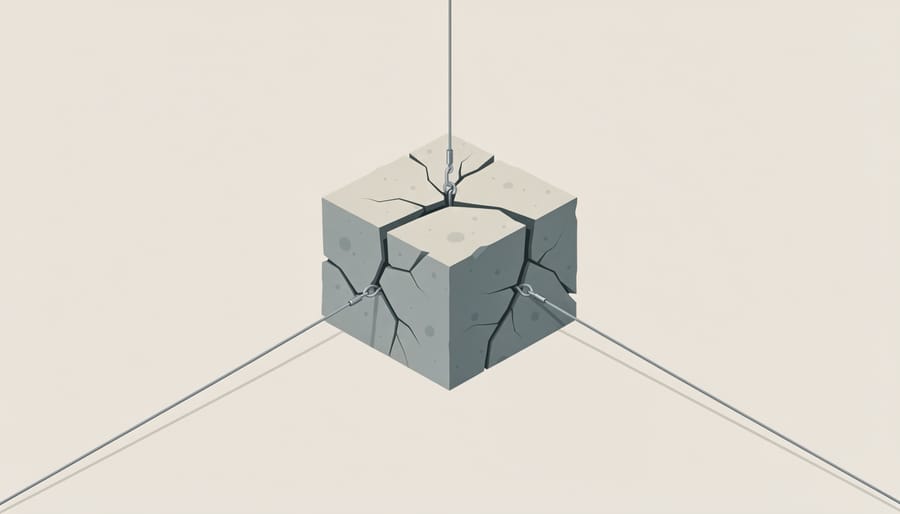
Measuring tensile strength in natural stone isn’t as straightforward as testing compression. You can’t simply pull on both ends of a rock sample the way you might test a steel rod. The irregular surfaces, brittleness, and gripping challenges with stone mean engineers have developed several testing approaches, each revealing different aspects of how stone handles tension.
Direct tensile testing attempts to measure pure tensile strength by attaching grips or adhesive fixtures to opposite ends of a prepared sample and pulling until failure. While this method provides the most theoretically accurate measurement of true tensile strength, it’s rarely used in practice for natural stone. The preparation is labor-intensive, results vary significantly based on sample preparation quality, and the gripping mechanism itself often creates stress concentrations that skew results. Most direct tests on rock yield tensile strength values between 2 and 25 MPa, depending on stone type.
The Brazilian test, or splitting tensile test, has become the industry standard for indirect measurement. A cylindrical or disc-shaped stone sample is compressed along its diameter between two flat plates. This loading creates tensile stress perpendicular to the applied compression, causing the sample to split along a vertical plane. The test is reliable, relatively simple to perform, and produces consistent results that correlate well with real-world performance. The Brazilian test typically shows tensile strength values about 50 to 80 percent of what direct testing would reveal, but its repeatability makes it more useful for comparing stones.
Three-point and four-point bending tests measure flexural strength, which combines both tensile and compressive behavior. A rectangular stone beam is supported at two points while force is applied at the center (three-point) or at two points (four-point). The bottom surface experiences tension while the top is compressed. These tests simulate real-world conditions like cantilevered countertops or floor tiles spanning between supports. Flexural strength values generally fall between direct tensile and compressive strength measurements.
Each method serves a purpose. Brazilian tests work well for quality control and material comparison. Bending tests better predict performance in specific applications. Understanding which test produced the tensile strength values in a technical data sheet helps you interpret what those numbers actually mean for your project.
Tensile Strength Across Common Natural Stones
Natural stone types vary considerably in tensile strength based on their formation processes, mineral composition, and internal structure. Understanding these differences helps predict how specific stones will perform under tension in real-world applications.
The tensile strength ranges for common natural stones reveal significant variation both between stone types and within each category:
- Granite: 7-25 MPa, influenced by crystal interlocking and quartz content
- Marble: 7-20 MPa, affected by calcite crystal size and metamorphic grade
- Limestone: 2-15 MPa, varying with density, porosity, and fossil content
- Slate: 7-25 MPa, determined by foliation quality and mineral alignment
- Sandstone: 2-10 MPa, controlled by cementation type and grain bonding
Granite typically offers the highest and most consistent tensile strength among common natural stones. The interlocking crystalline structure of quartz, feldspar, and mica creates strong mechanical bonds that resist pulling forces effectively. Coarse-grained granites with larger crystals may show slightly lower tensile strength than fine-grained varieties because grain boundaries can act as weak points under tension.
Marble’s tensile performance depends heavily on its metamorphic history. Higher-grade marbles with tightly interlocked calcite crystals achieve better tensile strength than lower-grade varieties. Veining patterns, which represent areas of different mineral composition or previous stress, often create directional weakness where tensile failure occurs preferentially.
Limestone shows the widest performance range due to its sedimentary origin. Dense, well-cemented limestones approach marble in tensile strength, while porous, fossil-rich varieties struggle with tension. The calcite or aragonite cement binding the grains together determines much of the stone’s tensile capacity.
Slate achieves surprisingly good tensile strength when loaded perpendicular to its cleavage planes, thanks to aligned mica minerals and metamorphic compaction. However, its foliated structure means tensile strength varies dramatically with loading direction, a critical consideration for any application.
Sandstone’s tensile performance hinges entirely on what binds the quartz grains together. Silica-cemented sandstones outperform those bound with clay or carbonate cements, sometimes by a factor of three or more.
Where Tensile Strength Matters Most
Countertops and Overhangs
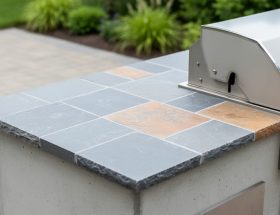
Countertop overhangs create some of the most demanding tensile conditions in residential natural stone applications. When a section of stone extends beyond its supporting cabinet base, the cantilevered portion acts like a lever. The weight of the stone itself, plus anything placed on the overhang, a heavy appliance, someone leaning against the edge, or even a person sitting on the counter, generates significant tensile stress along the top surface at the point where the overhang meets the supported section.
This is why you’ll see different overhang limits for different stones. Granite, with typical tensile strengths of 7-25 MPa, usually handles 10-12 inches of overhang without reinforcement, though denser varieties can safely extend to 14 inches. Marble ranges from 7-18 MPa and typically maxes out at 8-10 inches unsupported. Softer stones like limestone rarely exceed 6-8 inches without support.
Fabricators address longer overhangs through reinforcement, steel brackets, hidden support corbels, or epoxied rods installed in routed channels on the underside. These additions don’t increase the stone’s inherent tensile strength but redistribute the load to prevent the concentration of tensile stress that causes fractures. Stones with prominent veining require extra caution, since these natural features can become failure planes under tensile load.
Thin Stone Panels and Cladding
Thin stone panels pushed to 10-20 mm thickness face tensile challenges that thicker slabs avoid. Wind pressure on facade stone walls creates flexing that generates tensile stress at the panel back, while attachment points concentrate forces at clip or anchor locations. Thermal cycling compounds the problem: expansion and contraction differentials between stone and substrate introduce cyclical tensile strain that can propagate micro-cracks over years.
Engineers typically specify minimum 20 mm thickness for exterior cladding in granites with tensile strength above 7 MPa, though some high-strength varieties perform adequately at 15 mm. Marble and limestone usually require 30 mm minimum for cladding given their lower tensile capacity. The attachment system matters as much as thickness. Point-fixed mechanical anchors create concentrated tensile stress zones, demanding stones with uniform grain structure and minimal natural flaws. Continuous adhesive systems distribute loads more evenly but introduce different failure modes during thermal movement. Always verify that panel dimensions, attachment spacing, and expected deflection match the stone’s tested tensile and flexural limits.
Flooring and Paving Applications
When installed over a flexible substrate or large spans, stone flooring experiences tensile stresses quite different from simple foot traffic compression. A slab resting on an unsupported span between joists bends slightly under load, creating tension on the bottom face even when the top surface is compressed. Substrate deflection, movement in the underlying floor structure, can exceed what rigid stone tolerates, causing tensile failure from below rather than surface crushing.
Point loads concentrate forces through a small area, and while the immediate contact zone experiences compression, the surrounding material flexes and stretches. Heavy furniture legs, equipment wheels, and even high-heel impacts generate these localized bending moments. For most residential and commercial installations on properly supported concrete slabs, compressive strength remains the primary concern because the substrate doesn’t flex significantly and loads distribute across a stable base.
Tensile strength becomes the limiting factor when natural stone flooring is installed with large-format tiles (exceeding 24 inches), over radiant heating systems that create thermal expansion stresses, or on wood subfloors with joist spacing that allows movement. Stones with visible veining should be installed with the vein direction perpendicular to primary traffic paths and substrate spans to minimize tensile stress along natural weakness planes. Proper substrate preparation, thin-set mortar coverage, and tile thickness selection all work together to prevent tensile failures that appear as cracks running between joints rather than at impact points.
Testing and Specifications for Your Project
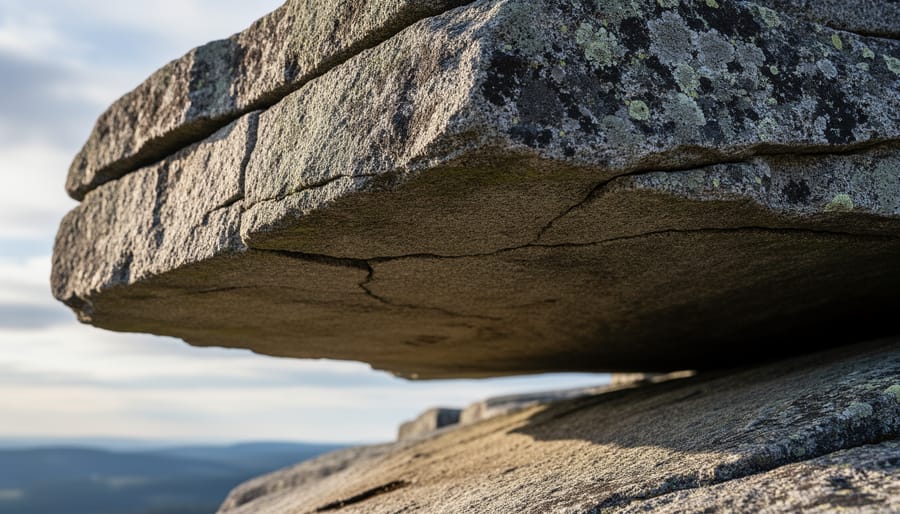
When specifying natural stone for a project, obtain tensile strength data directly from your supplier or fabricator. Reputable suppliers provide technical data sheets that include test results from accredited laboratories. Look for results from standardized tests, particularly ASTM C99 (modulus of rupture) in North America or EN 13161 (flexural strength under constant moment) in Europe. These tests measure a stone’s ability to resist bending forces, which directly relates to tensile performance.
Technical data sheets typically report flexural strength in megapascals (MPa) or pounds per square inch (psi). For granite, values above 10 MPa indicate good tensile performance for most applications. Marble and limestone generally range from 7-15 MPa, while slate can exceed 20 MPa when tested parallel to its cleavage planes. These numbers tell you whether a stone can handle your project’s specific demands.
Request third-party testing when working with unusual stone types, large-format installations, critical structural applications, or stones from new quarries without established performance records. Testing costs typically range from $300 to $800 per sample but provide essential data for high-stakes projects like thin cladding panels or dramatic cantilevers.
Different applications have different requirements. Countertop overhangs typically need stones with flexural strength above 8 MPa, while thin wall panels (10-20mm thick) may require 12 MPa or higher depending on span and attachment method. Flooring specifications usually focus more on compressive strength, but tensile strength becomes relevant in areas with substrate movement or point loads.
Work with fabricators who understand these specifications and can recommend appropriate stone thicknesses, reinforcement strategies, and installation methods based on actual test data rather than general assumptions. Proper specification based on tensile strength works hand-in-hand with natural stone care practices to ensure your installation performs well for decades.
Frequently Asked Questions
Understanding tensile strength in natural stone often raises practical questions for consumers and professionals alike. Here are answers to the most common concerns about this important property and its role in stone performance.
Can you improve tensile strength after installation?
No, tensile strength is an inherent property determined by the stone’s mineral composition and crystalline structure. Once installed, you cannot increase the stone’s tensile capacity, though proper support and reinforcement can prevent tensile failure.
How does sealing affect tensile strength?
Sealing does not directly change tensile strength values. However, penetrating sealers help prevent moisture infiltration and chemical attack that could weaken grain boundaries over time, indirectly preserving the stone’s original tensile capacity.
Why do some stones break along veins?
Veins often represent planes of weakness where different minerals meet or where previous geological stress created micro-fractures. These features concentrate tensile stress and create preferential failure paths when the stone experiences pulling forces.
What’s the difference between tensile and flexural strength?
Tensile strength measures resistance to pure pulling forces, while flexural strength (or modulus of rupture) measures resistance to bending. Flexural tests are more common because they’re easier to perform and better simulate real-world loading conditions like countertop overhangs.
How does temperature affect tensile properties?
Extreme temperature changes can reduce tensile strength temporarily during thermal cycling and permanently if repeated freeze-thaw cycles create internal micro-cracks. Stones with higher porosity are more vulnerable to thermal stress damage.
Do all stone suppliers provide tensile strength data?
Not always. Compressive strength is more commonly listed, but reputable suppliers should be able to provide flexural strength data or arrange testing for critical applications where tensile performance matters.
These questions highlight why tensile strength rarely exists in isolation. The property intersects with moisture absorption, chemical exposure, thermal movement, and structural design. When evaluating natural stone for a project, consider tensile strength alongside the application’s specific demands.
For instance, a marble fireplace surround faces different tensile challenges than a limestone facade panel. The fireplace experiences thermal cycling and minimal external loads, while the cladding must resist wind pressure and attachment stresses. Both applications benefit from understanding tensile limits, but the failure mechanisms differ considerably.
If you’re working on a project with unusual spans, thin sections, or challenging environmental conditions, discuss tensile requirements with your fabricator early in the selection process. They can help identify stones with appropriate strength characteristics and recommend reinforcement strategies where needed. Testing data becomes particularly valuable when you’re pushing beyond typical application parameters or working with unfamiliar stone varieties.
Understanding tensile strength isn’t about memorizing numbers from a data sheet. It’s about recognizing how this property interacts with everything else that makes natural stone perform well over decades of use. A granite with excellent tensile strength but poor chemical resistance will still fail in acidic environments. Marble with beautiful veining needs proper orientation to maximize its tensile capacity. Dense limestone might compress beautifully under load yet crack when subjected to bending forces at an overhang.
The best natural stone selections happen when professionals consider the complete picture: tensile strength, compressive strength, porosity, density, chemical resistance, and how the stone will actually be used. A countertop overhang demands different properties than a shower surround. Exterior cladding faces stresses that interior flooring never encounters.
Working with suppliers and fabricators who understand these fundamentals makes the difference between a stone installation that ages gracefully and one that develops problems within years. Ask about tensile testing results for your specific application. Discuss how your stone’s natural characteristics affect its structural behavior. Request installation details that account for the material’s actual mechanical properties rather than generic industry practices.
Natural stone has performed in demanding applications for thousands of years, but only when matched correctly to its intended use. Tensile strength is one critical piece of that puzzle. Ignore it, and you’re planning based on incomplete information. Understand it alongside other properties, and you’re positioned to make selections that last.