Showing 23 Result(s)
Wide shot of a contemporary living room with a tall honed stone wall, fabric-wrapped acoustic panels on the adjacent wall, upholstered sofa and chairs, and a large area rug covering most of the stone floor, lit by soft daylight with a coffered ceiling in the background.
Stone Art and Design

Why Your Stone Walls Echo (And How to Fix It)

Position sound-absorbing materials strategically in stone-heavy interiors by installing fabric-wrapped acoustic panels on walls perpendicular to major stone surfaces, incorporating upholstered furniture to break up hard reflective planes, and selecting area rugs sized to cover at least 60% of stone flooring in primary gathering spaces. These interventions allow you to preserve the visual drama of natural stone while reducing reverberation times to comfortable levels between 0.4 and 0.8 seconds.
Layer different stone finishes within the same space to naturally control sound reflection. Honed or leathered surfaces absorb approximately…

Close-up of a gloved hand rolling clear sealer onto weathered natural stone patio pavers with hairline cracks, salt crystals, wet spots, and scattered autumn leaves, with a softly blurred garden and faint melting frost in the background.
Maintenance and Care

Why Your Natural Stone Looks Worse Every Season (And How to Fix It)

Natural stone surfaces face distinct threats each season—winter freeze-thaw cycles crack sealants, spring moisture penetrates unsealed joints, summer heat degrades protective coatings, and autumn debris stains porous surfaces. Without a structured maintenance calendar aligned to these seasonal challenges, your stone investment deteriorates faster, requiring costly repairs or premature replacement.
The evidence is clear: stone maintained on a seasonal schedule lasts 40-60% longer than neglected installations. Yet most property owners follow reactive maintenance, addressing problems only after visible damage appears. This approach …

Gloved engineer tightens a stainless steel anchor bracket securing a stone cladding panel to concrete, low-angle view with a blurred high-rise facade and crane in the background under soft overcast light
Codes, Standards & Compliance

How IBC Seismic Certification Keeps Your Stone Cladding From Falling Off Buildings

Understanding IBC seismic certification requirements separates compliant stone cladding installations from potential structural liabilities. When stone veneer exceeds four stories or 40 feet in height in seismic design categories D, E, or F, the International Building Code mandates specific anchoring systems, detailed structural calculations, and often third-party testing to verify the installation can withstand lateral forces without failure.
Verify your project’s seismic design category through local building departments, as this single classification determines whether you need standard attachment methods or enhanced …

Contemporary living room with a honed limestone feature wall and stone floor, complemented by neutral fabric acoustic panels, suspended ceiling baffles, a thick area rug, upholstered seating, and lined drapery under soft natural daylight.
Technical Aspects

How Natural Stone Surfaces Can Transform Room Acoustics (Without Ruining the Sound)

Natural stone delivers unmatched visual elegance but presents significant acoustic challenges—hard surfaces reflect sound waves rather than absorbing them, creating echo, reverberation, and noise amplification that compromise comfort in residential and commercial spaces.
Balance stone’s reflective properties by integrating acoustic panels on adjacent walls, positioning fabric-wrapped fiberglass boards at primary reflection points to absorb mid and high frequencies while preserving stone’s aesthetic dominance. Install acoustic ceiling treatments in rooms with extensive stone flooring or wall cladding, using micro-…

Four-axis laser engraving machine etching a cylindrical granite column on a rotary axis, with the laser head moving along rails in a professional stone workshop.
Emerging Stone Technologies

Why 4-Axis Laser Engravers Are Transforming Stone Cutting Precision

Precision stone engraving has evolved beyond flat surface work. Four-axis laser engravers add rotational capability to traditional three-axis movement, enabling fabricators to engrave curved surfaces, cylindrical columns, spherical objects, and complex three-dimensional stone pieces with remarkable accuracy. Unlike conventional laser engraving technology limited to flat materials, these advanced systems rotate the workpiece while the laser head moves along X, Y, and Z axes, opening new possibilities for …

Close-up of a five-axis CNC stone router cutting a marble slab with water spray, the diamond tool forming a precise edge, with blurred stone racks and a control console in the background.
Innovation and Technology

How CNC Technology Transforms Stone Fabrication (And Why It Matters for Your Project)

CNC machining has transformed stone fabrication from a labor-intensive craft into a precision manufacturing process capable of executing designs that would be impossible by hand. Computer Numerical Control technology guides cutting tools along programmed paths with microscopic accuracy, carving intricate patterns, three-dimensional reliefs, and complex architectural elements from marble, granite, limestone, and other natural stone materials. This modern technology revolutionizing stone production enables fabricators…

Close-up view inside a home oven showing a preheated pizza stone on the lowest rack as a hand slides a margherita pizza from a wooden peel onto the stone, with warm orange oven glow and a softly blurred kitchen in the background.
Culinary Stone Applications

Why 500°F Is Wrong: The Real Temperature Your Pizza Stone Needs

Preheat your pizza stone to 500-550°F (260-288°C) for at least 45 minutes to achieve the crispy, evenly-browned crust that rivals pizzeria results. This temperature range allows natural stone materials like granite, marble, or cordierite to fully saturate with heat and transfer it efficiently to your dough upon contact.
The science behind optimal pizza stone temperature lies in thermal conductivity—different stone materials absorb and radiate heat at varying rates. Dense stones like granite require higher temperatures and longer preheating times, while porous materials like clay-based cordierite reach working temperature faster …

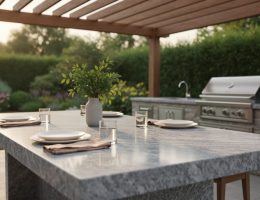
Granite outdoor dining table with a honed finish in an outdoor kitchen at golden hour, sharply focused tabletop with blurred stainless grill, stone cabinetry, pergola, and landscaped garden in the background.
Exterior and Landscaping

Why Your Outdoor Kitchen Needs a Stone Dining Table (And Which Type to Choose)

A stone outdoor dining table transforms your patio or garden into a permanent entertaining destination that withstands decades of sun, rain, and temperature extremes while requiring minimal upkeep. Unlike wood that warps or metal that rusts, natural stone surfaces maintain their structural integrity and aesthetic appeal through countless seasons, making them the cornerstone of well-designed outdoor kitchens.
Select granite for high-traffic outdoor dining areas where heat resistance and durability matter most. This dense igneous rock resists scratches from serving dishes, handles hot cookware without damage, and stands up to harsh UV…

Modern lobby with polished marble floors, a textured limestone feature wall, and suspended acoustic ceiling baffles illuminated by soft daylight from clerestory windows; glass atrium and staircase in the background.
Technical Properties

Why Natural Stone Makes Spaces Quieter (Or Louder) Than You Think

The sound quality of your space depends fundamentally on how materials absorb, reflect, or diffuse acoustic energy. Natural stone, with its density and mass, creates distinct acoustic signatures that can either enhance or compromise your environment’s sonic character. Understanding these properties empowers you to select and specify stone that serves both aesthetic and functional acoustic goals.
Dense materials like granite and marble reflect most sound waves, creating bright, reverberant spaces ideal for lobbies and atriums where you want sound to carry and create a sense of grandeur. Their reflective surfaces bounce …

Mobile robotic arm with vacuum grippers positioning a large limestone panel on a building facade as two workers in PPE supervise, with scaffolding and stacked stone in the background under soft overcast light.
Installation and Manufacturing

Stone Robots Are Transforming How We Install Natural Stone (Here’s What You Need to Know)

Stone robots are revolutionizing how natural stone gets cut, shaped, and installed in construction projects. These robotic systems combine advanced programming with precision machinery to automate tasks that traditionally required skilled craftspeople working manually for hours or days. The technology spans from CNC machines that carve intricate patterns into granite countertops to mobile robotic arms that position heavy stone panels on building facades with millimeter accuracy.
The automation addresses critical industry challenges: labor shortages, safety risks from handling massive stone slabs, and the need for consistent …