Showing 16 Result(s)
Restoration engineer in hard hat on scaffolding examining an ornate limestone facade while referencing a tablet, with a subtle translucent 3D wireframe aligned to the stone; bright overcast light and softly blurred city buildings in the background.
Stone Restoration and Preservation

How 5D Cost Estimation Transforms Stone Restoration Projects Before Work Begins

Stone restoration projects fail most often not from poor craftsmanship, but from cost estimation blind spots that emerge weeks into the work. Traditional 2D blueprints and spreadsheet budgets cannot account for the stone-specific variables that separate accurate bids from budget disasters—hidden deterioration beneath surfaces, volumetric calculations for specialty materials, and the timeline dependencies that cascade through multi-phase heritage projects.
5D cost estimation transforms this landscape by integrating three spatial dimensions with schedule and cost data into a single, dynamic model. When applied to stone restoration, …

Early 20th-century street scene with a granite and limestone skyscraper casting long shadows over brick tenements, a small stone civic building, and a factory smokestack, with pedestrians and a streetcar in the distance at golden hour.
Historical and Cultural Context

How Stone Buildings Shaped America’s First Zoning Laws

America’s cities didn’t always look the way they do today. Before 1916, nothing stopped a factory from operating next to a mansion, a slaughterhouse beside a school, or a towering skyscraper from casting entire neighborhoods into permanent shadow. The history of zoning in the United States began as a response to these chaotic conditions, fundamentally reshaping how Americans build, live, and interact with urban spaces.
New York City enacted the nation’s first comprehensive zoning ordinance in 1916, establishing a legal framework that would spread to virtually every American municipality within decades. This …

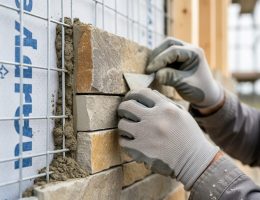
Gloved installer spreading thin-set mortar in a Z-shaped pattern on the back of a large-format porcelain slab with a notched trowel, workshop tools softly blurred behind.
Technical Aspects

The Z-Technique: How Professional Installers Prevent Stone Failure

Large-format porcelain panels and natural stone slabs have transformed modern architecture, but their impressive size creates a critical installation challenge: warping, lippage, and uneven surfaces that compromise both aesthetics and structural integrity. The Z-technique solves this problem through a methodical back-buttering approach that ensures complete mortar coverage and eliminates voids beneath heavy stone tiles.
This installation method gets its name from the distinctive Z-shaped pattern installers create when applying thin-set mortar to the back of each stone piece. Unlike traditional methods that rely solely on mortar …

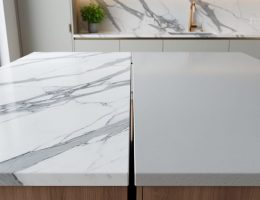
Two large slabs of Calacatta marble and light gray quartz displayed side by side on a modern kitchen island, with soft daylight and a blurred background of cabinetry, a brass faucet, and a small potted herb.
Countertop Materials and Selection

Why Marble Countertops Cost More Than Quartz (And When They’re Worth It)

Yes, marble typically costs more than quartz—expect to pay $50-$200 per square foot installed for marble versus $50-$150 for quartz. However, this conventional wisdom oversimplifies a nuanced purchasing decision that depends on the specific grade, origin, and rarity of each material.
The price gap exists because marble is a natural stone requiring extensive quarrying, transportation, and skilled fabrication, while quartz is an engineered product with more predictable manufacturing costs. Premium Calacatta or Statuario marble can reach $300+ per square foot, far exceeding most quartz options. Yet basic marble varieties sometimes …

Close-up of a honed gray stone countertop meeting warm oak cabinetry in natural side light, with a blurred slate floor, walnut wall paneling, and an indoor plant in the background.
Aesthetic and Style Trends

Why Stone and Wood Create Spaces That Feel Right

Stone and wood have shaped human shelter for millennia, yet their partnership transcends mere tradition. These materials share fundamental qualities that create visual and tactile harmony: both emerge from earth’s slow transformations, display organic patterns unique to each piece, and age gracefully while developing character. When designers unite stone’s cool permanence with wood’s warm resilience, they tap into biophilic design principles that resonate deeply with human psychology…

Polished quartz countertop in a modern kitchen with an out-of-focus terraced stone quarry and excavator visible through a side window.
Culinary Stone Applications

Why Your Crystal Countertops Might Come from an Unethical Mine (And How to Fix It)

The natural stone industry harbors a troubling secret: many crystals and stone materials reach your countertop or design project through supply chains marked by environmental destruction, unfair labor practices, and community displacement. Understanding ethical sourcing isn’t merely about feeling good—it directly impacts the quality, authenticity, and long-term value of your stone investments.
Ethical sourcing in natural stone procurement means verifying that materials are extracted using environmentally responsible methods, workers receive fair wages and safe conditions, and local communities benefit from quarrying …