Geological deposits are accumulations of minerals, rocks, and organic materials that have formed over millions of years through natural processes like sedimentation, volcanic activity, and metamorphic transformation. These deposits are the source of every piece of natural stone used in construction and design, from the marble countertops in modern kitchens to the granite façades of historic buildings.
Understanding where natural stone originates matters for anyone specifying or purchasing stone products. The geological history of a deposit directly influences a stone’s color, pattern, durability, and performance characteristics. A marble formed from ancient seabeds in Carrara, Italy exhibits different properties than one created by metamorphic pressure in the mountains of Vermont. These variations aren’t just aesthetic. They affect how the stone responds to heat, moisture, and daily wear.
The story behind geological deposits connects geological time scales to practical present-day decisions. When you choose a limestone for a flooring project, you’re selecting material that began forming hundreds of millions of years ago under specific temperature, pressure, and chemical conditions. Those formation conditions determined the stone’s porosity, hardness, and susceptibility to staining.
This article explains how geological deposits form, categorizes the major deposit types that produce commercial stone, and connects geological processes to the material properties you encounter in real applications. You’ll learn why certain regions produce specific stone varieties, how formation methods influence stone characteristics, and what these geological factors mean for sustainability and long-term material performance. Whether you’re an architect specifying stone for a major project or a homeowner selecting materials for a renovation, understanding geological deposits gives you the knowledge to make informed choices based on how and where your stone was created.
What Geological Deposits Are
Geological deposits are natural accumulations of minerals, rocks, and sediments that form beneath the Earth’s surface through processes spanning millions of years. These deposits represent the raw material source for the natural stone you see in kitchens, bathrooms, building facades, and landscaping, from granite countertops to marble floors, each piece began as mineral-rich material slowly accumulating under specific geological conditions.
When we talk about deposits in the context of natural stone, we’re describing concentrated zones where valuable stone formed in sufficient quantity and quality to make extraction commercially viable. Not every rock formation qualifies as a deposit worth quarrying. A true geological deposit suitable for natural stone contains consistent material with desirable characteristics, strength, color, pattern, workability, concentrated in accessible layers or masses large enough to yield commercially useful slabs and tiles.
- Sediment
- Loose particles of minerals, rocks, and organic material that settle and accumulate over time, eventually compacting into sedimentary stone like limestone or sandstone.
- Strata
- Distinct layers of sedimentary rock visible in deposits, formed by successive periods of material accumulation that create the characteristic banding in stones like travertine.
- Mineralization
- The process by which dissolved minerals crystallize and concentrate within rock formations, creating deposits of specific stone types with unique colors and patterns.
- Bedrock
- The solid rock layer beneath soil and loose surface materials, often containing the geological deposits from which natural stone is quarried.
- Deposit Formation
- The long-term geological process through which minerals and rocks accumulate and transform into concentrated zones suitable for stone extraction.
The formation of these deposits involves heat, pressure, chemical processes, and immense time scales that transform basic minerals into the durable, beautiful materials we use today. Understanding geological deposits helps explain why certain regions produce specific types of stone, why colors and patterns vary even within the same stone type, and why natural stone remains a premium material, each deposit represents a unique geological event that can never be exactly replicated.
How Natural Stone Deposits Form
Igneous Formation
Igneous stone deposits form through the cooling and solidification of magma beneath the Earth’s surface or lava above it. When molten rock cools slowly deep underground, over thousands or even millions of years, large mineral crystals have time to develop. This slow crystallization creates the distinctive speckled patterns and exceptional hardness found in granite, the most commercially important igneous stone for countertops and architectural applications.
The depth at which magma cools determines the stone’s characteristics. Granite typically forms several miles below the surface, where insulation from surrounding rock allows gradual cooling that produces visible quartz, feldspar, and mica crystals. The longer the cooling period, the larger and more defined these crystals become, which is why some granite slabs display dramatic crystal formations while others show finer, more uniform patterns.
Not all igneous deposits cool underground. Basalt forms when lava cools rapidly at the surface, creating a dense, fine-grained stone with smaller crystals. While less common in residential interiors than granite, basalt’s durability makes it valuable for exterior paving and commercial flooring in high-traffic areas.
These ancient cooling events created the massive granite deposits now quarried across continents. The very process that makes igneous stones form also gives them their practical advantages: the interlocking crystal structure that develops during slow cooling produces exceptional strength, scratch resistance, and longevity, qualities that explain why granite remains the benchmark for kitchen countertops decades after installation.
Sedimentary Formation
Sedimentary stone deposits form in a fundamentally different way than igneous varieties, through the gradual accumulation of particles that settle in layers and harden over millions of years. Picture a riverbed, ocean floor, or ancient lake where tiny fragments of shell, coral, sand, and mineral grains continuously drift downward and pile up. As these layers grow thicker, the weight from above squeezes out water and air from the spaces between particles. This process of burial, compaction, and cementation bonds the sediments into solid rock.
Limestone deposits typically develop in warm, shallow marine environments where calcium carbonate from shells and skeletons of ancient sea creatures accumulates on the ocean floor. The resulting stone often contains visible fossils and displays a range of colors from cream to gray, depending on the specific minerals present during formation.
Travertine forms around mineral springs and hot springs, where calcium carbonate precipitates from water and builds up in distinctive banded layers. These deposits create stone with characteristic holes and channels where gases escaped during formation.
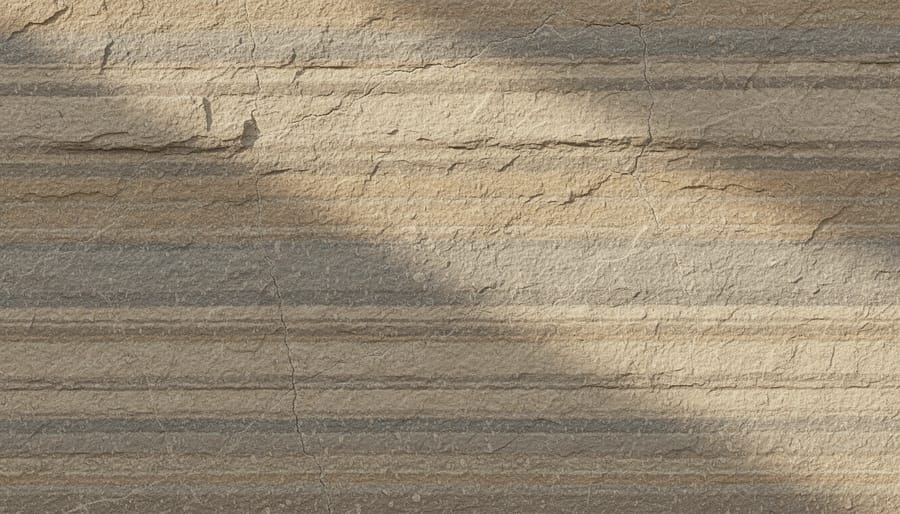
Sandstone deposits develop from quartz-rich sand that accumulates in deserts, riverbeds, or coastal areas. The individual sand grains remain visible in the finished stone, giving sandstone its characteristic granular texture. The cementing minerals that bind the grains together, often silica, calcite, or iron oxide, determine the stone’s final color and durability.
Metamorphic Formation
Metamorphic deposits form through transformation rather than creation from scratch. When existing limestone, shale, or sandstone becomes buried miles beneath the Earth’s surface, often during mountain-building events, high heat and pressure fundamentally change the rock’s structure without melting it. This process, called metamorphism, rearranges mineral crystals into new configurations that create entirely different materials with distinct properties.
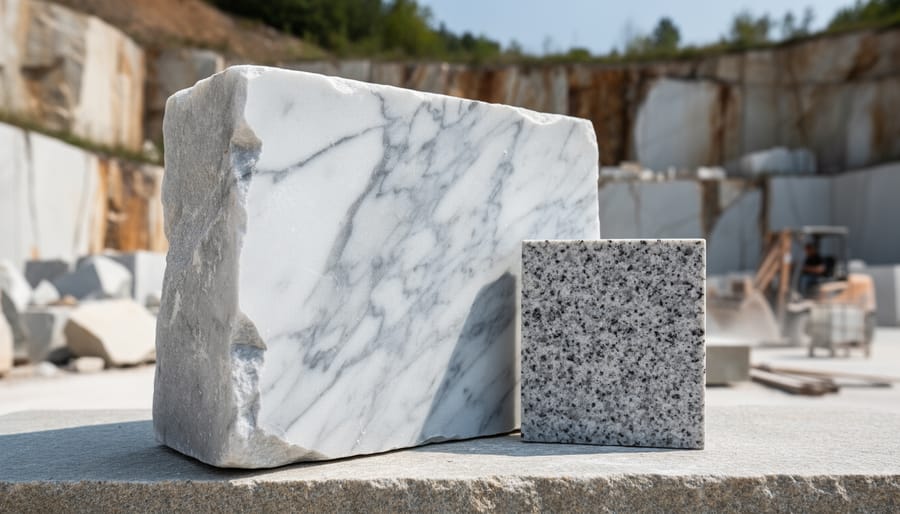
Marble represents the most commercially important metamorphic stone deposit. It starts as sedimentary limestone composed of calcium carbonate. Under temperatures exceeding 400°F and pressure equivalent to several miles of overlying rock, the small calcite crystals in limestone recrystallize into larger, interlocking crystals. This transformation creates marble’s characteristic smooth texture and ability to take a high polish. The famous Carrara deposits in Italy’s Apuan Alps formed this way roughly 25 million years ago when ancient seabeds were compressed during the formation of the Apennine mountain range.
Quartzite deposits follow a similar pattern but begin with sandstone. Extreme pressure fuses individual quartz grains together so completely that fractures cut through the grains rather than around them, creating one of the hardest natural stones available. Brazilian quartzite deposits, widely used in contemporary kitchens, formed during the Precambrian era when continental plates collided with immense force, subjecting ancient sandstone to conditions that produced today’s durable slabs.
Major Types of Natural Stone Deposits
Carbonate Deposits
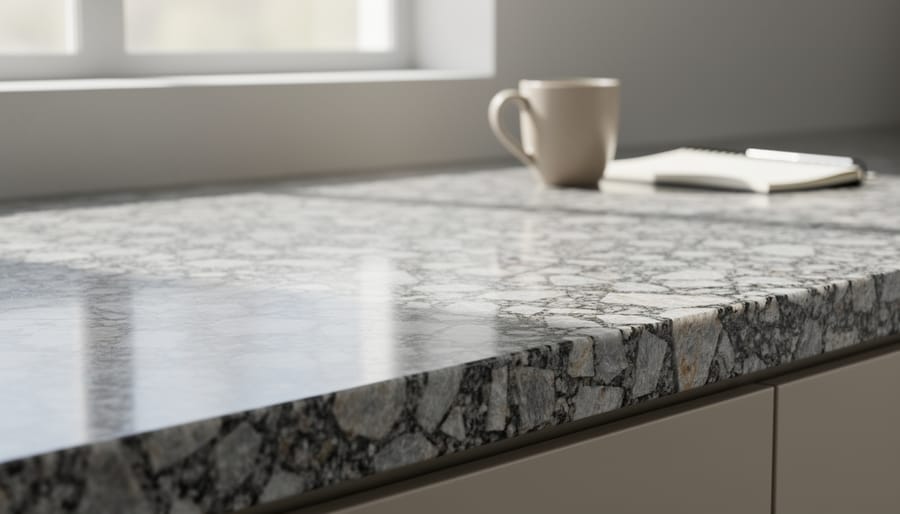
Carbonate deposits form when calcium carbonate accumulates over millions of years, primarily in ancient marine environments. These deposits create two of the most commercially valuable natural stones: limestone and marble.
Limestone develops directly from the compression of calcium carbonate-rich sediments, often shell fragments, coral, and microscopic marine organisms that settled on ancient ocean floors. Major limestone deposits exist throughout Europe, particularly in Italy and France, as well as across the American Midwest and Middle East. The stone’s relative softness and workability make it popular for flooring, wall cladding, and exterior applications where its natural porosity creates distinctive weathering patterns.
Marble forms when existing limestone deposits undergo metamorphosis deep underground. Heat and pressure recrystallize the calcium carbonate, creating the interlocking crystal structure that gives marble its characteristic strength and ability to take a polish. The world’s most prized marble deposits, Italian Carrara, Greek Thassos, and Turkish Afyon, developed in regions with significant tectonic activity that provided the necessary heat and pressure.
Commercial value varies dramatically based on color, veining, and consistency. White Carrara marble commands premium prices, while regional limestones offer cost-effective alternatives for large-scale projects.
Silicate Deposits
Silicate deposits contain high concentrations of silicon and oxygen, forming the quartz-rich stones that dominate kitchens and high-traffic commercial spaces. Granite deposits, the most commercially significant silicate stones, form when molten magma cools slowly deep underground, allowing large interlocking crystals of quartz, feldspar, and mica to develop. This crystalline structure creates granite’s legendary hardness and resistance to scratching.
Quartzite deposits begin as sandstone but transform through intense heat and pressure that fuses individual quartz grains into an interlocked mass, often harder than the original igneous granite. The resulting stone offers exceptional durability with a distinctive sparkle from its recrystallized quartz content.
Major silicate deposits cluster in geologically active or ancient mountain-building regions. Brazil, India, and Scandinavia host vast granite deposits formed during continental collisions hundreds of millions of years ago. These deposits can span hundreds of square kilometers, with consistent coloration that allows quarries to extract matching slabs over decades.
Silicate stones typically score 6-7 on the Mohs hardness scale, compared to 3-4 for carbonate stones. This density and hardness explain why granite countertops resist heat, knife marks, and daily wear better than marble or limestone alternatives.
Specialty Deposits
Soapstone, slate, and a handful of other natural stones occupy a specialized niche in both geological classification and practical application. These deposits form through distinct processes that create unique physical and aesthetic properties, making them valuable for specific uses where mainstream stones fall short.
Soapstone deposits develop when silica-rich rocks undergo metamorphism in the presence of water and carbon dioxide. The process converts minerals into talc and chlorite, producing a stone with exceptional heat resistance and a distinctive soft, soapy feel. Major deposits exist in Brazil, India, and parts of the United States, particularly in the Appalachian region. This stone’s non-porous nature and thermal properties make it ideal for laboratory countertops, wood stoves, and artisan carving.
Slate forms from fine-grained sedimentary rocks, typically shale or mudstone, that metamorphose under moderate pressure. The resulting stone develops a pronounced tendency to split into thin, flat sheets along parallel planes. Significant slate deposits occur in Wales, Spain, Vermont, and Pennsylvania. Its durability and natural cleft surface make it the traditional choice for roofing tiles, flooring, and exterior cladding in wet climates.
Other specialty deposits include onyx, a translucent calcite deposit formed by mineral-rich water in caves, and serpentine, a greenish metamorphic stone sometimes mistaken for marble. These rarities appear in limited quantities worldwide, commanding premium prices for feature walls, backlit installations, and artistic applications where their distinctive characteristics justify the investment.
Regional Deposits Around the World
Natural stone deposits concentrate in specific regions worldwide because of unique geological histories that unfolded over millions of years. Understanding where different stones come from helps explain their characteristics and why availability varies dramatically by location.
Europe’s Historic Stone Centers
Italy stands as one of the world’s premier sources of natural stone, with deposits shaped by ancient tectonic activity when Africa collided with Europe. The Apuan Alps near Carrara contain metamorphic marble deposits that have been quarried for over 2,000 years, producing the white and blue-grey marble prized since Roman times. Greece’s Thassos Island offers pure white marble deposits formed from ancient limestone recrystallized under extreme pressure. Spain’s sedimentary deposits yield Crema Marfil limestone, created when shallow Cretaceous seas covered the region.
The Americas’ Diverse Geology
North and South America host dramatically different deposit types reflecting their geological evolution. Vermont’s Green Mountains contain metamorphic schist and marble deposits formed when ancient continental plates collided 450 million years ago. These same tectonic forces created Canada’s Precambrian Shield deposits of granite and gneiss. Brazil emerged as a granite superpower thanks to igneous intrusions that cooled slowly beneath the Earth’s surface, creating the exotic colors and patterns seen in stones like Blue Bahia and Fusion. Quartzite deposits in Brazil’s interior formed when ancient sandstone underwent metamorphism, producing extremely hard, colorful stone.
Asia’s Growing Production Centers
Major stone-producing regions worldwide include:
– Carrara, ItalyWorld-renowned white marble from metamorphosed Jurassic limestone
– Vermont, USAHigh-quality marble and slate from Paleozoic metamorphic deposits
– Rajasthan, IndiaSandstone, marble, and granite from diverse geological formations
– BrazilExotic granites and quartzites with unique color patterns from Precambrian igneous activity
– TurkeyTravertine and marble deposits formed by ancient tectonic uplift and thermal springs
– ChinaVast granite and marble deposits across multiple geological provinces
India’s Rajasthan region contains both sedimentary sandstone deposits laid down in ancient deserts and metamorphic marble deposits near Makrana, where the Taj Mahal’s white marble originated. China’s rapid expansion as a stone producer stems from extensive granite deposits in Fujian Province and marble in Yunnan, both created by complex tectonic interactions along the Pacific Ring of Fire.
Why Certain Regions Produce Specific Stones
Regional geology determines deposit types through three primary factors. First, tectonic history governs whether an area experienced the volcanic activity creating igneous deposits or the metamorphism producing marble. Second, ancient environments matter, regions once covered by warm, shallow seas often contain limestone and travertine, while areas with historical volcanic activity yield granite and basalt. Third, erosion patterns influence which deposits remain accessible near the surface for economical extraction.
Climate also plays a role in deposit accessibility. Mediterranean regions benefit from relatively easy quarrying conditions, while tropical areas face challenges from weathering that can degrade surface stone quality. This explains why certain deposit types from specific regions command premium prices, their unique geological conditions can’t be replicated elsewhere.
How Geological Deposits Are Located and Extracted
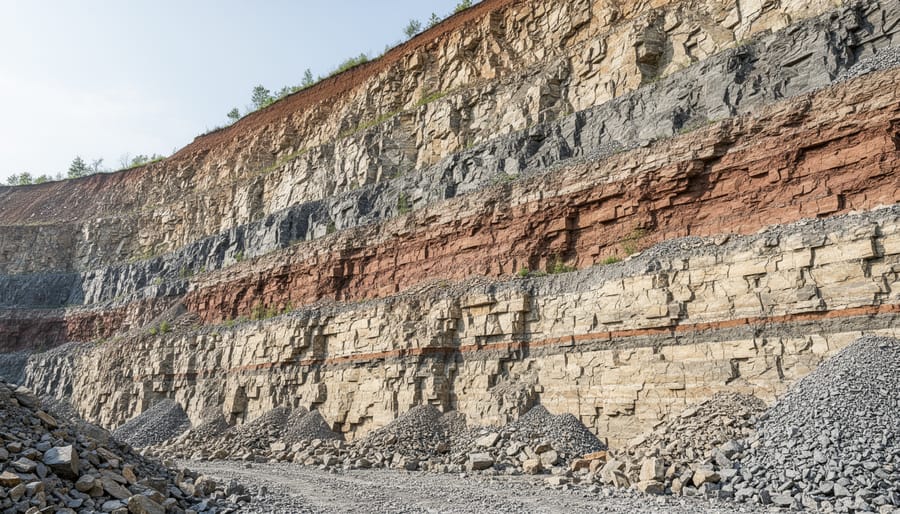
Finding commercial stone deposits requires systematic geological detective work long before the first block is ever cut. Geologists begin with satellite imagery and topographical surveys to identify promising areas where surface features suggest deeper deposits. They then conduct core drilling to extract cylindrical samples from hundreds of feet underground, analyzing mineral composition, structural integrity, and color consistency throughout the potential deposit.
Once samples confirm commercial viability, geologists map the deposit’s three-dimensional extent. This mapping process determines not just where the stone exists but how deep it runs, whether quality remains consistent, and what the optimal extraction zones are. Advanced ground-penetrating radar and seismic surveys now supplement traditional core sampling, giving quarry operators a clearer picture of what lies beneath before committing to excavation.
Modern extraction methods have evolved significantly from historical blasting techniques that often fractured valuable stone. Today’s quarries use diamond wire saws and precision drilling to separate massive blocks from the deposit with minimal waste. Wire saws thread through initial drill holes, then cut horizontally and vertically to isolate blocks weighing 20 tons or more. This controlled approach preserves the stone’s natural structure and reduces the debris that earlier methods created.
Quality assessment happens continuously during extraction. Teams perform marble extraction checks at multiple stages, inspecting each freed block for veining patterns, structural soundness, and color uniformity before transport. This quarry quality control ensures only premium material reaches fabricators and ultimately your home.
Environmental management has become central to extraction operations. Quarries implement water recycling systems that capture and reuse the water needed for cooling wire saws and controlling dust. Careful marble block selection maximizes yield from each deposit, and many operators now restore quarried sites through terracing and revegetation programs that return land to productive use after extraction concludes.
Applications of Natural Stone from Geological Deposits
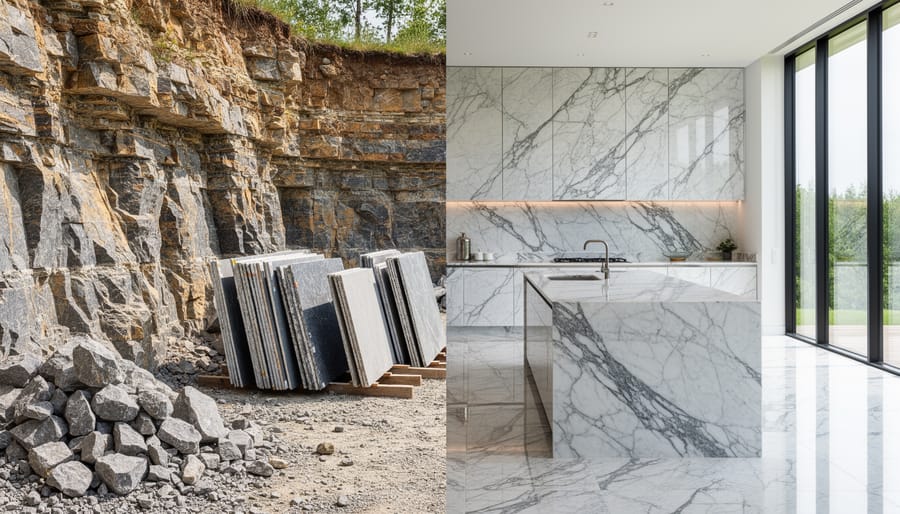
The type of geological deposit directly determines which applications best showcase a natural stone’s strengths. Igneous deposits like granite, formed from slowly cooling magma, produce exceptionally hard, dense stone that withstands daily wear in high-traffic environments. This makes granite ideal for kitchen countertops where hot pots, sharp knives, and acidic spills are constant threats. Metamorphic deposits yield marble and quartzite with distinctive veining patterns that command attention in statement applications, marble thrives in bathroom vanities and feature walls where its elegance outweighs maintenance considerations, while quartzite’s hardness allows those striking patterns to appear in kitchens without sacrificing durability.
Sedimentary deposits offer different advantages. Limestone’s porosity and workability make it suitable for interior flooring in moderate-traffic areas and exterior cladding where its soft texture catches light beautifully. Travertine, with its characteristic pitting formed by ancient mineral-rich waters, creates textured outdoor paving that stays cool underfoot and provides natural slip resistance around pools. Sandstone’s layered structure and earthy tones suit landscaping elements like retaining walls and garden paths where its natural weathering enhances rather than diminishes appearance.
- Kitchen countertops: granite, quartzite, and soapstone from igneous and metamorphic deposits
- Bathroom vanities: marble, onyx, and travertine from carbonate deposits
- Flooring: limestone, slate, and travertine from sedimentary and low-grade metamorphic deposits
- Wall cladding: thin-cut limestone, marble, and quartzite from various deposit types
- Outdoor paving: sandstone, bluestone, and travertine selected for weather resistance
- Decorative features: specialty stones like alabaster and serpentine from unique deposits
Commercial projects leverage deposit characteristics at scale. Granite from deep igneous deposits clads high-rise facades where dimensional stability prevents cracking across large panels. Slate from low-temperature metamorphic deposits provides roofing that lasts centuries because its layered structure sheds water naturally. Dense limestone from ancient seabeds forms lobby flooring that develops a burnished patina under thousands of footsteps daily.
Understanding deposit origins helps specifiers match stone to purpose. Stones assessed for quality before extraction ensure performance meets expectations, a granite slab destined for a restaurant kitchen countertop receives different scrutiny than decorative wall stone. Regional deposit variations create availability patterns too. Italian Carrara marble remains the standard for sculpture and luxury interiors because that specific carbonate deposit produces unmatched purity, while American granites from New England igneous deposits dominate commercial cladding for their consistent color and competitive pricing.
Common Questions About Geological Deposits and Natural Stone
Understanding how geological processes create the stone in your home helps you make better decisions about material selection and care. While earlier sections covered formation and types, these frequently asked questions address practical concerns about deposit sustainability, quality, and what deposit characteristics mean for the stone you’re considering.
How long does it take for geological deposits to form?
Most natural stone deposits require millions to hundreds of millions of years to form. Granite deposits typically develop over 50-300 million years as magma slowly cools deep underground, while marble forms as limestone undergoes metamorphosis over 100-200 million years under intense heat and pressure.
Are some natural stone deposits running out?
While individual quarries eventually deplete, geological deposits themselves are vast and new commercially viable sites continue to be discovered. The challenge is not scarcity of stone but rather access to deposits with desirable characteristics, extraction economics, and environmental permits.
Why does the same type of stone vary between regions?
Regional differences in geological conditions create variations in color, veining, and mineral composition even within the same stone category. Carrara marble differs from Vermont marble because each deposit formed under unique temperature, pressure, and mineral content conditions specific to its location.
How does deposit depth affect stone quality?
Deeper deposits often yield higher-quality stone because they experienced greater pressure and more complete metamorphosis or crystallization. However, depth also increases extraction costs, which is why understanding how marble is sourced helps explain price variations for seemingly similar materials.
What makes a geological deposit commercially viable?
Commercial viability depends on stone quality, deposit size, accessibility, and market demand. A deposit must be large enough to justify quarrying infrastructure, produce consistent blocks with minimal fracturing, and contain stone with desirable aesthetic or performance characteristics that justify extraction and transportation costs.
The relationship between deposit characteristics and final product performance matters when selecting stone for specific applications. Igneous deposits that cooled slowly produce granite with tighter crystal structures and superior hardness, making them ideal for high-traffic countertops. Sedimentary deposits with consistent layering yield limestone and travertine with predictable veining patterns, valuable for projects requiring visual continuity across large installations.
Regional geology also affects porosity and staining resistance. Marble from deposits with higher calcite purity tends to be more uniform in color but potentially more reactive to acids, while deposits containing additional minerals may offer greater variation and sometimes improved durability. These trade-offs explain why Italian Carrara marble differs in performance from Greek Thassos marble despite both being white marbles from carbonate deposits.
Sustainability concerns about deposit extraction are valid but nuanced. Modern quarrying focuses on maximizing yield from existing sites rather than constantly opening new deposits, and many quarries now restore sites after depletion. The durability of natural stone means buildings clad in materials from these deposits can last centuries, making the one-time extraction impact relatively small when measured across a building’s lifespan.
Understanding geological deposits transforms how we select and appreciate natural stone. When you choose a granite countertop or marble floor, you’re bringing millions of years of geological history into your space. The formation process, whether igneous cooling, sedimentary layering, or metamorphic transformation, directly influences the stone’s durability, appearance, and suitability for your project.
For consumers, knowing that Brazilian granite formed from ancient volcanic activity or that Italian Carrara marble resulted from limestone metamorphism adds depth to design decisions. This knowledge helps you ask better questions about hardness, porosity, and maintenance requirements. A limestone from sedimentary deposits will behave differently than quartzite from metamorphic processes, affecting everything from stain resistance to longevity.
Professionals benefit from understanding deposit characteristics when specifying materials. Regional variations in chemical composition and formation conditions explain why Vermont marble differs from Greek marble, or why certain Indian granites excel in high-traffic applications. This geological perspective improves project outcomes and client satisfaction.
The sustainability angle matters too. Finite geological deposits require responsible extraction and informed consumption. Choosing stone from well-managed quarries that understand their deposit’s extent supports long-term industry viability.
Every slab tells a geological story. The swirls in your marble record ancient tectonic pressures. The speckles in granite capture the moment magma crystallized. Recognizing these patterns as evidence of specific geological processes helps you select stone that meets both aesthetic vision and practical needs. Your design choices connect directly to the earth’s deep history, making each installation unique and grounded in natural processes that shaped our planet.