A modern stone bathroom combines natural stone materials with contemporary design principles to create spa-like spaces characterized by clean lines, minimalist aesthetics, and a focus on the inherent beauty of unadorned stone surfaces. Unlike traditional stone bathrooms that often feature ornate patterns, heavy fixtures, and dark color palettes, the modern approach emphasizes simplicity, light-enhancing tones, and the strategic use of stone as both a functional surface and a sculptural element.
The distinction matters because stone selection and installation techniques directly impact durability, maintenance requirements, and overall design cohesion in high-moisture environments. Choosing between marble, granite, travertine, or slate affects everything from slip resistance to cleaning protocols, while decisions about slab versus tile formats influence both visual continuity and budget.
This shift toward contemporary stone bathrooms reflects broader design trends favoring natural materials, sustainable sourcing, and wellness-oriented spaces. Homeowners investing in bathroom renovations in 2026 increasingly prioritize materials that age gracefully and contribute to healthier indoor environments, making stone an attractive alternative to synthetic surfaces.
This article explains what defines modern stone bathroom design, how different stone types perform in wet conditions, and which design components create the sleek, cohesive look associated with contemporary spaces. You’ll find practical guidance on stone selection based on porosity and finish, layout strategies that maximize visual impact, and real-world examples demonstrating how designers balance aesthetics with function. Whether you’re planning a full renovation or updating specific elements, understanding these fundamentals ensures your investment delivers both immediate visual appeal and long-term performance.
What a Modern Stone Bathroom Actually Means
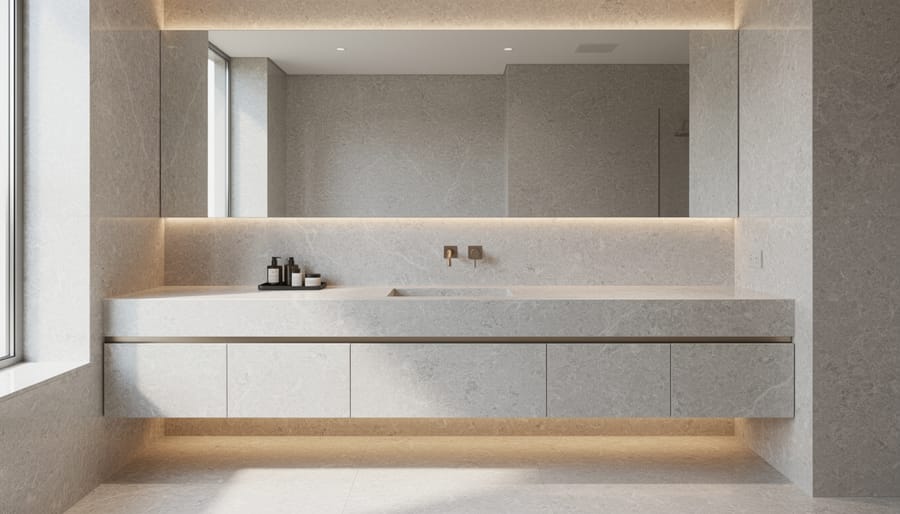
A modern stone bathroom unites the raw beauty of natural materials with streamlined contemporary design sensibility. Rather than ornate columns, decorative moldings, or busy tile patterns typical of traditional stone applications, this approach emphasizes the stone itself as the primary visual and textural element. The design philosophy centers on showcasing natural veining, color variations, and tactile qualities within spare, uncluttered spaces where each surface serves both aesthetic and functional purposes.
Contemporary stone bathrooms distinguish themselves through their treatment of material. Where traditional designs might compartmentalize stone into discrete tile grids or decorative accents, modern applications favor expansive surfaces that create visual continuity. A shower enclosure might feature floor-to-ceiling slabs with minimal grout lines, or a vanity counter could extend seamlessly into a wall backsplash, maintaining uninterrupted stone grain patterns throughout.
- Book-matching
- A technique where adjacent stone slabs are opened like a book, creating mirror-image veining patterns that produce symmetrical, dramatic visual effects on walls or shower surrounds.
- Monolithic slabs
- Large-format stone pieces that cover substantial areas without seams, reducing grout lines and emphasizing the stone’s natural character while simplifying maintenance.
- Seamless transitions
- Design approach where stone surfaces flow from one plane to another without visual breaks, such as floors extending up walls or counters integrating with backsplashes.
- Wet-room design
- Open bathing spaces without traditional shower enclosures, where water-resistant stone covers all surfaces and proper drainage manages moisture throughout the room.
- Integrated stone features
- Elements carved or formed from the same stone as surrounding surfaces, including built-in shelving, benches, or sinks that appear continuous with walls or floors.
The materials themselves remain grounded in nature: marble with its classic veining, granite offering durability and speckled patterns, limestone and travertine contributing organic textures, and slate providing earthy tones with natural slip resistance. What shifts in modern applications is restraint in how these stones are deployed. Color palettes tend toward neutrals, hardware choices favor minimal profiles, and lighting design highlights stone’s inherent qualities rather than competing with them. The result feels intentional yet understated, where the stone commands attention through its presence rather than decorative embellishment.
How Modern Stone Bathrooms Function in Daily Use
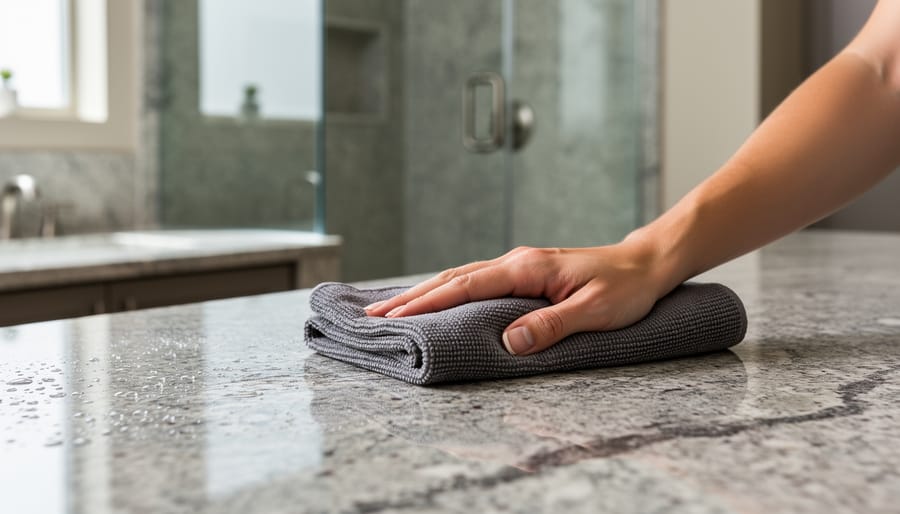
Modern stone bathrooms perform remarkably well in daily use because natural stone possesses inherent properties that align perfectly with wet environments. When properly sealed during installation, materials like marble, granite, and slate create surfaces that repel water rather than absorb it. The sealing process fills the stone’s microscopic pores with a protective barrier that prevents moisture penetration while maintaining the material’s natural breathability, a crucial distinction from synthetic surfaces that can trap humidity underneath. This means your morning shower won’t compromise the stone’s integrity, and water beading on a sealed marble wall functions exactly as intended.
Maintenance in a modern stone bathroom proves simpler than many homeowners expect. Daily cleaning requires nothing more than a damp microfiber cloth or a pH-neutral stone cleaner wiped across surfaces. The minimalist design philosophy behind modern stone bathrooms, with their large-format slabs and reduced grout lines, actually decreases cleaning time compared to small-tile installations. You’ll reseal surfaces every 1-3 years depending on stone type and use intensity, a straightforward process that takes an afternoon. If damage does occur from dropped objects or harsh cleaners, modern stone resurfacing techniques can restore the original finish without full replacement.
Durability distinguishes stone from virtually every bathroom material alternative. A granite shower floor withstands decades of foot traffic without wearing through its finish because the color and pattern extend through the entire thickness of the material. Marble vanity tops develop a lived-in patina that many homeowners prize as character rather than damage. Unlike porcelain or acrylic that can crack from impact or flex under weight, stone remains dimensionally stable and impact-resistant throughout its lifespan, which typically exceeds 50 years in residential applications.
Thermal properties affect comfort in ways that surprise first-time stone bathroom owners. Stone feels cool underfoot initially, which proves refreshing in warm climates but less appealing in cold regions. Radiant floor heating solves this completely, the stone’s thermal mass absorbs and radiates warmth evenly, creating a spa-like experience. Stone walls and countertops moderate bathroom temperature naturally, absorbing excess heat from showers and releasing it gradually to prevent the muggy feeling common in fully tiled spaces with poor ventilation.
Stone Types and Their Bathroom Applications
Marble in Modern Bathrooms
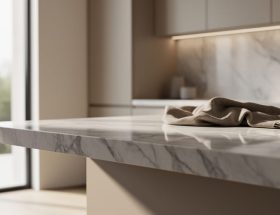
Marble remains the most sought-after stone for modern bathrooms, prized for its luminous quality and distinctive veining that transforms spaces into sophisticated sanctuaries. Carrara marble, sourced from Italian quarries, features soft gray veining on white backgrounds and offers accessible luxury for floors, shower walls, and vanity tops. Calacatta marble presents bolder, more dramatic veining with gold or gray tones and commands premium prices, making it ideal for statement walls or single-slab vanities where its patterns become focal points.
White marble varieties create the airy, light-filled aesthetic central to contemporary bathroom design. The stone’s crystalline structure reflects light beautifully, enhancing brightness even in smaller spaces. Book-matched slabs, where consecutive cuts create mirror-image patterns, amplify this effect on feature walls.
Marble requires regular sealing every six to twelve months to prevent water staining and etching from acidic products. Modern installations favor honed or leathered finishes over polished surfaces in wet areas, as these provide better slip resistance while minimizing visible water spots. Despite maintenance requirements, marble’s timeless elegance and natural variation ensure each bathroom remains unique, with no two installations ever identical.
Granite and Quartzite Options
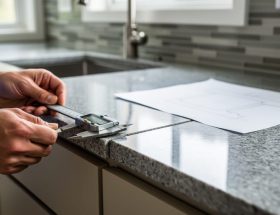
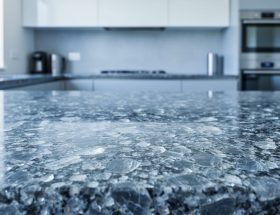
Granite and quartzite represent the workhorses of modern stone bathrooms, prized for their exceptional hardness and resistance to daily wear. Both materials score high on the Mohs scale, granite at 6-7, quartzite at 7, making them significantly more scratch-resistant than marble or limestone. This durability makes them ideal candidates for vanity tops, flooring in busy family bathrooms, and shower benches that see constant use.
The color range spans from dramatic blacks and deep grays to warm beiges, subtle whites, and even blues or greens with natural veining. Unlike marble’s bold patterns, granite typically displays speckled or mottled surfaces, while quartzite offers marble-like veining with superior toughness. Both stones resist etching from common bathroom products better than softer materials.
In practice, you’ll find granite most often on countertops where its proven track record and lower cost appeal to budget-conscious projects. Quartzite commands higher prices but delivers marble’s aesthetic without the vulnerability, making it a strategic choice for shower walls where both beauty and low maintenance matter. Both require initial sealing but need far less frequent reapplication than softer stones.
Limestone and Travertine
Limestone and travertine bring warmth and organic texture to modern bathrooms, offering softer alternatives to the polished formality of marble. Both stones form from sedimentary processes, creating naturally pitted surfaces that designers either preserve for rustic appeal or fill with resin for smoother finishes.
Travertine’s characteristic voids give it a distinctive character, unfilled and honed finishes emphasize natural texture, while filled and polished versions approach marble’s refinement at lower cost. Limestone presents subtler variation, with tight-grained varieties like German Jura creating elegant, monochromatic backdrops in minimalist spaces.
These stones excel in creating spa-like environments where visual warmth matters. Their matte, honed finishes reduce glare and hide water spots better than polished surfaces, making them practical for shower walls and flooring.
Both require diligent sealing, their porosity makes them vulnerable to staining from soaps, oils, and hard water. Expect to reseal every 12-18 months in wet areas. Avoid acidic cleaners entirely; even mild acids etch these calcium-based stones. Their softer composition also means they scratch more easily than granite, so consider traffic patterns when specifying locations.
Slate and Other Contemporary Choices
Slate brings built-in slip resistance to modern bathroom floors, its natural texture and dimensional stability making it practical for wet areas without sacrificing visual impact. The stone’s layered structure creates subtle surface variation that reads as sophisticated restraint in minimalist schemes, charcoal, graphite and deep green tones anchor contemporary palettes without competing for attention.
Soapstone appeals to designers seeking tactile warmth; its smooth, almost waxy finish resists water penetration naturally, though it darkens with mineral oil application. Expect soft grays with gentle veining rather than dramatic contrast. Basalt, increasingly specified in high-end projects, delivers near-black uniformity with fine grain, ideal for accent walls or vanity tops where understated luxury matters more than showy patterns. These stones share durability and low porosity, requiring minimal sealing compared to marble or limestone.
Key Design Elements and Installation Approaches
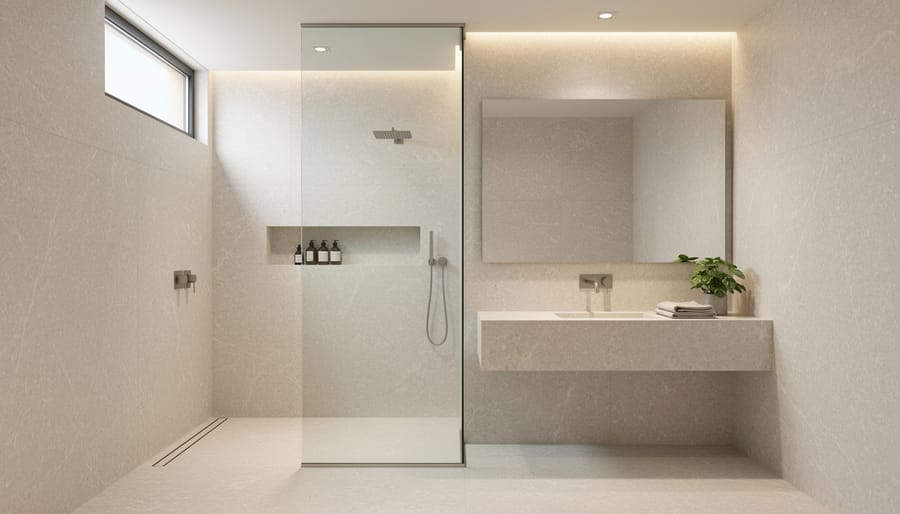
Modern stone bathroom design distinguishes itself through deliberate material choices and precise installation techniques that prioritize visual continuity and functional elegance. Large-format slabs form the foundation of this approach, with panels measuring 120 by 60 inches or larger reducing seam lines to near-invisibility. These expansive pieces transform walls into uninterrupted canvases of natural veining, creating the serene, cohesive look that defines contemporary stone spaces.
Book-matching and quarter-matching techniques elevate simple stone installation into architectural statement-making. Book-matching mirrors adjacent slabs along their edges like opened pages, creating symmetrical vein patterns that draw the eye and anchor the room’s visual hierarchy. Quarter-matching arranges four slabs around a central axis, producing kaleidoscopic effects particularly striking in shower enclosures or behind freestanding tubs. The choice between these approaches depends on the stone’s natural veining and the room’s proportions, with subtle marbles often benefiting from book-matching while dramatic stones can handle quarter-matching’s complexity.
Several core design principles define the modern stone bathroom aesthetic:
- Monolithic slab walls that eliminate visual breaks and grout lines
- Concealed drainage systems with linear or point drains instead of traditional curbs
- Invisible seams achieved through precise cutting and color-matched epoxy
- Integrated LED lighting within recessed stone niches and toe-kicks
- Material continuity flowing from floor to ceiling without transitional moldings
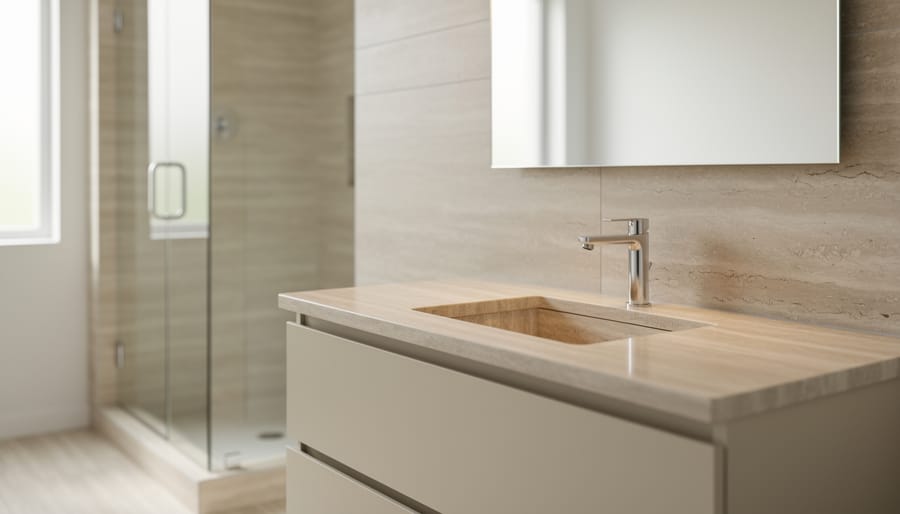
Integrated sinks carved from the same slab as the vanity counter exemplify this philosophy. The basin emerges from the stone surface without joints or mounting hardware, creating seamless transitions that prevent water infiltration and simplify cleaning. These require advanced stone design tools and CNC fabrication, but the result is a single functional sculpture rather than assembled components.
Curbless showers represent perhaps the most technically demanding element. The stone floor slopes gradually toward a linear drain, requiring precise Z-pattern stone finishing to achieve proper water flow without visible grading. Waterproofing membranes must extend well beyond the wet area, and the stone itself needs slip-resistant finishing even when wet.
Hardware integration completes the minimalist vision. Wall-mounted faucets eliminate deck-mounted fixtures, floating vanities hide plumbing behind continuous stone walls, and recessed medicine cabinets sit flush with stone surfaces. Each decision removes visual clutter, allowing the stone’s inherent beauty to dominate the space without competing for attention.
Where Modern Stone Bathrooms Work Best
Modern stone bathrooms adapt remarkably well to diverse spaces, though certain contexts showcase their strengths more effectively than others. Understanding where stone delivers the greatest impact helps you make informed decisions for your specific project.
Primary bathrooms offer the ideal canvas for comprehensive stone applications. These larger spaces accommodate expansive stone surfaces without overwhelming the room, from floor-to-ceiling marble slabs in the shower to granite vanity tops and limestone flooring. The square footage justifies the investment in premium materials, and daily use by multiple household members benefits from stone’s durability. Homeowners typically allocate larger budgets here, making elaborate installations with book-matched slabs and integrated stone fixtures financially feasible.
Powder rooms present a different opportunity. Their compact footprint means stone makes a dramatic statement without stretching budgets thin. A single marble accent wall or striking granite vanity transforms a small space into a memorable guest experience. The lower moisture exposure compared to full bathrooms reduces maintenance concerns, while limited square footage keeps material costs manageable.
En-suite bathrooms strike a middle ground, working beautifully with stone when designed thoughtfully. Focus stone applications on high-impact areas like the shower surround or vanity rather than every surface. This approach delivers luxury where you experience it most while managing costs in a secondary space.
Wet rooms, increasingly popular in contemporary design, practically demand stone’s water-resistant properties. Continuous stone flooring that extends from the shower area throughout the room creates seamless, spa-like environments. Quartzite and granite particularly excel here, handling constant moisture exposure better than softer stones.
High-end hospitality and commercial settings showcase stone’s durability advantage. Hotel bathrooms, upscale spa facilities, and luxury office washrooms benefit from stone’s ability to maintain appearance under heavy use while projecting quality that justifies premium pricing.
Climate matters less than you might expect. Radiant floor heating solves cold-surface concerns in northern regions, while stone’s thermal mass actually helps regulate temperature in varying conditions.
Real-World Modern Stone Bathroom Examples
Seeing stone bathroom concepts executed in real spaces demonstrates how theory translates to livable design. These four projects illustrate the range and adaptability of modern stone applications.
A 900-square-foot Chicago loft conversion showcases minimalist precision through book-matched Carrara marble slab walls in the primary bathroom. The designer eliminated grout lines by using 60×120-inch slabs, creating continuous white-gray veining that flows uninterrupted from floor to ceiling. A frameless glass enclosure separates the walk-in shower without visual barriers, while the floating vanity uses a single 10-foot marble slab folded to form countertop and integrated basin. Heated flooring addresses marble’s natural coolness. The outcome reflects principles seen in broader modern urban stone design clean geometry, material continuity, and sculptural simplicity in compact square footage.
A Scottsdale residence demonstrates spa-inspired design through contrasting stone textures. The 280-square-foot primary suite pairs honed travertine flooring with leathered black granite accent walls behind the freestanding soaking tub. Designers selected filled travertine to prevent water pooling in natural voids while maintaining organic surface texture. A rainfall shower features stacked slate tiles creating subtle horizontal striations. Ambient LED strips behind the granite wall create dramatic backlighting at night. The combination of warm beige travertine, dark granite, and textured slate provides visual interest while maintaining the serene, neutral palette essential to spa aesthetics.
A 45-square-foot Manhattan powder room proves stone works in tight quarters. Full-height book-matched Calacatta Gold marble creates the illusion of expanded space through dramatic veining that draws the eye vertically. A wall-mounted sink and concealed plumbing maximize floor area. The design relies on a single striking material rather than multiple competing finishes, a strategic choice that prevents visual clutter in confined dimensions.
A London townhouse wet room illustrates curbless accessibility through honed limestone. The 120-square-foot space uses consistent stone across all surfaces with a linear drain creating the necessary subtle slope. Large-format limestone tiles minimize grout lines while providing natural slip resistance when honed. The continuous stone plane from entry through shower demonstrates how proper installation achieves both barrier-free access and water management without sacrificing modern aesthetics.
Common Questions About Modern Stone Bathrooms
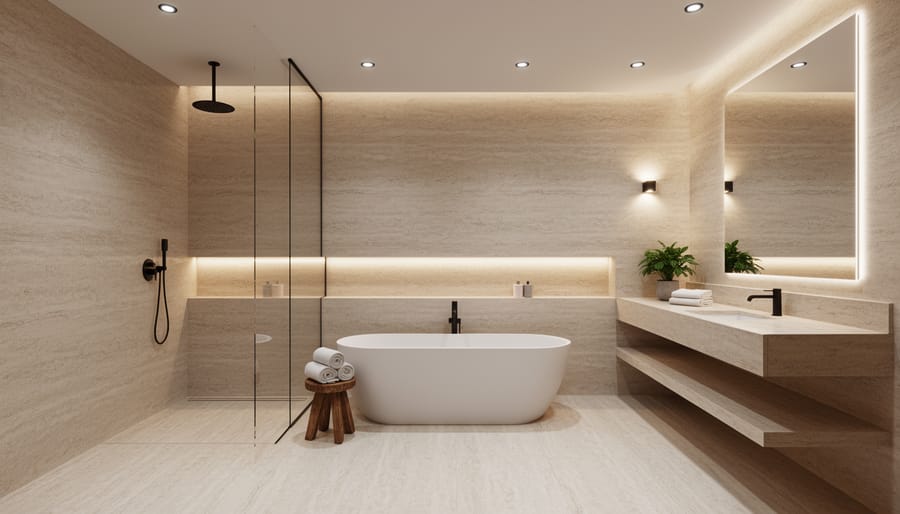
Most homeowners planning a modern stone bathroom have similar concerns before committing to the material. Understanding the practical realities, from budget to maintenance, helps you make informed decisions about whether stone fits your lifestyle and space.
How much does a modern stone bathroom cost in 2026?
Expect to invest $15,000 to $50,000 for a complete modern stone bathroom renovation, with material costs ranging from $15 to $200 per square foot depending on stone type and finish. High-end projects featuring book-matched marble slabs or digital stone technology applications can exceed $75,000.
How often does bathroom stone need sealing?
Porous stones like marble, limestone, and travertine require sealing every 6 to 12 months in wet bathroom environments. Denser materials such as granite and quartzite need resealing only every 2 to 3 years, while some treated stones come with factory sealants lasting up to 5 years.
Will stone flooring feel cold underfoot?
Natural stone retains ambient temperature, which can feel cool initially in cold climates. Installing radiant floor heating beneath stone solves this issue while adding luxury, and the stone’s thermal mass actually helps distribute heat efficiently once warmed.
Is stone slippery when wet in showers?
Polished stone can be slippery, but honed, brushed, or textured finishes provide excellent slip resistance. Slate naturally offers superior traction, and smaller mosaic tiles increase grout lines for added grip in wet areas.
Budget concerns often dictate stone selection. While Carrara marble costs $40 to $100 per square foot installed, premium Calacatta runs $150 to $250. Granite and quartzite fall in the middle at $60 to $120, offering durability that offsets higher upfront costs through longevity. Labor typically accounts for 40 to 50 percent of total project expenses, as professional installation ensures proper waterproofing and prevents costly failures.
Small bathrooms absolutely accommodate stone, though material selection matters. Large-format slabs create fewer grout lines and visually expand compact spaces. A powder room clad in book-matched marble makes a dramatic statement within 25 to 40 square feet, while continuous stone from floor to wall eliminates visual breaks that fragment tight layouts. Lighter stones such as white marble or pale limestone reflect light better than dark granite in windowless spaces.
Climate affects stone performance primarily through humidity and freeze-thaw cycles. In humid regions, prioritize ventilation and regular sealing to prevent moisture absorption and staining. Cold climates with exterior stone require freeze-resistant varieties like certain granites, though interior bathroom applications face no temperature-related limitations. Desert environments suit all stone types, though aggressive water minerals may require more frequent cleaning to prevent scale buildup on polished surfaces.
Resale value typically increases with quality stone installations. Real estate data shows bathrooms featuring natural stone command 5 to 8 percent higher sale prices than comparable homes with synthetic materials, provided the design remains timeless rather than trendy. Neutral stone choices in classic modern arrangements appeal to broader buyer pools than bold colored granite or overly specific aesthetic statements that date quickly.
Modern stone bathrooms represent more than a design trend, they embody a fundamental shift toward integrating natural materials with contemporary living in ways that balance beauty with everyday practicality. Throughout this exploration, we’ve seen how stone transforms from raw geological material into surfaces that define personal spaces: from marble’s veined elegance to granite’s resilient durability, from limestone’s warm texture to slate’s understated grip underfoot.
The mechanics are straightforward. Properly selected and installed stone withstands moisture, endures decades of use, and maintains its character with routine care that becomes second nature. Large-format slabs eliminate grout lines, curbless thresholds create seamless transitions, and book-matched panels turn functional walls into focal points. These aren’t complicated innovations, they’re thoughtful applications of materials that have anchored human shelter for millennia, now refined for modern expectations.
What makes these bathrooms compelling isn’t just their visual impact or their longevity, though both matter. It’s their versatility across contexts: the urban powder room clad in honed travertine, the spa-inspired suite with Calacatta shower walls, the compact wet room where slate does double duty. Stone adapts without losing its essential nature.
As you consider your own space, remember that choosing stone means choosing a material that ages rather than deteriorates, that gains patina instead of showing wear. It’s an investment in substance over novelty, in permanence over disposability, qualities that feel increasingly valuable in an ephemeral world.