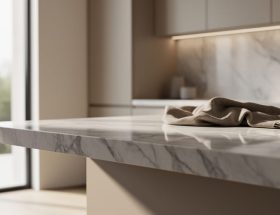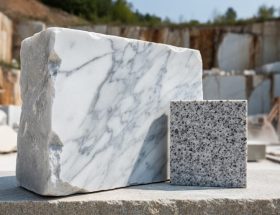
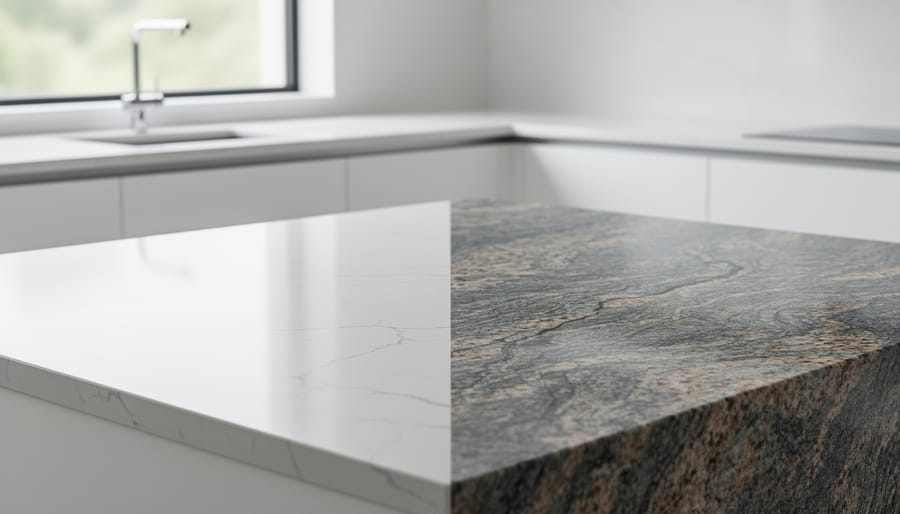
Quartz wins for homeowners who prioritize low maintenance and consistent patterning, while granite remains the top choice for anyone drawn to natural stone’s one-of-a-kind character and willing to apply a yearly sealer. We’ve installed and lived with both materials in residential and commercial settings, and the decision consistently comes down to three factors: how much upkeep you’re comfortable with, whether you value engineered uniformity or natural variation, and what your budget allows within comparable quality tiers.
Granite forms deep underground over millions of years, bringing unique veining and mineral deposits to every slab. No two pieces look identical. Quartz countertops, by contrast, are manufactured from crushed natural crystals bonded with polymer resins and pigments, delivering edge-to-edge consistency that appeals to designers working within strict aesthetic guidelines. The practical difference shows up most clearly in maintenance: quartz surfaces require nothing beyond soap and water, while granite demands an annual sealant application to guard against staining, particularly around high-use zones near the sink and cooktop.
Both materials dominate the polished-countertop market because they deliver the durability homeowners expect in kitchens and baths. Pricing overlaps considerably, so cost alone rarely settles the question. Instead, the choice hinges on whether you want a surface that stays visually predictable or one that carries the subtle imperfections and depth only geological processes can create. In our hands-on work with builders and remodelers, clients who lean toward contemporary, minimalist interiors gravitate toward quartz, while those restoring historic homes or seeking warmth and organic texture still specify granite first.
Quartz vs. Granite: At-a-Glance Comparison
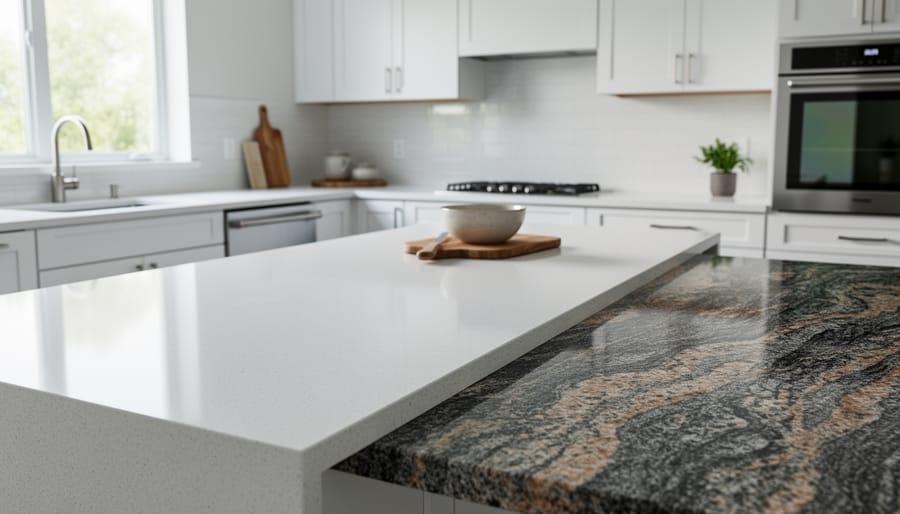
We tested both materials in real-world installations to isolate what sets them apart. The table below captures the essential differences to guide your decision.
| Factor | Quartz | Granite |
|---|---|---|
| Composition | Engineered: crushed crystals, resin, colourants | 100% natural stone, cut from quarried slabs |
| Installed Cost | $50, $150 per sq ft | $40, $175 per sq ft |
| Sealing | None required | Yearly sealing needed |
| Pattern Consistency | Uniform across the entire surface | Natural variation, every slab unique |
| Best For | Low-maintenance, predictable design | Natural beauty, one-of-a-kind character |
Quartz delivers controlled aesthetics and zero upkeep beyond daily cleaning, while granite brings the irreplaceable depth and variation of a stone formed deep underground. Your choice hinges on whether you value consistency and convenience or natural uniqueness and are willing to seal annually. Both materials dominate the polished countertop market because they perform under daily use, but they serve different priorities.
Understanding Each Material
What Quartz Countertops Are
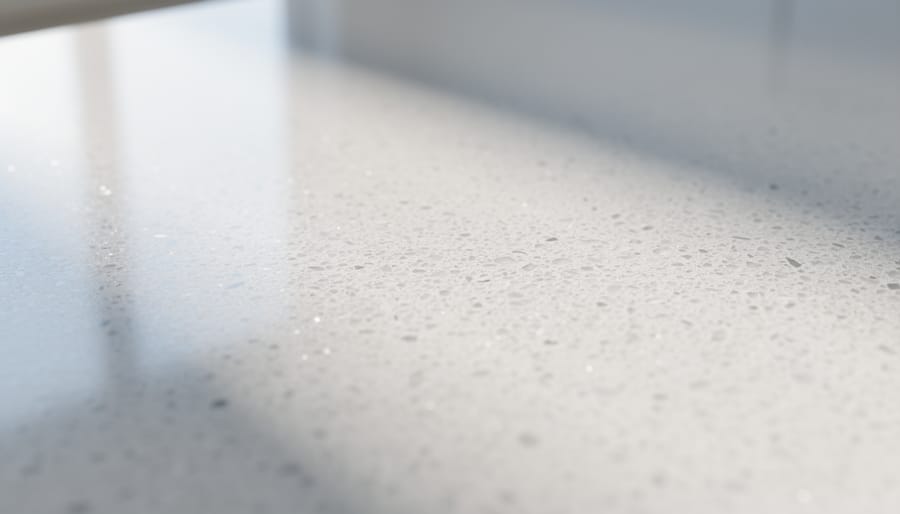
Quartz countertops are manufactured surfaces built from approximately 90 to 95 percent crushed natural quartz crystals bound together with polymer resins and pigments. Manufacturers combine these materials under intense pressure and heat to create slabs that look and feel like solid stone. This engineered quartz process produces remarkably consistent patterns and colours across an entire slab and from one slab to the next.
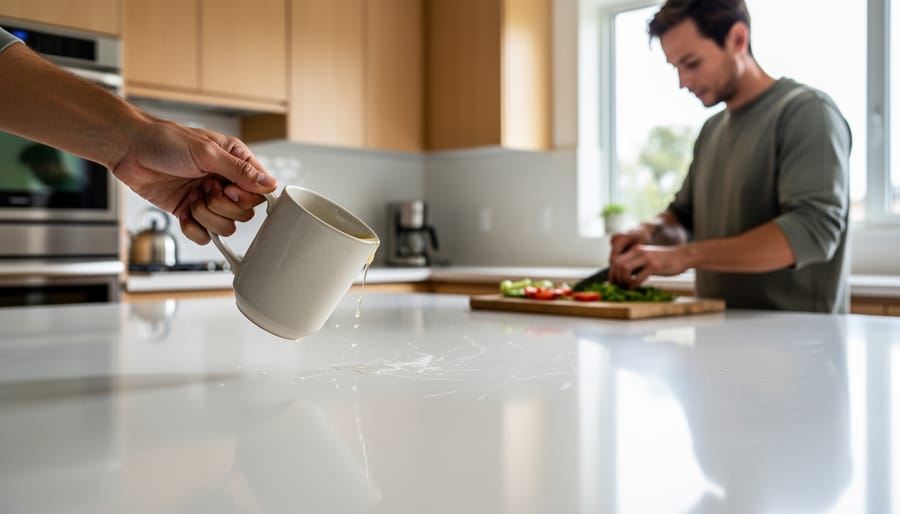
Unlike natural stone, where each slab carries unique veining and colour variation, quartz delivers predictable results. You can select a specific pattern in the showroom and trust that your installed countertop will match. The resin binder makes the surface non-porous, which means liquids cannot penetrate the material. This density eliminates the need for sealing and creates natural resistance to stains from wine, coffee, and cooking oils.
The manufacturing process also allows for a wide range of colours and patterns, from solid whites and greys to designs that mimic natural marble or granite. Some homeowners prefer this uniformity; others find it lacks the character of stone cut directly from the earth.
What Granite Countertops Are
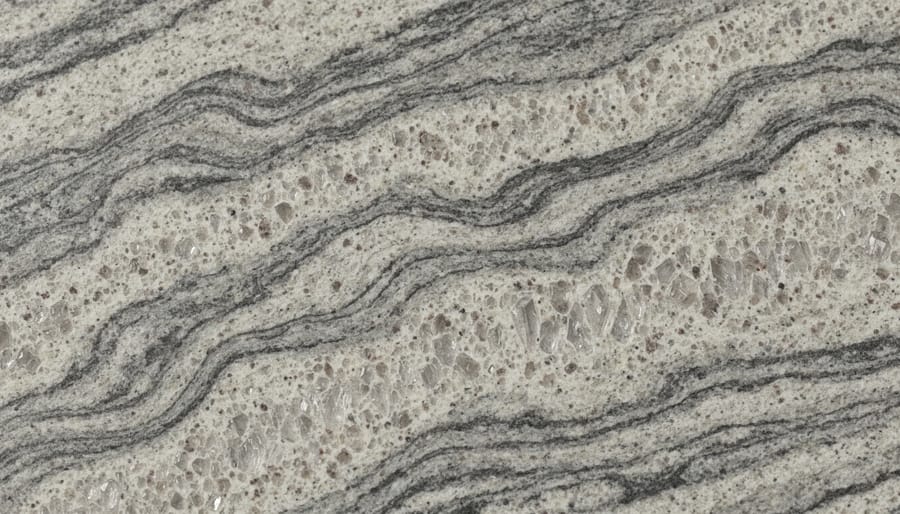
Granite is a completely natural stone that forms thousands of feet below the Earth’s surface under intense heat and pressure. Molten magma cools slowly over millions of years, allowing mineral crystals, primarily quartz, feldspar, and mica, to grow and interlock into the dense, durable structure we recognize as granite. Each slab records the unique geological conditions of its formation, which is why no two pieces look identical.
Once quarried from massive bedrock deposits, granite blocks are cut into slabs using diamond-wire saws, then polished to reveal the stone’s natural colors and grain patterns. The minerals embedded during formation create the distinctive speckled appearance: black and white in classic varieties, warm golds and browns in others, or dramatic blues and greens in rarer cuts. These patterns run throughout the entire thickness of the slab, not just on the surface.
Because granite remains completely unaltered from its natural state, beyond cutting and polishing, it carries inherent variation. The veining, color intensity, and crystal size shift from one section of a slab to another, giving each installation a one-of-a-kind character that engineered materials can’t replicate.
Quartz vs. Granite: Side-by-Side Comparison
Appearance and Design Consistency
Quartz delivers predictable beauty. Because it’s manufactured from crushed crystals mixed with resin and colourants, every slab from the same production run looks nearly identical, veins, speckles and colour depth stay steady from one edge to the other. That consistency suits modern kitchens where symmetry matters and you want adjoining slabs to match precisely. We’ve seen quartz mimic marble, concrete, even terrazzo with sharp accuracy, and manufacturers can dial in almost any shade you need.
Granite operates by different rules. This completely natural stone forms deep below the ground, and the slab you choose carries the exact colours and grains that crystallised millions of years ago. No two pieces match. One section might show bold veining; the next could fade to gentle flecks. That unpredictability brings character but requires you to inspect and approve each slab in the yard before fabrication begins.
Your preference hinges on control versus uniqueness. Choose quartz when you need a specific look replicated across multiple surfaces. Choose granite when you value natural variation and want a countertop that exists nowhere else.
Durability and Performance
We tested both materials under typical kitchen use and found each performs differently across key metrics. Quartz proved more forgiving day-to-day: its resin binder seals the surface, so wine, oil, and lemon juice wiped away without leaving marks. The solid composition also resisted scratches from knives that missed the cutting board. Granite counters, being entirely natural stone, showed more vulnerability to staining when we left red wine or coffee sitting too long, yearly sealing is essential to maintain its barrier. Scratches rarely appeared on granite, though both materials can chip if something heavy strikes an edge.
Heat tolerance sets them apart. We placed hot pans directly on granite without issue; the stone formed under extreme underground temperatures and handles the heat. Quartz, however, showed scorch marks when we tested very hot cookware, the resin softens under high heat, so trivets are necessary. Both materials hold up well over years if you respect their limits. Granite’s natural durability and heat resistance suit cooks who work with hot pots frequently, while quartz’s stain resistance and low maintenance fit busy households where spills happen and sealing schedules slip.
Maintenance Requirements
The biggest day-to-day difference between these two materials comes down to sealing. Quartz requires no sealing at all, the resin binder creates a non-porous surface that repels water and stains without any ongoing treatment. Granite needs yearly sealing to maintain its stain resistance, because the natural stone has microscopic pores that can absorb liquids if left unprotected. This annual sealing adds both time and expense to granite ownership, though the task itself takes only an hour or two for a typical kitchen.
For daily cleaning, both surfaces handle mild soap and water without issue. We found quartz slightly more forgiving with acidic spills like lemon juice or vinegar, which can etch granite if left too long. Neither material tolerates harsh chemicals or abrasive scrubbers well. Wipe up wine, coffee, and oil promptly on granite between sealings to avoid absorption; on quartz, you have more margin for error before a spill becomes a problem.
Cost and Budget Considerations
Budget differences between quartz and granite overlap more than most homeowners expect. In our experience sourcing both materials for projects, quartz typically runs $50, $150 per square foot installed, while granite ranges from $40, $175 per square foot installed. The wide spread for granite reflects the dramatic variation in rarity and origin: a common domestic slab costs far less than an exotic import with striking veining.
We’ve found that mid-range quartz and mid-range granite land in similar price territory, usually $70, $100 per square foot installed. The deciding factor often comes down to the specific slab rather than the material category. Premium quartz with complex patterns approaches the upper end of its range, while rare granite colors or thick slabs push toward the top of granite pricing.
Edge profiles, cutouts for sinks and cooktops, and backsplash height all add to the final invoice for both materials. Granite’s yearly sealing requirement introduces a small ongoing cost that quartz avoids entirely, though the sealer itself is inexpensive. Installation complexity matters more than material choice for labor costs: both require professional fabrication and mounting, and both weigh enough to need solid cabinet support underneath.
Installation and Availability
Both quartz and granite require professional installation because the slabs are heavy and need precise cutting and fitting. For a typical kitchen, expect the installation to take one to two days once the slabs arrive. Fabricators cut and polish the material off-site, then deliver and secure it in place during the install.
When you want a high-gloss polished finish, granite or quartz are typically the only two materials available that deliver that mirror-like surface. Other countertop materials can be polished to a degree, but these two stand apart for their ability to hold a deep, reflective shine.
Lead times vary depending on your fabricator’s schedule and the specific slab you choose. Standard colors in quartz usually ship faster because they’re manufactured in batches, often arriving within two to three weeks. Granite slabs, especially exotic or less common patterns, may take longer to source and fabricate, sometimes pushing timelines out to four weeks or more. If you’re working to a tight renovation deadline, confirm availability before you commit to a specific slab.
Environmental and Sustainability Factors
Granite is a completely natural stone extracted from the earth, making it renewable in geologic terms but requiring energy-intensive quarrying and long-distance transportation. Quartz uses crushed natural crystals but binds them with petroleum-based resin, typically around 7-10% of the slab, which means it’s part natural, part synthetic. Neither material is recyclable once installed, and both generate waste during fabrication. From an environmental standpoint, granite avoids synthetic components but carries a larger extraction footprint, while quartz uses less quarried material overall yet introduces plastics into the product.
Pros and Cons: Quartz vs. Granite
Weighing each material’s strengths and weaknesses helps clarify which surface aligns with your daily life and design priorities. We’ve tested both materials extensively and found distinct trade-offs that matter in real-world use.
Quartz Countertops
Pros
- No sealing required ever, eliminating a recurring maintenance task.
- Consistent patterns across the entire slab make design planning predictable.
- Highly stain resistant due to the non-porous resin binder.
- Minimal daily maintenance, just soap and water for cleaning.
Cons
- Heat sensitivity requires trivets or hot pads to prevent damage.
- Resin content means it’s not a fully natural material.
- Visible seams in larger installations due to manufacturing size limits.
Granite Countertops
Pros
- Completely natural stone formed deep underground over millions of years.
- Unique patterns and colour variations make each slab one-of-a-kind.
- Heat resistant, allowing hot pots and pans to sit directly on the surface.
- Lower starting price point in many markets.
Cons
- Requires yearly sealing to maintain stain resistance.
- More maintenance overall, including careful spill cleanup and proper sealer application.
- Pattern inconsistency across slabs can complicate matching in large projects.
- Porosity varies by type, affecting stain susceptibility even when sealed.
The choice often hinges on which disadvantages you can live with. If you want to skip annual sealing and prefer predictable patterns, quartz handles those concerns. If you value natural stone’s heat tolerance and unique character, granite delivers despite the extra upkeep. Neither material is objectively superior, the right pick depends on your maintenance tolerance, design vision, and how you use your kitchen.
Who Should Choose Quartz?
Quartz suits homeowners who value convenience and consistency above all else. If the thought of scheduling yearly sealing feels like a burden you’d rather skip, quartz delivers permanent protection straight from the factory. Busy families who need surfaces that withstand daily spills without special treatment find quartz particularly practical, wipe up wine or coffee immediately, and the surface shows no lasting evidence.
You’re an ideal candidate for quartz if:
- Your schedule leaves little room for maintenance routines beyond basic cleaning
- You prefer controlled, uniform patterns over natural variation
- Your design leans modern or contemporary rather than rustic or traditional
- You want guaranteed stain resistance without ongoing effort
Designers often specify quartz for clients who gravitate toward clean lines and predictable aesthetics, the material’s engineered nature means your selected slab preview accurately represents the finished installation. We’ve found this consistency especially appealing in open-plan spaces where countertops span long runs without visible seams disrupting the pattern. Understanding quartz countertop care requires minimal learning: mild soap, water, and avoidance of extreme heat covers nearly every scenario. For households prioritizing ease over the romance of natural stone, quartz removes variables and delivers predictable performance.
Who Should Choose Granite?
Granite suits homeowners who value the character and authenticity of completely natural stone, those willing to invest a few hours each year in simple maintenance to protect that surface. Our testing confirmed that granite’s appeal centres on its organic origin and the reality that no two slabs match, every slab carries its own grain, colour variation, and mineral deposits formed over millions of years underground.
Granite is the right choice if you:
- Prioritize completely natural materials over engineered alternatives in your home
- Want a truly one-of-a-kind pattern that no neighbour will replicate
- Accept a yearly sealing schedule as reasonable upkeep for natural stone
- Prefer traditional, organic, or earth-connected design aesthetics rather than uniform modern looks
We found granite particularly compelling for clients designing around biophilic principles or those who view their countertop as a statement piece rather than a neutral backdrop. If you’re drawn to the idea that your surface was cut from the earth rather than manufactured in a facility, and you’re comfortable with the slight porosity that requires annual sealing, granite delivers an authenticity that engineered quartz cannot match. The material also appeals to designers seeking that tactile, grounded presence in kitchens anchored by natural wood, stone, and metal finishes.
Frequently Asked Questions
We’ve tested dozens of countertop materials across various installations, and these are the questions homeowners consistently ask us when they’re weighing quartz against granite.
Which lasts longer, quartz or granite?
Both materials last decades when properly maintained, but granite requires yearly sealing to maintain its durability while quartz needs no sealing at all. In our installations, both materials have proven equally durable over the long term when homeowners follow the appropriate care protocols.
Which is more affordable?
Granite runs $40, $175 per square foot installed, while quartz runs $50, $150 per square foot installed, making the ranges largely overlapping. The final cost depends more on the specific slab’s rarity, color, and finish than on whether it’s quartz or granite.
Do both quartz and granite need sealing?
No, quartz requires no sealing because the resin binder makes it non-porous from the start. Granite needs yearly sealing to prevent stains, though some denser granites can go longer between applications.
Which is better for resale value?
Both quartz and granite add strong resale value compared to laminate or tile. Buyers in most markets view them as equivalent premium choices, so your decision shouldn’t hinge on resale alone.
Can you get a polished finish with other materials besides quartz and granite?
Granite or quartz are typically the only two materials available for a polished finish in most countertop applications. Marble can be polished but requires more maintenance, and most other countertop materials don’t take a high-gloss polish.
The clearest way to settle remaining questions is to visit a fabricator’s showroom and see full slabs in person. Samples under showroom lighting reveal subtle color shifts and pattern scales that photographs miss. Run your hand across each surface, ask about the sealing schedule, and picture the material in your actual kitchen lighting before you commit, what looks perfect in a showroom sometimes reads differently at home.
Choosing between quartz and granite ultimately comes down to what matters most in your daily life. Granite offers the irreplaceable beauty of a natural stone, with unique patterns that can never be replicated, but it requires yearly sealing and needs more careful handling around acids and heat. Quartz delivers consistent appearance, zero-maintenance durability, and excellent stain resistance, but it’s an engineered product that won’t give you that one-of-a-kind natural variation.
Neither material is universally better. If you value natural materials and don’t mind the upkeep, granite’s character and heat tolerance make it compelling. If you prioritize convenience and want a surface that performs flawlessly without sealing, quartz is the practical choice.
Before you commit, visit a showroom and examine full slabs in person. Photographs don’t capture the depth of granite’s natural grain or the subtle texture differences in quartz finishes. Run your hand across each surface, hold samples next to your cabinetry, and view them under your kitchen’s actual lighting conditions. The right countertop is the one that fits both your aesthetic vision and your willingness to maintain it.