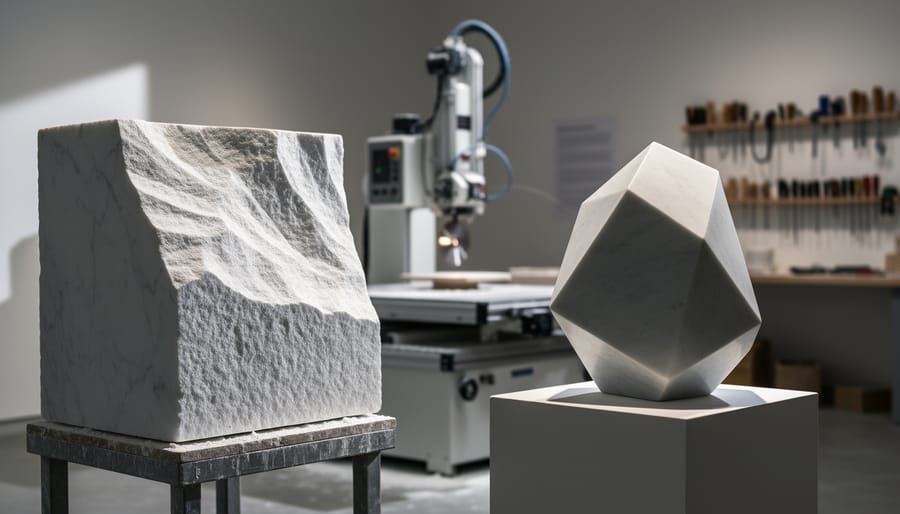
Contemporary stone sculpture is the practice of carving, shaping, or constructing three-dimensional artworks from natural stone using both traditional hand tools and modern technologies such as diamond wire saws, CNC routers, and pneumatic chisers. Unlike the representational traditions of classical sculpture, today’s stone sculptors embrace a wider spectrum of approaches, from abstract geometric forms to conceptual installations that explore the material’s geological and cultural histories.
This art form bridges ancient craft and cutting-edge expression. While early civilizations carved stone primarily for religious monuments and commemorative statuary, contemporary practitioners treat stone as a medium for personal vision, environmental commentary, and architectural integration. The shift matters because it has expanded where and how stone sculpture appears in public spaces, galleries, and private collections, transforming perception of what stone can communicate beyond permanence and monumentality.
What makes contemporary stone sculpture distinctive is its material diversity and conceptual range. Artists work with marble, granite, limestone, sandstone, basalt, and soapstone, selecting each for specific visual, tactile, and symbolic qualities. Some honor the stone’s natural character through minimal intervention, while others push technical boundaries with gravity-defying forms or hybrid works combining stone with metal, glass, or light.
This article explains how contemporary stone sculptors approach their craft, the materials and methods they employ, the major stylistic movements shaping the field, and where you’ll encounter these works in 2026. Whether you’re a design professional considering stone sculpture for a project or simply curious about this enduring art form, understanding its current practice reveals how an ancient material continues to evolve.
What Contemporary Stone Sculpture Means in Today’s Art World
Contemporary stone sculpture refers to works created roughly from the 1970s onward by artists who choose stone as their primary medium while engaging with current artistic dialogues, technologies, and cultural concerns. Unlike classical stone sculpture, which typically emphasized idealized human forms and mythological narratives, or even modern sculpture’s break with representation, contemporary work encompasses an expansive range of approaches, from pure abstraction to conceptual installations, unified more by temporal context and artistic intention than by a single style or philosophy.
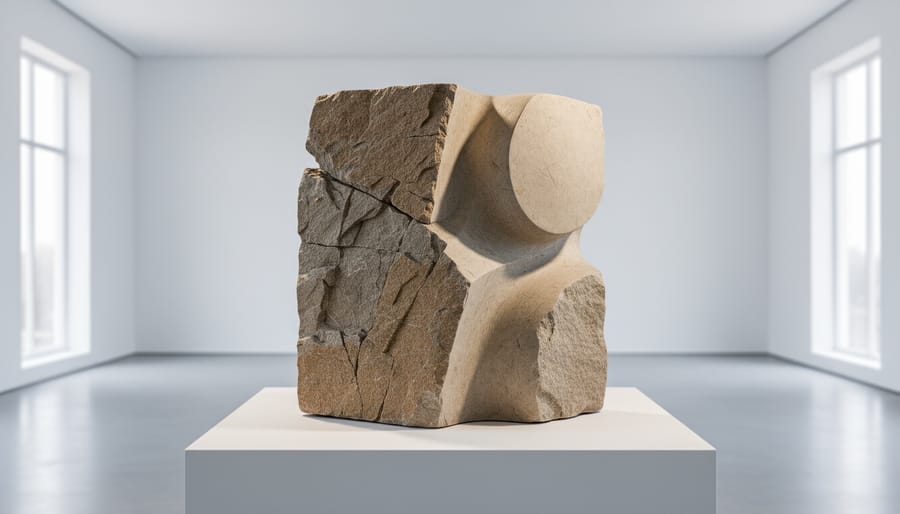
What distinguishes contemporary stone sculpture is not merely its timeline but its relationship to the material itself. Today’s artists often foreground stone’s physical properties, weight, texture, geological history, as integral to a work’s meaning rather than treating it as a neutral medium for representing something else. A contemporary sculptor might leave chisel marks visible, incorporate the stone’s natural fissures into the design, or juxtapose polished and rough surfaces to create tension between refinement and rawness. This material consciousness reflects broader contemporary art values: authenticity, process transparency, and respect for the object’s own nature.
Several concepts help clarify what contemporary stone sculpture encompasses:
- Contemporary Period
- Generally refers to art made from the 1970s to the present, characterized by pluralism, conceptual depth, and the dissolution of rigid stylistic movements. In stone sculpture, this means no single aesthetic dominates.
- Stone Carving vs. Stone Sculpture
- Carving implies subtractive process (removing material), while sculpture broadly includes any three-dimensional art form. Contemporary artists may combine carving with assemblage, casting, or digital fabrication.
- Site-Specific Work
- Sculpture designed for a particular location, where the relationship between artwork, architecture, landscape, and viewer is essential to its meaning and cannot be replicated elsewhere.
- Direct Carving
- Working the stone without preliminary models, allowing the material’s qualities and the carving process itself to guide formal decisions. Many contemporary sculptors value this intuitive, responsive approach.
The philosophical shift matters as much as technique. Where classical sculpture often served religious or commemorative functions, and modern sculpture explored form for its own sake, contemporary stone work frequently addresses identity, environment, memory, and cultural exchange. An artist might reference ancient carving traditions from their heritage while creating something entirely new, or use monumental stone to comment on impermanence and ecological fragility. The medium carries 40,000 years of human history, and contemporary sculptors leverage that weight, sometimes honoring it, sometimes subverting it, always aware of the conversation between past and present that working in stone inevitably creates.
How Contemporary Stone Sculptors Work
Traditional Techniques Meet Modern Technology
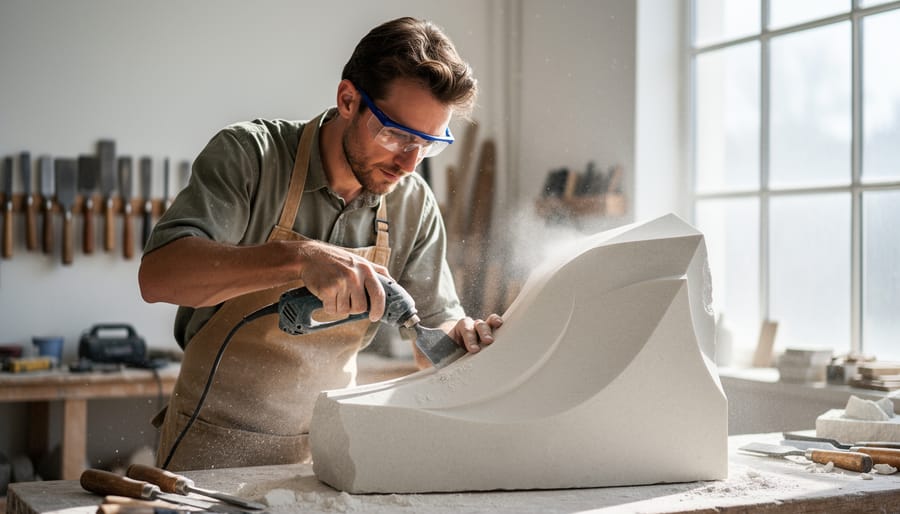
Contemporary stone sculptors stand at a unique crossroads, drawing from techniques perfected over millennia while embracing innovations that would have astonished their predecessors. Many artists begin with hand tools, hammers, chisels, rasps, that connect them directly to the material’s resistance and grain. The physical dialogue between sculptor and stone remains central: feeling where the material wants to split, reading the subtle shifts in color that signal changes in density, making intuitive adjustments that no machine can replicate.
Yet the same artist might employ diamond wire saws to rough out a massive block, saving weeks of brutal physical labor. CNC routers can execute complex undercuts or replicate a clay model at precise scale, freeing sculptors to focus on surface refinement and conceptual development. Water jet cutters slice through granite with surgical precision, opening possibilities for intricate patterns that hand tools would struggle to achieve. Digital technology like 3D scanning allows artists to capture organic forms, a model’s gesture, a tree’s branch structure, and translate them into stone with remarkable fidelity.
The choice between traditional and modern approaches isn’t either-or but strategic. Sculptors working in hard stones like basalt or black granite rely heavily on power tools for efficiency, while those pursuing subtle surface textures may spend months with hand files and abrasives. Many reserve machine work for initial blocking and use hand tools for final surfaces, believing the marks of human touch give work its emotional resonance. The technology expands what’s possible; the artist’s judgment determines what’s meaningful.
From Quarry Selection to Final Installation
The journey from raw stone to completed sculpture begins at the quarry, where artists must balance aesthetic vision with practical reality. Contemporary sculptors often visit quarries personally, examining blocks for color consistency, grain patterns, and structural integrity. A vein of darker mineral running through white marble might inspire one artist while disqualifying the stone for another’s geometric vision. Sculptors working at monumental scale may need to coordinate extraction of specific blocks years before carving begins, ensuring the stone meets both dimensional and compositional requirements.
Scale planning starts during material selection. A fifteen-ton granite piece demands different quarry access, transportation logistics, and studio infrastructure than a tabletop-sized alabaster work. Artists calculate not just the finished sculpture’s dimensions but the waste material removed during carving, a figurative work might require a block three times the volume of the final piece. Site considerations enter early: will the work sit outdoors exposed to freeze-thaw cycles and pollution, or indoors where more delicate stones remain viable?
Working with stone means accepting unpredictability. Hidden fissures may appear mid-carving, forcing design adjustments. Fossil pockets in limestone or crystal formations in granite become features to incorporate rather than flaws to eliminate. Experienced sculptors develop contingency plans, maintaining flexibility within their conceptual framework.
Installation requirements shape the entire process. Outdoor works need engineered foundations, proper drainage, and sometimes steel armatures concealed within the stone. Indoor pieces require floor load calculations and careful path planning through doorways. Many contemporary sculptors now design with disassembly in mind, creating modular components that facilitate transport to exhibitions while appearing seamless when installed. The most successful works acknowledge these practical constraints during conception, not as afterthoughts.
Forms and Styles in Contemporary Stone Sculpture
Abstract and Minimalist Works
Abstract and minimalist stone sculpture strips away narrative and representation to focus on the material’s essential nature. These works explore pure form through geometric shapes, spheres, cubes, cylinders, or precisely cut angles, that reveal how light interacts with polished or textured surfaces. The grain patterns in marble, the crystalline structure of granite, or the layered striations in limestone become central to the work’s visual impact rather than incidental details.
Sculptors working in this vein often embrace reductive processes, carving away material to arrive at elemental forms that feel both ancient and contemporary. A single block might be shaped into a perfect ovoid that sits directly on the ground, its weight and mass creating a physical presence that viewers experience spatially rather than interpret symbolically. Others create geometric compositions that play with positive and negative space, cutting precise voids through solid stone or balancing multiple forms in careful relationships.
Artists like Isamu Noguchi pioneered this approach in the mid-twentieth century, but contemporary practitioners continue pushing these ideas forward. They might polish one surface to mirror-like perfection while leaving another rough from the quarry, creating deliberate contrasts that heighten awareness of the stone’s transformation from raw material to refined object.
Figurative and Representational Sculpture
While classical stone sculpture idealized the human form, today’s figurative artists use the medium to explore fragmented identity, cultural memory, and social tension. Contemporary stone figures often appear incomplete, distorted, or deliberately rough-hewn, surfaces left partially uncarved to contrast polished anatomy with raw stone, suggesting bodies emerging from or dissolving back into matter.
Many sculptors work at the intersection of tradition and critique. Figures might adopt classical contrapposto poses while bearing contemporary scars, prosthetics, or cultural markers that address displacement, gender, trauma, or race. The stone’s permanence creates pointed irony when depicting vulnerable or marginalized subjects, transforming marble’s historical association with power and immortality into commentary on whose bodies get memorialized.
Scale matters differently now. Monumental figures command public spaces with activist messages, while intimate portrait busts in galleries demand close viewing to reveal psychological nuance, a furrowed brow carved with obsessive detail, capturing anxiety rather than nobility. The stone itself becomes metaphor: alabaster’s translucency for vulnerability, granite’s density for endurance, limestone’s fossil layers for embedded histories.
Environmental and Site-Specific Installations
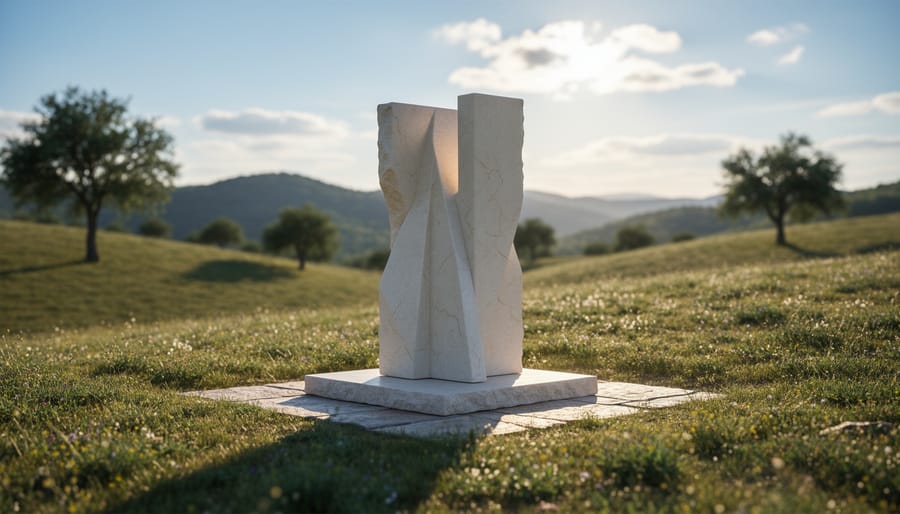
Contemporary stone sculpture reaches monumental scale in environmental and site-specific installations, where the work becomes inseparable from its location. These pieces engage directly with landscape, architecture, or urban context, transforming how viewers experience both the sculpture and its surroundings.
Land art pioneers like Andy Goldsworthy use locally sourced stone to create cairns, walls, and arrangements that respond to topography, weather patterns, and seasonal changes. The stone’s geological connection to place becomes part of the artwork’s meaning. In urban settings, sculptors design pieces that complement architectural lines, frame sightlines, or create gathering spaces within public plazas.
Site-specific installations consider sun angles casting shadows across carved surfaces, how visitors move around and through the work, and the stone’s visual relationship to existing materials, concrete, glass, brick. Some artists incorporate water features or plantings that grow around the stone over time. Scale matters tremendously: a ten-ton granite form commands space differently in a forest clearing versus a museum courtyard. The most successful environmental installations feel inevitable, as if the stone has always belonged exactly there.
Conceptual and Mixed-Media Approaches
Contemporary stone sculptors increasingly break with the material’s monolithic tradition by integrating it into hybrid works that expand what stone sculpture can express. Rather than viewing stone as a self-sufficient medium, these artists combine it with contrasting materials to create dialogues between weight and lightness, permanence and transience, or natural and manufactured. A granite form might be paired with delicate glass elements that catch light, emphasizing the stone’s opacity through contrast. Metal components, whether rusted steel, polished bronze, or industrial aluminum, can frame stone fragments or grow organically from carved surfaces, suggesting transformation or decay. Water features transform static stone into kinetic sculpture, with liquid flowing over carved channels or pooling in basins to activate reflective surfaces and introduce sound.
Artists working conceptually use stone to question assumptions about permanence, value, and cultural memory. Some deliberately fracture or fragment stone pieces, challenging expectations of wholeness and monumental stability. Others juxtapose rough quarry blocks with highly polished sections, exposing the labor and aesthetic choices embedded in finishing processes. Common approaches include:
- Combining stone with transparent materials (glass, resin, acrylic) to create visual layering and play with solid versus void
- Integrating LED lighting within or beneath stone to reveal internal structure, veining, or translucency
- Pairing stone with organic materials (wood, fiber, plant matter) to explore cycles of growth and geological time
- Using stone fragments as readymades or found objects, recontextualizing quarry waste or architectural salvage
- Incorporating sound elements that resonate through stone’s density or respond to viewer interaction
These mixed-media strategies allow sculptors to address contemporary themes, environmental change, technological mediation, cultural displacement, that pure stone work might struggle to convey. The material becomes one voice in a larger conversation rather than the sole subject, opening stone sculpture to narrative complexity and conceptual depth that honor the medium’s history while firmly anchoring it in present concerns.
Stone Types and Their Contemporary Applications
Contemporary sculptors select stone types based on both aesthetic vision and practical considerations, with each material offering distinct qualities that influence the final work. The choice extends beyond appearance to encompass workability, durability, and how the stone’s inherent characteristics can serve the artistic concept.
Marble remains a favorite for its translucency and fine grain, which allows for detailed carving and smooth surface finishes. White Carrara and Statuario marbles continue to attract sculptors seeking purity of form, while colored varieties, including green, pink, and black marbles, provide dramatic visual impact. The stone’s slight translucency creates subtle depth effects when light penetrates the surface, making it ideal for works exploring themes of transformation or ethereality. However, marble’s relative softness and vulnerability to weathering limit its use in harsh outdoor environments.
Granite offers exceptional durability and resistance to weathering, making it the preferred choice for monumental public installations and outdoor site-specific works. Its hardness presents technical challenges, requiring diamond tools and often pneumatic equipment, but yields sculptures that can withstand decades of exposure. Contemporary artists exploit granite’s varied colors, from deep blacks and reds to speckled grays, and its ability to take either high polish or rough, textured finishes. The material’s toughness particularly suits bold, geometric forms.
Limestone and sandstone provide warmer, more porous alternatives with easier workability. These sedimentary stones carve readily with both traditional and power tools, allowing for expressive mark-making and textured surfaces. Their earthy tones, cream, buff, ochre, integrate naturally into landscape settings. The trade-off is lower weather resistance; outdoor limestone works gradually erode, which some artists embrace as part of the sculpture’s life cycle.
Alabaster attracts sculptors drawn to luminous, translucent effects. This soft stone carves easily and polishes to a glowing finish, though its fragility restricts it to indoor settings and smaller scales. Contemporary artists use alabaster for intimate works where light transmission becomes central to the concept.
Basalt and other volcanic stones provide dense, dark materials with unique textures. Basalt’s near-black color and fine grain suit minimalist abstractions and works requiring visual weight. Its hardness demands specialized equipment but rewards sculptors with extraordinary permanence.
The selection process also considers regional availability, transportation costs for large-scale works, and environmental impact, factors that increasingly influence contemporary practice as artists consider the full lifecycle of their materials.
Where Contemporary Stone Sculpture Is Used
Public Art and Urban Spaces
Contemporary stone sculpture transforms public spaces into sites of artistic engagement, offering communities permanent landmarks that withstand decades of weather and urban wear. Cities commission these works for plazas, parks, transit stations, and government buildings, seeking pieces that reflect civic identity while creating visual anchors in the built environment.
The commissioning process typically begins with public art programs or developer requirements, involving open calls, panel reviews, and community input sessions. Artists submit proposals showing how their vision responds to the site’s history, architecture, and pedestrian flow. Successful projects balance artistic ambition with practical constraints, weight loads, maintenance access, public safety, and budget realities that can range from $50,000 for small plaza pieces to millions for signature installations.
Durability drives material selection: granite and basalt endure harsh climates better than softer limestones, though the latter offer warmer tones for pedestrian-scale works. Some contemporary sculptors reference ancient precedents, the resilience of Mayan stone monuments in tropical environments informs choices for humidity-prone regions. Surface treatments matter too: polished finishes resist graffiti but show scratches, while rougher textures hide wear but collect grime. Installation requires engineering coordination, foundation analysis, and sometimes cultural protocols when work addresses indigenous heritage or contentious histories.
Gallery and Museum Exhibitions
Contemporary stone sculpture occupies prominent space in museums and galleries worldwide, where curators present these works to highlight both material mastery and conceptual depth. Major institutions like the Yorkshire Sculpture Park, Storm King Art Center, and the Hakone Open-Air Museum maintain dedicated galleries for stone pieces, controlling lighting and climate to showcase subtle surface treatments and intricate detail work.
International biennales, Venice, Documenta, Sydney, regularly feature ambitious stone installations that challenge traditional display conventions. Artists exploit the gallery’s white-cube environment to create dramatic contrasts between raw stone and refined architectural spaces, or they intervene directly with existing structures.
Museum acquisitions typically focus on works that represent significant artistic movements or technical innovations. Permanent collections at institutions like Tate Modern, the Museum of Modern Art, and Centre Pompidou include stone sculptures that document the medium’s evolution from minimalist experiments to contemporary hybrid approaches.
Temporary exhibitions often group stone works thematically, exploring texture, monumentality, or cultural heritage, allowing viewers to compare how different artists manipulate similar materials toward divergent ends. These curated presentations emphasize stone sculpture’s continued relevance within contemporary art discourse.
Private Collections and Residential Settings
Contemporary stone sculpture finds a natural home in private residences and gardens, where collectors commission pieces that resonate with their personal aesthetic and architectural vision. Unlike public installations, residential works typically range from tabletop-scale compositions to garden pieces standing six to eight feet tall. These sculptures function as focal points in living spaces, meditation gardens, or outdoor terraces, transforming everyday environments into curated experiences.
Successful integration depends on understanding scale, sightlines, and the dialogue between sculpture and architecture. A massive granite piece might overwhelm a modest courtyard, while an alabaster work requires protection from weather exposure. Collectors often work directly with sculptors to develop site-specific commissions, considering factors like natural lighting throughout the day, viewing angles from interior rooms, and how the stone’s color complements surrounding materials.
Corporate collections follow similar principles but emphasize works that reflect brand identity or create conversation in lobbies and conference areas. Durability becomes paramount, marble and granite withstand high-traffic environments better than softer stones. Many collectors value contemporary stone sculpture for its permanence and connection to elemental materials, qualities that distinguish it from other contemporary art forms in domestic and professional settings.
Cultural Perspectives and Global Influences
Contemporary stone sculpture today is inherently global, drawing from rich traditions that span continents and millennia. Artists worldwide bring distinct cultural lenses to the medium, creating works that reinterpret ancestral techniques through contemporary perspectives. This cross-pollination has revitalized stone carving as both a living tradition and a vehicle for cultural dialogue.
In Zimbabwe, sculptors working in serpentine stone have transformed the Shona tradition into an internationally recognized contemporary movement. Artists like Tapfuma Gutsa merge traditional spiritual iconography with abstract forms that speak to post-colonial identity and globalization. Their work demonstrates how regional stone-working practices can evolve into distinctly modern expressions without severing ties to cultural origins.
Japanese sculptors continue the dialogue between ancient stone Buddhist sculpture and minimalist aesthetics, often working with local granite in ways that emphasize negative space and meditative simplicity. This approach contrasts sharply with the Western sculptural tradition’s focus on volume and mass, offering alternative philosophies about how stone can occupy space and engage viewers.
Indigenous artists in North America and Australia increasingly use stone to assert cultural continuity and address colonial histories. Haida artist Jim Hart’s monumental works in basalt draw from Pacific Northwest Coast traditions while incorporating contemporary environmental themes. Similarly, Aboriginal Australian artists working with local sandstone embed Dreamtime narratives in forms that contemporary audiences read through multiple cultural frameworks.
Latin American sculptors often combine pre-Columbian stone-working techniques with modernist formal languages. Mexican artists, for instance, might reference Olmec or Aztec monumentality while exploring abstraction, creating works that exist simultaneously in multiple time frames.
This global exchange has practical dimensions too. A sculptor trained in Italy’s Carrara workshops might collaborate with craftspeople in Rajasthan, blending Mediterranean marble traditions with Indian ornamentation. Chinese sculptors educated in Western academies return home to reinterpret classical Chinese jade carving at architectural scales. The result is a contemporary stone sculpture field where techniques, materials, and meanings cross borders freely, enriching the medium with perspectives no single tradition could provide alone.
Notable Contemporary Stone Sculptors and Case Studies
The global landscape of contemporary stone sculpture includes artists working at vastly different scales and with divergent philosophies, yet all share an intimate understanding of their material’s possibilities and limitations.
Anish Kapoor has created monumental works in stone that challenge perception and space. His granite and marble pieces often feature polished, void-like surfaces that seem to absorb light rather than reflect it. “Cloud Gate” in Chicago, though stainless steel, demonstrates principles he also applies to stone, creating forms that alter viewers’ relationship to their surroundings. His marble works for major exhibitions have pushed the boundaries of how highly-polished stone can distort and frame space.
Ursula von Rydingsvard brings an entirely different sensibility, working primarily with cedar but occasionally incorporating stone into mixed-media pieces that explore texture, memory, and ancestral connection. When she does use stone, particularly in smaller works paired with bronze or wood, the material’s permanence contrasts powerfully with organic elements.
Peter Randall-Page exemplifies the intersection of natural form and abstract pattern. His large-scale granite works, including “Seed” at the Eden Project in Cornwall, draw directly from botanical structures and mathematical principles found in nature. He carves complex, rhythmic patterns into hard stone, creating surfaces that invite both visual and tactile exploration. His approach demonstrates how contemporary sculptors can honor stone’s geological history while imposing human ordering systems.
Several other artists have made significant contributions:
- Isamu Noguchi (though working mid-20th century, his influence extends into contemporary practice), basalt, granite, marble; biomorphic forms bridging Eastern and Western aesthetics; major public installations worldwide
- Magdalena Abakanowiczgranite and bronze combinations; figurative-abstract works addressing human vulnerability and collective experience; “Space of Stone” installations
- Andy Goldsworthysandstone, limestone, slate; ephemeral and permanent site-specific works; documented through photography as works weather and change
- Emily Youngmarble, alabaster; portrait heads and abstract forms; works that engage with art-historical traditions while maintaining contemporary relevance
- Martin Cooneylimestone, sandstone; architectural-scale abstract forms; works exploring geometry and the relationship between mass and void
These artists approach stone preservation not just as maintenance but as an artistic consideration from the outset, choosing materials and finishes that will age gracefully or designing works that acknowledge natural weathering as part of their life cycle, quite different from efforts to save gravestones from historical deterioration.
What unites these diverse practitioners is their refusal to treat stone as merely difficult material to be conquered. Instead, they collaborate with its grain, faults, and geological character, allowing the material itself to inform the final form.
Common Questions About Contemporary Stone Sculpture
Contemporary stone sculpture raises many practical and artistic questions for collectors, commissioners, and enthusiasts. Here are answers to the most common inquiries about this enduring medium.
How much does contemporary stone sculpture typically cost?
Prices vary dramatically based on the artist’s reputation, scale, stone type, and complexity, ranging from a few thousand dollars for smaller works by emerging artists to hundreds of thousands or millions for major pieces by established sculptors. Commission costs also include quarrying, transportation, and installation expenses, which can be substantial for large-scale works.
Can stone sculptures withstand outdoor weather conditions?
Most dense stones like granite and basalt handle outdoor exposure extremely well, lasting centuries with minimal maintenance. Softer stones such as marble, limestone, and sandstone require more careful consideration of climate, periodic cleaning, and sometimes protective treatments to prevent weathering and biological growth.
How does contemporary stone sculpture differ from classical work?
While both use similar materials and some traditional techniques, contemporary sculpture emphasizes conceptual exploration, abstraction, and personal expression over idealized representation. Contemporary artists often blend stone with other media, challenge the material’s conventional use, or engage with social and environmental themes rather than purely aesthetic or commemorative purposes.
What’s involved in commissioning a contemporary stone sculpture?
Commissioning typically begins with consultations about vision, budget, timeline, and site requirements, followed by the artist’s proposal with sketches or models. The process includes selecting appropriate stone, approving the design, monitoring fabrication progress, and coordinating delivery and installation, often taking six months to several years depending on scale and complexity.
Beyond these practical considerations, potential collectors and commissioners often wonder about maintenance requirements. Stone sculpture demands far less upkeep than many assume. Indoor pieces need only occasional dusting and protection from extreme temperature fluctuations. Outdoor works benefit from annual cleaning with water and soft brushes, inspection of mounting systems, and attention to drainage around bases to prevent water accumulation that can cause damage through freeze-thaw cycles.
The question of authenticity and attribution also arises in contemporary practice. Unlike historical works where provenance can be murky, contemporary sculptures come with clear documentation of authorship, fabrication dates, and often certificates of authenticity. Many artists now work with assistants or specialized fabricators for technical execution while maintaining creative control, a practice with deep roots in sculpture studios throughout history. Understanding this collaborative process helps collectors appreciate the balance between artistic vision and skilled craftsmanship that defines much contemporary stone work.
Contemporary stone sculpture stands at a remarkable intersection, where millennia-old material traditions meet urgent questions about form, place, and meaning in our time. The medium’s physical permanence carries a different weight now than it did for ancient carvers, precisely because we understand how fragile our environments and cultural connections have become.
What makes stone compelling for today’s artists isn’t nostalgia for classical techniques, though many do honor those methods. It’s the material’s honest resistance. Stone doesn’t cooperate easily. It cracks, reveals unexpected veins, demands patience and physical commitment. That struggle produces work with genuine presence, objects that occupy space with authority rather than spectacle.
The best contemporary stone sculpture operates on multiple registers simultaneously. A polished granite form in a corporate plaza functions as both minimalist meditation and civic anchor. An installation weaving local limestone with indigenous symbols reconnects communities to place-specific histories. These works aren’t simply beautiful, they’re arguments about durability, craft value, and what deserves to occupy our shared spaces permanently.
If you haven’t encountered contemporary stone sculpture beyond photographs, seek it out physically. Stand beside a two-meter basalt piece and notice how it changes the air around it. Run your hand along a surface that required weeks of incremental grinding. Stone sculpture rewards direct experience in ways screens cannot translate. Whether you’re considering a commission, planning a public space, or simply curious about where sculpture is heading, this is a medium very much alive, and worth your sustained attention.